Weird outdoor & roadside things to do in New York City
Weird outdoor and roadside things to do in New York City — 15 of them, from Dream House, Jim Power's Mosaic Trail and Storm King Art Center. Folk-art environments, unexplained monuments and roadside oddities worth pulling over for, all outdoors and mostly free. They spread across Tribeca, Manhattan, East Village, Manhattan, New Windsor, New York, Washington Heights, Manhattan and 10 more areas, so two or three can make a whole afternoon. 11 of them cost nothing. Every entry is hand-vetted against real sources — not scraped off a top-ten list or averaged out of crowd ratings.
-
 Dream House
Above composer La Monte Young's loft, a single room has hummed continuously since 1993: a 32-tone sine-wave drone generated by a synthesizer, tuned to precise mathematical ratios, bathed in Marian Zazeela's magenta light sculptures. You take off your shoes, sit on the carpet, and the sound physically changes as you move your head a few inches in any direction. It is run by the nonprofit MELA Foundation and feels like stepping into another dimension, not a gallery.
Dream House
Above composer La Monte Young's loft, a single room has hummed continuously since 1993: a 32-tone sine-wave drone generated by a synthesizer, tuned to precise mathematical ratios, bathed in Marian Zazeela's magenta light sculptures. You take off your shoes, sit on the carpet, and the sound physically changes as you move your head a few inches in any direction. It is run by the nonprofit MELA Foundation and feels like stepping into another dimension, not a gallery.
-
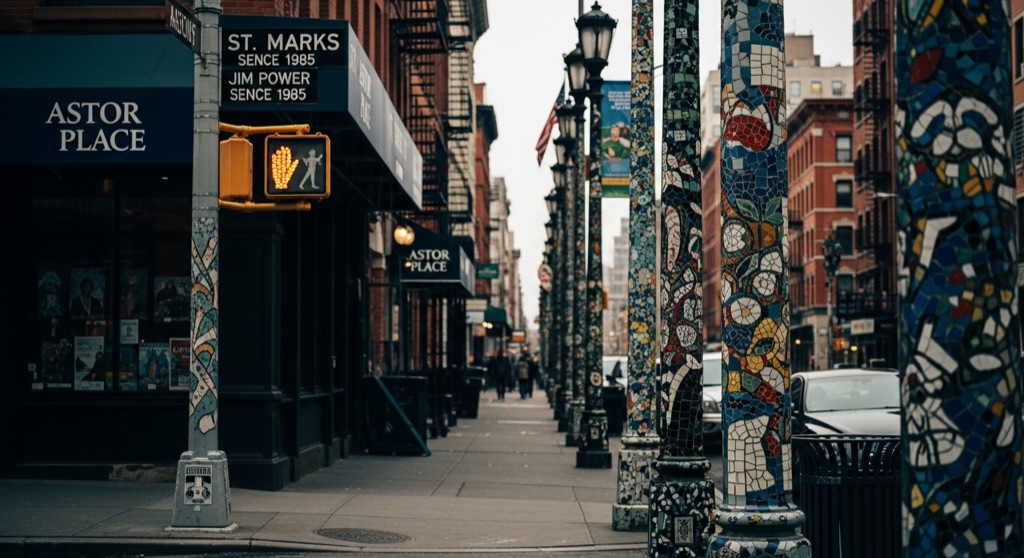 Jim Power's Mosaic Trail
Since 1985 the self-styled Mosaic Man, Jim Power, has wrapped East Village lampposts in tiled mosaics celebrating neighborhood and city history, with dozens scattered along St. Marks Place and nearby blocks. Some poles have been lost or repainted over the years, but a restoration effort removes and repairs them, and the surviving ones are visible day or night. Power, a Vietnam veteran who has weathered homelessness, sometimes works on the trail in person.
Jim Power's Mosaic Trail
Since 1985 the self-styled Mosaic Man, Jim Power, has wrapped East Village lampposts in tiled mosaics celebrating neighborhood and city history, with dozens scattered along St. Marks Place and nearby blocks. Some poles have been lost or repainted over the years, but a restoration effort removes and repairs them, and the surviving ones are visible day or night. Power, a Vietnam veteran who has weathered homelessness, sometimes works on the trail in person.
-
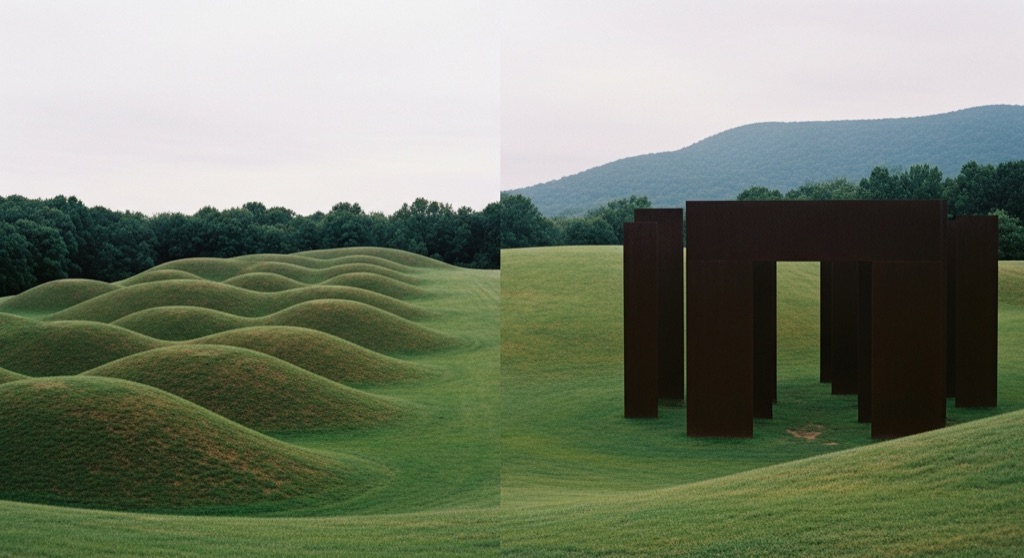 Storm King Art Center
Storm King spreads more than 100 monumental sculptures across 500 acres of fields, hills and woods in the Hudson Valley, so the landscape itself becomes the immersive artwork. You can walk the grassy waves of Maya Lin's Wavefield, seven rows of rolling earthen mounds up to 15 feet high that dwarf you as you move through them, or thread between the weathering-steel plates of Richard Serra's Schunnemunk Fork, set into a hillside to frame the mountain beyond. It's an open-air environment built to be experienced on foot over hours.
Storm King Art Center
Storm King spreads more than 100 monumental sculptures across 500 acres of fields, hills and woods in the Hudson Valley, so the landscape itself becomes the immersive artwork. You can walk the grassy waves of Maya Lin's Wavefield, seven rows of rolling earthen mounds up to 15 feet high that dwarf you as you move through them, or thread between the weathering-steel plates of Richard Serra's Schunnemunk Fork, set into a hillside to frame the mountain beyond. It's an open-air environment built to be experienced on foot over hours.
-
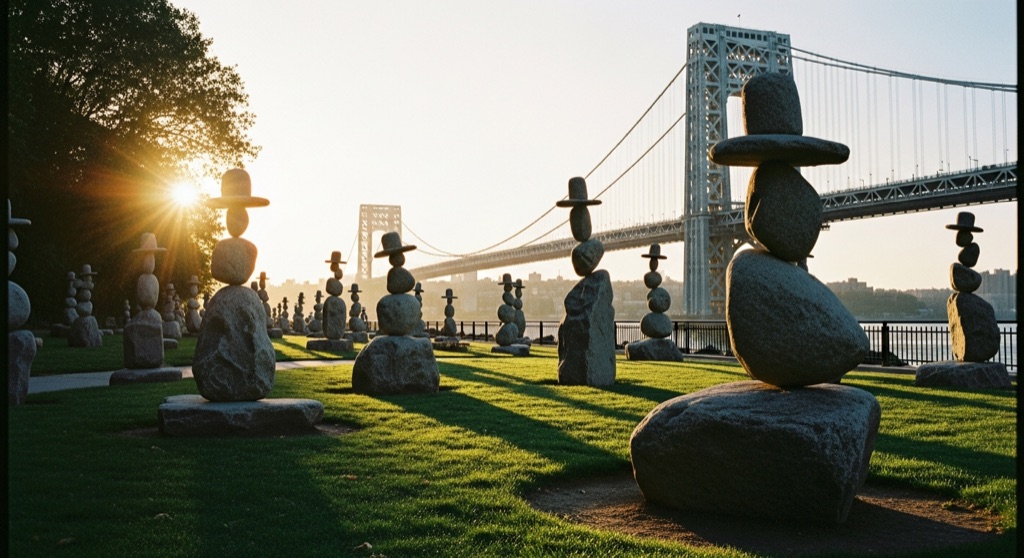 The Sisyphus Stones
Albanian-born artist Uliks Gryka has been stacking shards of glittering Manhattan schist into precarious, human-shaped figures along the Hudson shoreline in Fort Washington Park since July 2017. At its peak the installation held around 300 standing figures, each a balanced stack of stones with a body, head, and "hat" — some individual rocks weighing up to 300 pounds. Gryka rebuilds them constantly after storms, tides, vandals, and riverbank repairs knock them down, an endless task that gives the project its Sisyphean name. Hand-lettered signs note the stones are neither glued nor cemented, held up by nothing but balance.
The Sisyphus Stones
Albanian-born artist Uliks Gryka has been stacking shards of glittering Manhattan schist into precarious, human-shaped figures along the Hudson shoreline in Fort Washington Park since July 2017. At its peak the installation held around 300 standing figures, each a balanced stack of stones with a body, head, and "hat" — some individual rocks weighing up to 300 pounds. Gryka rebuilds them constantly after storms, tides, vandals, and riverbank repairs knock them down, an endless task that gives the project its Sisyphean name. Hand-lettered signs note the stones are neither glued nor cemented, held up by nothing but balance.
-
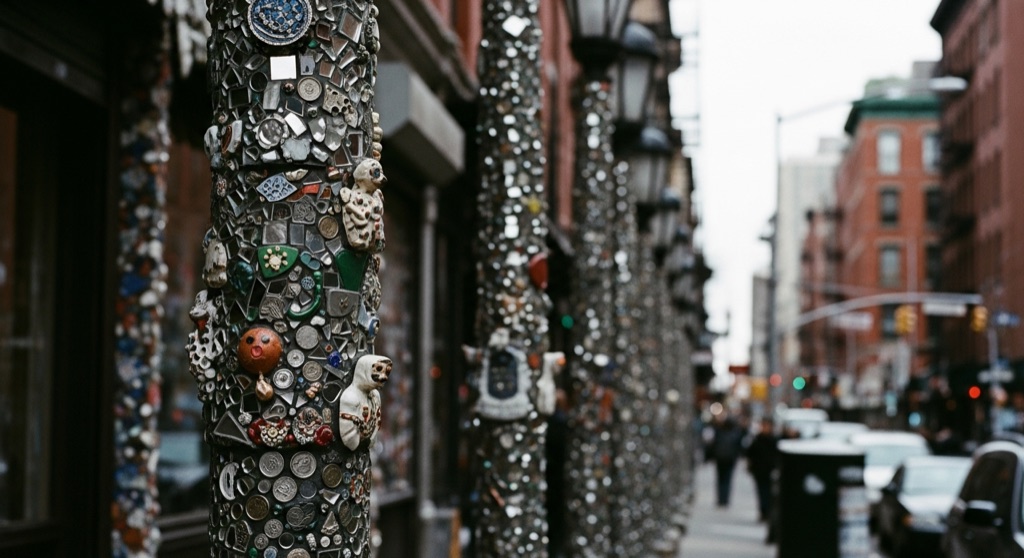 Jim Power's East Village Mosaic Trail
Vietnam veteran Jim Power, dubbed 'the Mosaic Man' by the Village Voice in 1988, has spent nearly four decades encrusting lampposts, stoops, planters, and walls with tiny tiles, mirror shards, broken pottery, coins, and small sculptures. Each pole is dedicated to a piece of neighborhood history, from McSorley's to the Fillmore East. Giuliani's anti-graffiti task force destroyed many over the years, and Power, now in a wheelchair, has rebuilt them. He was honored with a ribbon-cutting by City Lore and the Village Alliance in 2022.
Jim Power's East Village Mosaic Trail
Vietnam veteran Jim Power, dubbed 'the Mosaic Man' by the Village Voice in 1988, has spent nearly four decades encrusting lampposts, stoops, planters, and walls with tiny tiles, mirror shards, broken pottery, coins, and small sculptures. Each pole is dedicated to a piece of neighborhood history, from McSorley's to the Fillmore East. Giuliani's anti-graffiti task force destroyed many over the years, and Power, now in a wheelchair, has rebuilt them. He was honored with a ribbon-cutting by City Lore and the Village Alliance in 2022.
-
 Spot (the Dalmatian and Taxi)
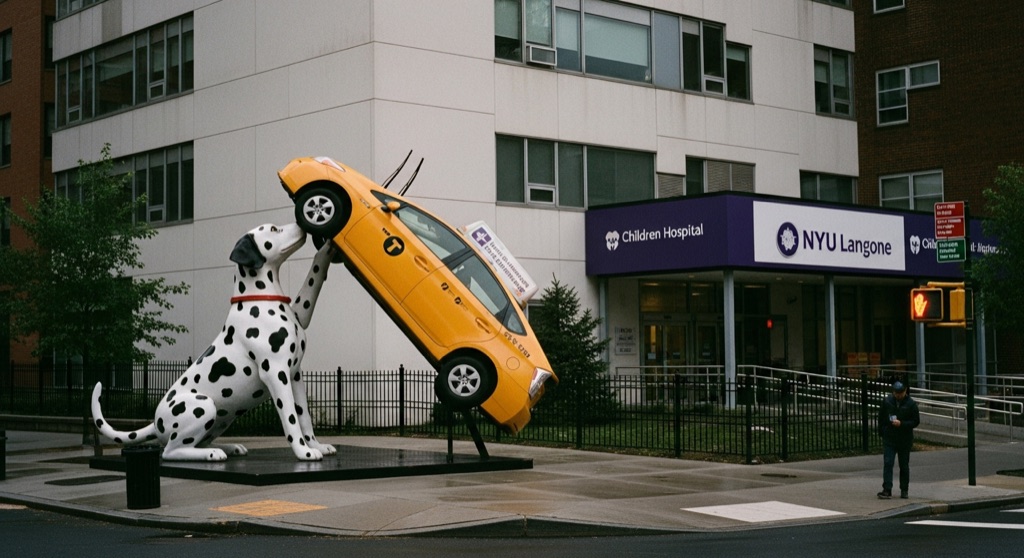
A four-story fiberglass Dalmatian balances a real, motor-stripped yellow-cab Prius on the tip of its nose outside NYU Langone's children's hospital. Artist Donald Lipski built the dog in a Wisconsin factory and trucked it to Manhattan; the donated Toyota was gutted to a shell. The cab is wired so its headlights illuminate the dog after dark and its wipers swipe when it rains.
Spot (the Dalmatian and Taxi)
A four-story fiberglass Dalmatian balances a real, motor-stripped yellow-cab Prius on the tip of its nose outside NYU Langone's children's hospital. Artist Donald Lipski built the dog in a Wisconsin factory and trucked it to Manhattan; the donated Toyota was gutted to a shell. The cab is wired so its headlights illuminate the dog after dark and its wipers swipe when it rains.
-
 Life Underground (Tom Otterness)
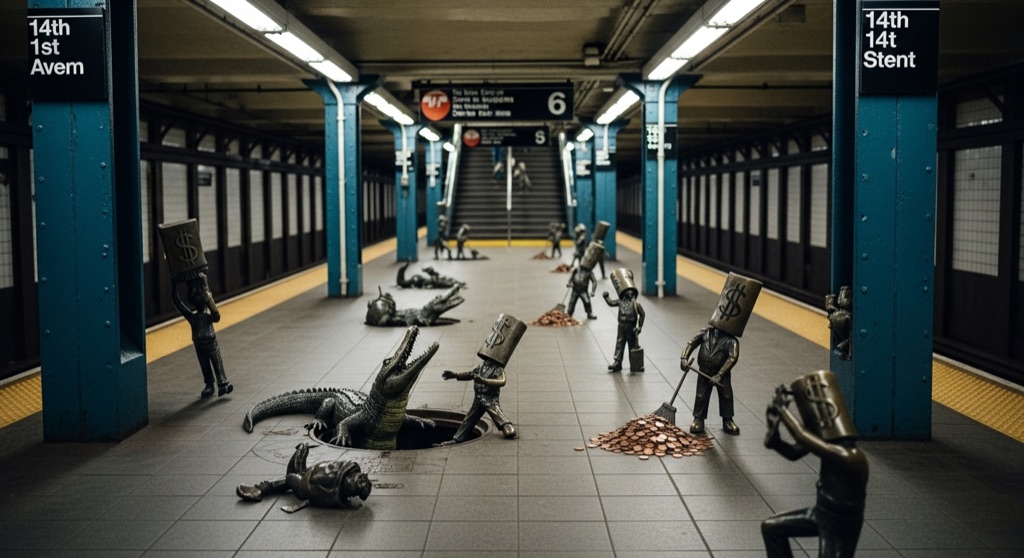
More than 130 cartoonish little bronze figures by Tom Otterness are scattered across this subway station, lurking under stairs, clinging to railings, and tucked into corners. An alligator lunges out of a manhole to devour a moneybag-headed man, tiny workers haul giant tools and sweep up piles of pennies, and money-headed characters skewer the city's obsession with capital. The 2001 MTA commission cost $200,000, one percent of the station renovation.
Life Underground (Tom Otterness)
More than 130 cartoonish little bronze figures by Tom Otterness are scattered across this subway station, lurking under stairs, clinging to railings, and tucked into corners. An alligator lunges out of a manhole to devour a moneybag-headed man, tiny workers haul giant tools and sweep up piles of pennies, and money-headed characters skewer the city's obsession with capital. The 2001 MTA commission cost $200,000, one percent of the station renovation.
-
 Socrates Sculpture Park
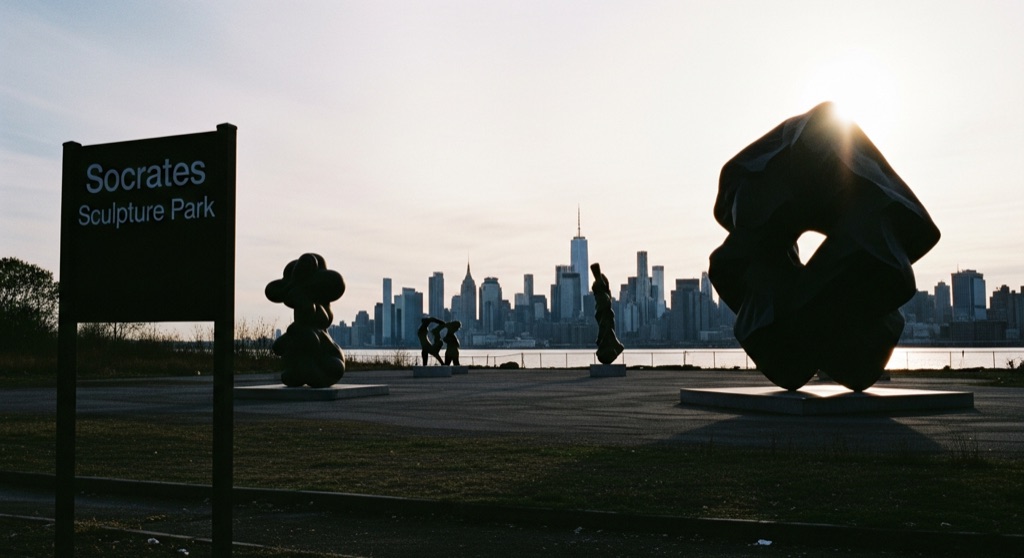
Sculptor Mark di Suvero founded this waterfront park in 1986 on a former illegal dumpsite and landfill jutting into the East River, with early help from Isamu Noguchi. Today it's a free, open-air gallery of large, often strange contemporary sculptures rotating through several exhibitions a year, set against an unobstructed Manhattan skyline view. The land was a junk-strewn wasteland before artists reclaimed it.
Socrates Sculpture Park
Sculptor Mark di Suvero founded this waterfront park in 1986 on a former illegal dumpsite and landfill jutting into the East River, with early help from Isamu Noguchi. Today it's a free, open-air gallery of large, often strange contemporary sculptures rotating through several exhibitions a year, set against an unobstructed Manhattan skyline view. The land was a junk-strewn wasteland before artists reclaimed it.
-
 Nitro Girl (Werbany Tire Town)
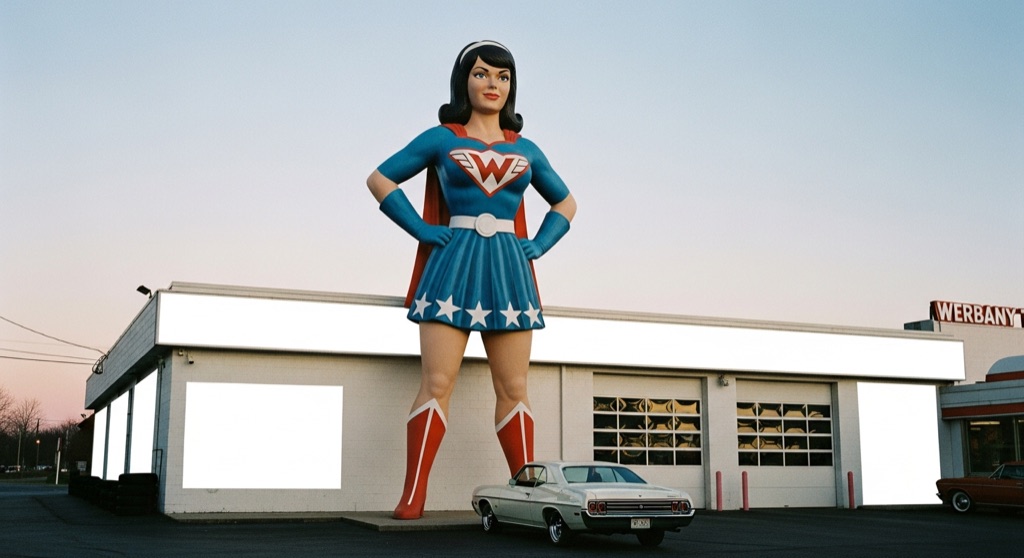
An 18-foot fiberglass giantess has loomed over Werbany Tire Town since 1965, bought by founder Ed Werbany Sr. for $300 as a standard 'Uniroyal Gal' roadside giant. In 2007 the family hired two artists to transform her into a superhero, adding go-go boots, gloves, a winged-W chest logo, and stars across her skirt and hair. Renamed Nitro Girl (the shop fills tires with nitrogen), she is one of the surviving International Fiberglass giants that once dotted American highways, and reportedly the only one left in the Northeast.
Nitro Girl (Werbany Tire Town)
An 18-foot fiberglass giantess has loomed over Werbany Tire Town since 1965, bought by founder Ed Werbany Sr. for $300 as a standard 'Uniroyal Gal' roadside giant. In 2007 the family hired two artists to transform her into a superhero, adding go-go boots, gloves, a winged-W chest logo, and stars across her skirt and hair. Renamed Nitro Girl (the shop fills tires with nitrogen), she is one of the surviving International Fiberglass giants that once dotted American highways, and reportedly the only one left in the Northeast.
-
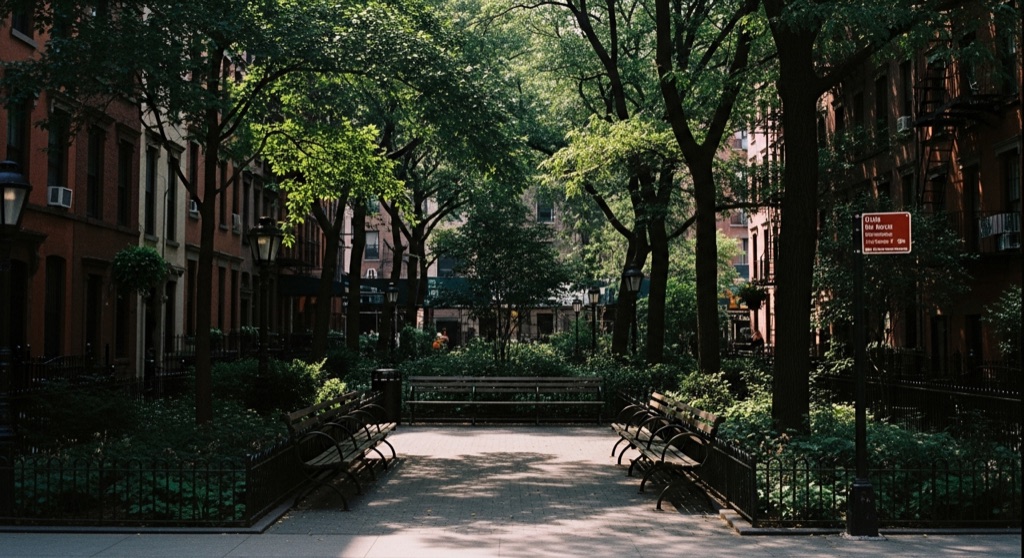 Septuagesimo Uno
Often called NYC's smallest park, this 0.04-acre sliver squeezes between two townhouses on West 71st Street. Built in the late 1960s under Mayor Lindsay's Vest Pocket Park campaign, it offers a few benches, shade trees, and planting beds in a space barely wider than a brownstone. Parks commissioner Henry Stern gave it its absurd Latin name ("seventy-first") in 2000; it was previously the blander "71st Street Plot." Most people walk right past without noticing it exists.
Septuagesimo Uno
Often called NYC's smallest park, this 0.04-acre sliver squeezes between two townhouses on West 71st Street. Built in the late 1960s under Mayor Lindsay's Vest Pocket Park campaign, it offers a few benches, shade trees, and planting beds in a space barely wider than a brownstone. Parks commissioner Henry Stern gave it its absurd Latin name ("seventy-first") in 2000; it was previously the blander "71st Street Plot." Most people walk right past without noticing it exists.
-
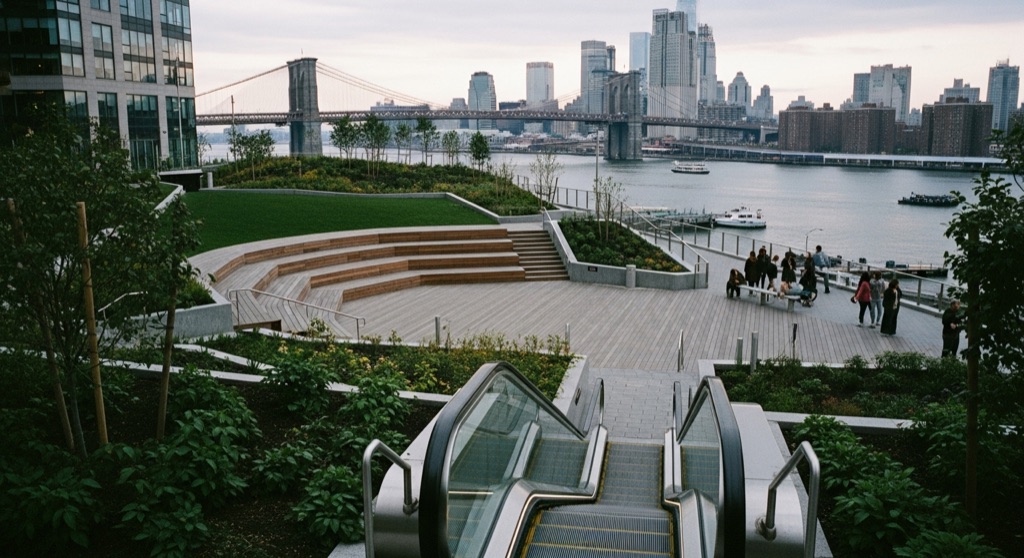 The Elevated Acre
Nearly an acre of lawn, gardens, and a tiered wooden amphitheater hidden 30 feet above the street, reached by an anonymous escalator set back from the Water Street sidewalk. Almost no one finds it by accident. A Brazilian-hardwood boardwalk juts out 30 feet above the East River with open views of the Brooklyn and Manhattan Bridges. It's one of only a handful of elevated privately-owned public spaces in the city, a leftover of mid-century zoning bonuses.
The Elevated Acre
Nearly an acre of lawn, gardens, and a tiered wooden amphitheater hidden 30 feet above the street, reached by an anonymous escalator set back from the Water Street sidewalk. Almost no one finds it by accident. A Brazilian-hardwood boardwalk juts out 30 feet above the East River with open views of the Brooklyn and Manhattan Bridges. It's one of only a handful of elevated privately-owned public spaces in the city, a leftover of mid-century zoning bonuses.
-
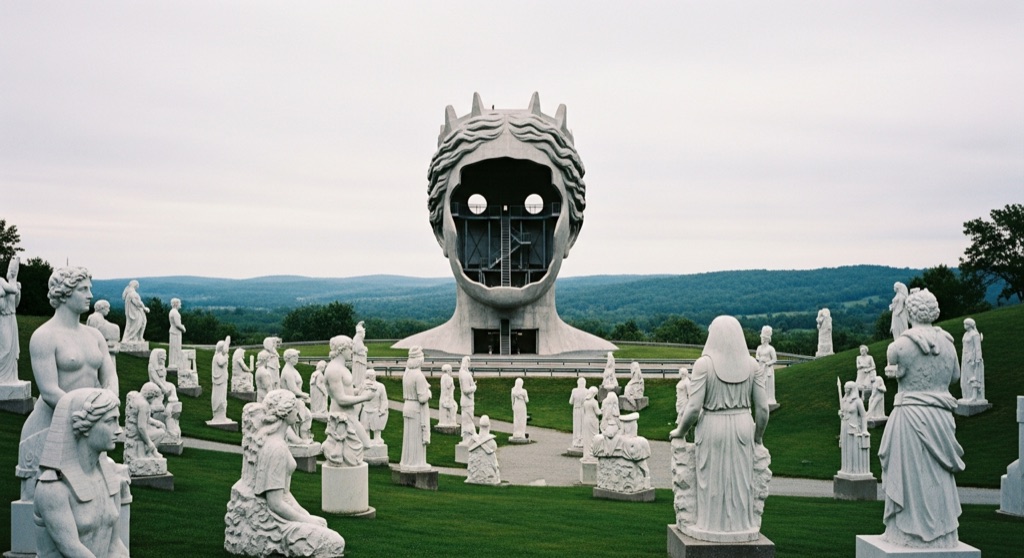 Taconic Sculpture Park
Self-taught sculptor Roy Kanwit spent some 40 years populating his hillside yard with more than 30 figures from Greek, Roman, Egyptian, and Native American mythology — some carved from Vermont marble, others cast in cement. The centerpiece is a roughly 20-foot head of Gaea, the Earth goddess, cast in steel-reinforced concrete in 1996, that peers over the Taconic State Parkway at passing drivers. The head is hollow, with a ladder inside up to a lookout at her crown, where you can take in the rolling hills. Kanwit died in 2023; his family reopened the park, which runs seasonally on weekends.
Taconic Sculpture Park
Self-taught sculptor Roy Kanwit spent some 40 years populating his hillside yard with more than 30 figures from Greek, Roman, Egyptian, and Native American mythology — some carved from Vermont marble, others cast in cement. The centerpiece is a roughly 20-foot head of Gaea, the Earth goddess, cast in steel-reinforced concrete in 1996, that peers over the Taconic State Parkway at passing drivers. The head is hollow, with a ladder inside up to a lookout at her crown, where you can take in the rolling hills. Kanwit died in 2023; his family reopened the park, which runs seasonally on weekends.
-
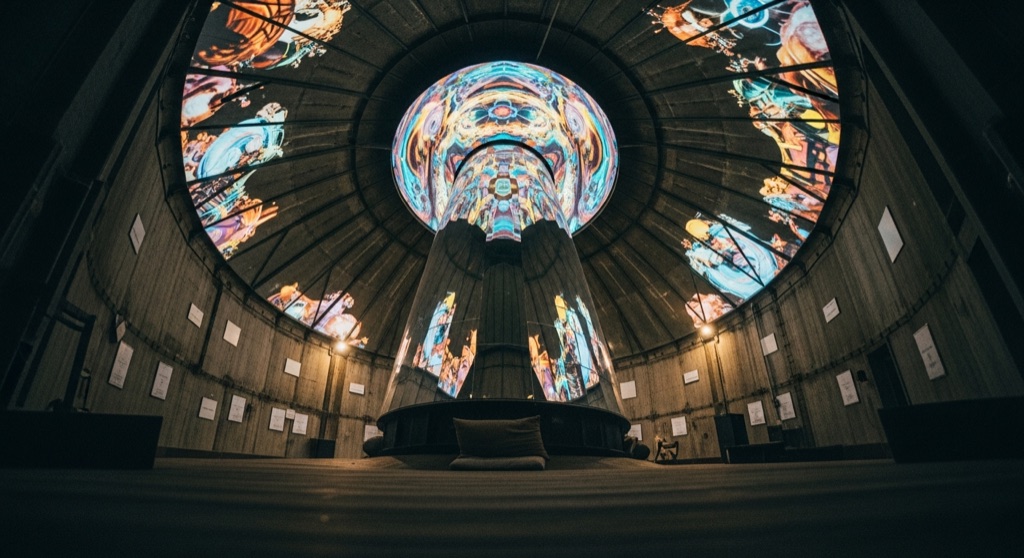 World's Largest Kaleidoscope
Built inside a 56-foot former grain silo at the Emerson Resort, this is certified as the world's largest kaleidoscope. You walk in, lie back on the floor or lean against the wall, and stare up at a roughly 20-minute psychedelic show of swirling color and imagery projected through the giant mirrored tube. Admission runs only a few dollars, and the adjoining shops are stuffed with handheld kaleidoscopes.
World's Largest Kaleidoscope
Built inside a 56-foot former grain silo at the Emerson Resort, this is certified as the world's largest kaleidoscope. You walk in, lie back on the floor or lean against the wall, and stare up at a roughly 20-minute psychedelic show of swirling color and imagery projected through the giant mirrored tube. Admission runs only a few dollars, and the adjoining shops are stuffed with handheld kaleidoscopes.
-
 Secret Caverns
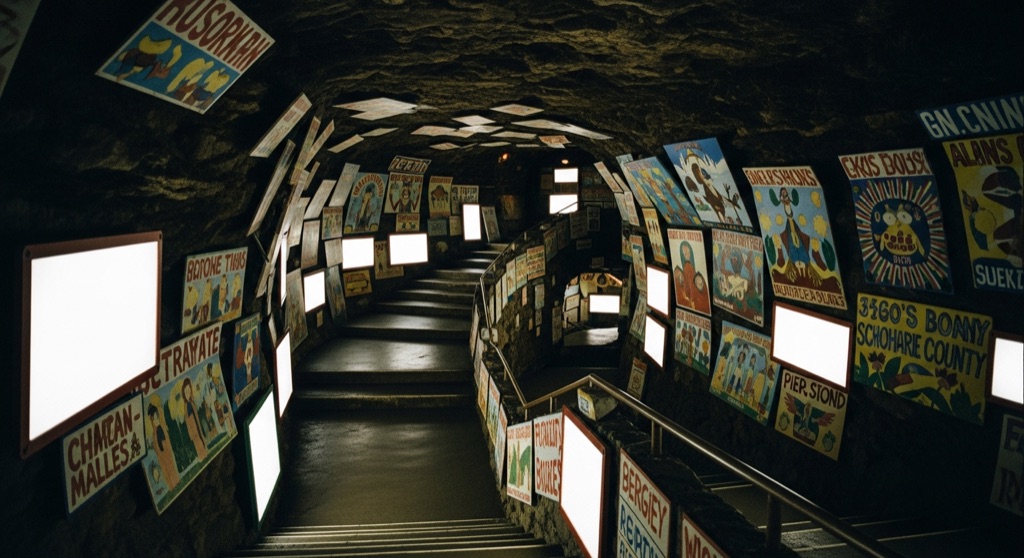
This limestone cave is famous less for geology than for its gleefully deranged hand-painted folk-art billboards, scattered across Schoharie County by a muralist and a tour guide who were fired from the slicker Howe Caverns nearby. The tour itself descends 103 steps (the 'petrified escalator') to a 100-foot underground waterfall. It runs cash-only and leans hard into its psychedelic, kitschy, anti-corporate roadside identity.
Secret Caverns
This limestone cave is famous less for geology than for its gleefully deranged hand-painted folk-art billboards, scattered across Schoharie County by a muralist and a tour guide who were fired from the slicker Howe Caverns nearby. The tour itself descends 103 steps (the 'petrified escalator') to a 100-foot underground waterfall. It runs cash-only and leans hard into its psychedelic, kitschy, anti-corporate roadside identity.
-
 Wing's Castle
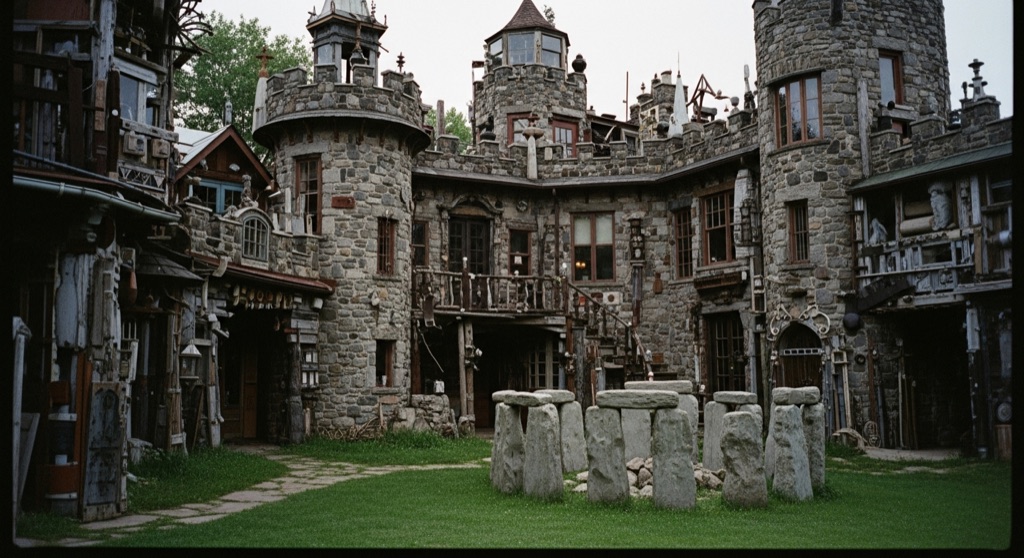
Artists Peter and Toni Wing began hand-building this stone castle in 1970 out of roughly 85% salvaged materials scavenged from demolished antique buildings, working on it for decades. The result is a quirky, fortress-like home crammed with reclaimed oddments and architectural junk, complete with its own miniature Stonehenge on the grounds. It now operates as a bed-and-breakfast, with small-fee tours offered for visitors.
Wing's Castle
Artists Peter and Toni Wing began hand-building this stone castle in 1970 out of roughly 85% salvaged materials scavenged from demolished antique buildings, working on it for decades. The result is a quirky, fortress-like home crammed with reclaimed oddments and architectural junk, complete with its own miniature Stonehenge on the grounds. It now operates as a bed-and-breakfast, with small-fee tours offered for visitors.
Weird outdoor & roadside things to do in New York City — FAQ
Which weird outdoor & roadside oddities in New York City are the strangest?
Ranked by how strange they actually are: Septuagesimo Uno, Secret Caverns and Dream House. Septuagesimo Uno — Often called NYC's smallest park, this 0.04-acre sliver squeezes between two townhouses on West 71st Street.
Where in New York City are they?
Across Tribeca, Manhattan, East Village, Manhattan, New Windsor, New York, Washington Heights, Manhattan and Kips Bay, Manhattan and 9 more. Each listing gives the neighborhood and address so you can cluster a couple into one outing.
Are any of the weird outdoor & roadside oddities in New York City free?
Yes — 11 are free to visit, including The Sisyphus Stones, Jim Power's East Village Mosaic Trail and Spot (the Dalmatian and Taxi). The rest are mostly low-cost.
Is this a good weird date in New York City?
That's what the list is built for. Every entry has a specific move rather than a vague recommendation — at Septuagesimo Uno, for instance: Pack two coffees and squeeze onto the single bench in this tucked-away pocket park to see who can spot it first from down the block.
How were these weird outdoor & roadside oddities chosen?
An agentic research system digs for the genuinely obscure — the spots even locals miss — and every one is verified against real sources before it makes the list. We deliberately skip the landmarks already on every New York City guide.