Entry No. 31 — the New York City file — filed under: roadside-oddity
Life Underground (Tom Otterness)
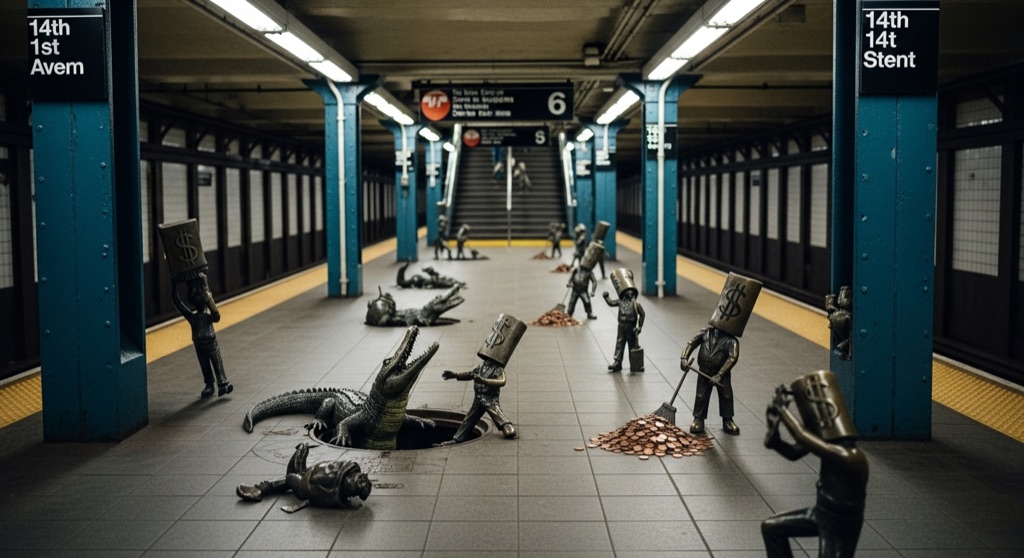
More than 130 cartoonish little bronze figures by Tom Otterness are scattered across this subway station, lurking under stairs, clinging to railings, and tucked into corners. An alligator lunges out of a manhole to devour a moneybag-headed man, tiny workers haul giant tools and sweep up piles of pennies, and money-headed characters skewer the city's obsession with capital. The 2001 MTA commission cost $200,000, one percent of the station renovation.
→ Three more weird outdoor & roadside oddities in New York City — never the same twice
The story
Most commuters pounding through the 14th Street and Eighth Avenue subway station are too focused on catching the L train to notice they're being watched by over 130 tiny bronze eyes. Commissioned by MTA Arts & Design in 2001 for $200,000—exactly one percent of the station's total renovation budget—sculptor Tom Otterness turned the complex into a permanent subterranean theater called *Life Underground*. The plump, bulbous bronze figures sit perching on overhead structural steel, clinging to stair handrails, and lurking in corner floorboards across the mezzanine and platforms.
If you look past their cute, Saturday-morning-cartoon shapes, you'll realize Otterness slipped a sharp, conspiratorial critique of New York's obsession with capital directly under the transit authority's nose. The figures act out scenes of economic absurdity and urban myth: a sewer alligator in a suit lunges out of a bronze manhole cover to gobble a man with a moneybag for a head, miniature workers haul giant crosscut saws across beams, and figureheads sweep piles of bronze pennies into tiny dustpans. It's a surreal, bronze class struggle unfolding silently above and beneath millions of daily commuters.
What it's like
You need to swipe or tap through the turnstiles to see the vast majority of the installation, as the pieces span the mezzanine levels and platforms connecting the A, C, E, and L lines. Skip rush hour—crouching under a stairwell to inspect a bronze manhole cover while thousands of commuters stream past is a reliable way to get trampled. Give yourself 20 or 30 minutes between trains to wander the upper passageways, keeping an eye on high I-beams overhead and low corners near floor level.
The move: Buy a single swipe, then turn the station into a scavenger hunt seeing who can spot the most hidden bronze creatures before a train comes.
📍 Before you go Inside a busy transit station, so you need a fare to reach most pieces; the figures span multiple platform levels and passageways.
- 📍 Chelsea, Manhattan
- 💸 Free
- ⚡ Up for anything
- 🌗 Outdoors
Where: 14th Street / Eighth Avenue subway station (A, C, E, L), New York, NY
Hours: Added 2026-06-23 — confirm current hours before you go.
Pair it with
- Stargazing on the High Line — Resurface at 14th Street and walk two blocks west to trade subterranean bronze oddities for telescope views over the Hudson.
- Mace — Head south into Greenwich Village for a post-hunt drink where every cocktail centers on a single distinct spice.
- The Museum of Interesting Things — Pair the underground public art hunt with a private collection of tactile, vintage technical curiosities nearby.
- Patent Pending — Head east to NoMad to continue the secret-in-plain-sight theme behind a coffee shop's false wall.
More weird in New York City
Good to know
Do I need to pay subway fare to see the art?
Yes. While a couple of pieces sit near the turnstiles, the vast majority of the 130-plus figures are inside the paid zone across the platform levels and transfer corridors.
How many bronze figures are hidden in the station?
There are more than 130 distinct bronze sculptures scattered throughout the station complex.
Which subway lines serve this station?
The installation is spread across the 14th Street / Eighth Avenue station complex, serving the A, C, E, and L trains.
When was Life Underground installed?
The MTA commissioned the work, which was officially completed and installed in 2001 as part of a major station renovation.
Plan a visit & invite your people →
Further reading: Wikipedia · mta.info · copper.org · Official site
last checked: 2026-06-23