Entry No. 29 — the New York City file — filed under: roadside-oddity
Jim Power's East Village Mosaic Trail
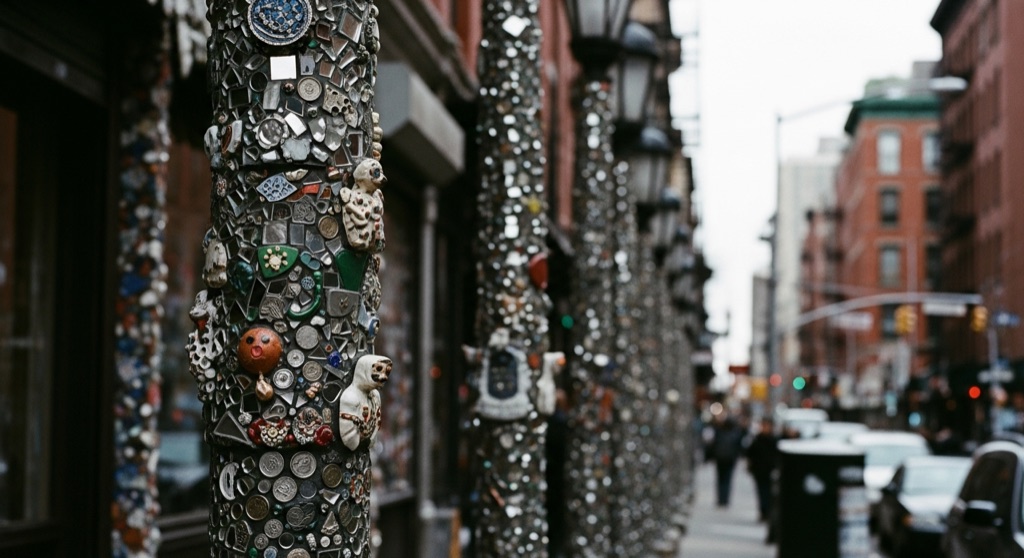
Vietnam veteran Jim Power, dubbed 'the Mosaic Man' by the Village Voice in 1988, has spent nearly four decades encrusting lampposts, stoops, planters, and walls with tiny tiles, mirror shards, broken pottery, coins, and small sculptures. Each pole is dedicated to a piece of neighborhood history, from McSorley's to the Fillmore East. Giuliani's anti-graffiti task force destroyed many over the years, and Power, now in a wheelchair, has rebuilt them. He was honored with a ribbon-cutting by City Lore and the Village Alliance in 2022.
→ Three more weird outdoor & roadside oddities in New York City — never the same twice
The story
In the mid-1980s, long before high-end real estate ate the neighborhood, a Vietnam veteran named Jim Power picked up mortar, broken tiles, mirror shards, coins, and ceramic odds and ends, and started wrapping East Village streetlamps without asking the city for permission. Dubbed 'The Mosaic Man' by the Village Voice in 1988, Power turned cold municipal iron into thick, textured columns of rogue neighborhood memory.
City Hall was not amused. In the late 1990s, Mayor Rudolph Giuliani’s anti-graffiti task force methodically stripped down and smashed dozens of his handcrafted light poles. Power didn't move away; he just went back outside with fresh mortar and rebuilt them. Each pole acts as a stubborn hyper-local archive: embedded in the concrete are dedications to long-gone cultural landmarks like the Fillmore East, surviving neighborhood fixtures like McSorley's Old Ale House, and local icons.
At his peak, Power had encrusted roughly 70 light poles across the East Village, though only a fraction survive intact today. Now in a wheelchair, Power finally received official city recognition with a formal ribbon-cutting by City Lore and the Village Alliance in 2022—a strange full-circle moment for work crews used to scrape away. Go check out the surviving Pink Floyd pole standing near 2nd Avenue and East 6th Street before the elements or sidewalk construction beat you to it.
What it's like
Don't look for a gift shop or an official map. You're scavenger-hunting street hardware down St. Marks Place between Broadway and Avenue A. You will walk right past half the surviving pieces if you look straight ahead—you need to train your eyes down toward stoops and planters, and up the bases of metal light poles. Some tiles are chipped and missing, while others glint with mirror shards and coins in the light. Keep an eye out on the sidewalk: Power himself is still known to hang around the neighborhood working on mosaics with his dog.
The move: Follow the trail of glittering lampposts down St. Marks Place, reading each one's hidden dedication, and end at McSorley's for a beer.
📍 Before you go Self-guided and free; only a fraction of the original ~70 poles survive, scattered across several blocks. Power himself is sometimes seen working with his dog.
- 📍 East Village, Manhattan
- 💸 Free
- ⚡ Up for anything
- 🌗 Outdoors
Where: St. Marks Place between Avenue A and Broadway (and surrounding blocks), New York, NY
Hours: Added 2026-06-23 — confirm current hours before you go.
Pair it with
- McSorley's Old Ale House — One of Jim Power's surviving mosaic poles is explicitly dedicated to this 1854 saloon, making it the natural place to end your walk over a dark or light ale.
- The Museum of Interesting Things — Pair Power's outdoor folk-art trail with Denny Daniel's hands-on, apartment-based collection of antique inventions just a short walk away.
- Merchant's House Museum — Contrast Power's rogue street-level memorial of the neighborhood with a preserved 1832 row house that hasn't changed its interior furnishings since the 19th century.
More weird in New York City

Good to know
Where can I see the remaining mosaic poles?
They are scattered across several East Village blocks, with the highest concentration along St. Marks Place between Broadway and Avenue A, plus offshoots like 2nd Avenue and East 6th Street.
Is there an entry fee or open hours?
No. The mosaics are built directly on public light poles, stoops, and planters, making the trail completely free and open 24/7.
Why were so many of the original poles destroyed?
Giuliani's anti-graffiti task force tore down dozens of the poles in the 1990s as unauthorized street art, forcing Power to painstakingly re-tile them over the following decades.
Who is Jim Power?
He is a Vietnam veteran and outsider artist who began guerilla-tiling East Village lampposts in the mid-1980s, becoming a neighborhood legend known as the Mosaic Man.
Plan a visit & invite your people →
Further reading: Untapped Cities · citylore.org · Official site · cbsnews.com
last checked: 2026-06-23