Entry No. 25 — the New York City file — filed under: art-immersive
Jim Power's Mosaic Trail
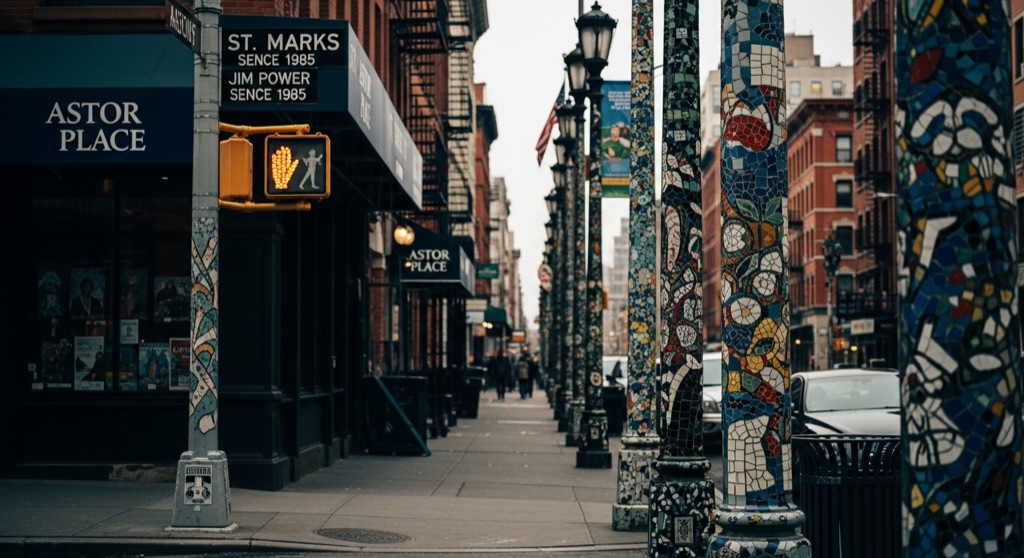
Since 1985 the self-styled Mosaic Man, Jim Power, has wrapped East Village lampposts in tiled mosaics celebrating neighborhood and city history, with dozens scattered along St. Marks Place and nearby blocks. Some poles have been lost or repainted over the years, but a restoration effort removes and repairs them, and the surviving ones are visible day or night. Power, a Vietnam veteran who has weathered homelessness, sometimes works on the trail in person.
→ Three more weird outdoor & roadside oddities in New York City — never the same twice
The story
In 1985, Jim Power started taking broken tile, porcelain, mirror fragments, and glass to standard East Village utility poles without asking the Department of Transportation for permission. A Vietnam veteran who weathered years of homelessness on these exact blocks, Power dubbed himself the 'Mosaic Man' and set out to turn bare steel and cast-iron light posts into a decentralized neighborhood archive. Each post he wrapped was dedicated to local history, punk landmarks, neighborhood figures, or emergency responders.
For decades, the city's reaction to the trail flipped between hostility and quiet tolerance. Municipal crews routinely stripped, repainted, or completely removed mosaic-wrapped light poles during street repaving and infrastructure upgrades. But neighborhood advocacy eventually turned the tide: during the major 2016 Astor Place and Cooper Square redesign by architecture firm WXY, city agencies like the Department of Design and Construction actually worked to preserve, restore, and reinstall several of Power's key mosaic light poles around Astor Place alongside the Alamo cube sculpture.
What remains today is a living street art ledger along St. Marks Place and surrounding East Village blocks. Because the art lives entirely on public infrastructure exposed to trash trucks, weather, and city crews, the lineup is never fixed—poles disappear for restoration or suffer chipped tiles, while others get repaired when Power works on the trail in person.
What it's like
Start near Astor Place and work your way east down St. Marks Place towards Avenue A, keeping your eyes on the base and midsections of municipal light posts. There are no velvet ropes or plaques; you're looking at cracked ceramics, glass, and hand-cut tiles embedded directly into the steel. Because it's outdoors on sidewalk public property, you can walk it anytime for free, day or night. Don't expect pristine gallery condition—some poles show severe wear or missing pieces, and if you're lucky, you might spot Power himself working on repairs right on the sidewalk.
The move: Start near Astor Place and follow the tiled lampposts down St. Marks together, reading the city history embedded in each pole.
📍 Before you go It's a free, self-guided outdoor trail; individual poles occasionally come down for restoration, so the exact lineup shifts over time.
- 📍 East Village, Manhattan
- 💸 $$
- ⚡ Up for anything
- 🌗 Indoors
Where: St. Marks Place and surrounding East Village streets, New York, NY 10003
Hours: Added 2026-06-23 — confirm current hours before you go.
Pair it with
- McSorley's Old Ale House — Pair street-level neighborhood art with a pint of ale at New York's oldest surviving saloon, located just two blocks away.
- Merchant's House Museum — Contrast Power's guerrilla street art with a step inside a perfectly preserved 1832 Federal row house a short walk south on East 4th Street.
- Gothic Renaissance — Continue exploring the neighborhood's subcultural identity by checking out one of the East Village's long-standing alternative fashion shops near Union Square.
More weird in New York City

Good to know
Where is the best place to start walking the trail?
Begin around Astor Place near the Alamo cube, where several restored mosaic poles stand, then follow St. Marks Place east through the neighborhood.
How much does it cost to view the Mosaic Trail?
It is completely free and located entirely on public outdoor sidewalks.
Are all the original mosaic poles still standing?
No. Many poles have been lost to street construction or repainting over the decades, though surviving ones are periodically restored or reinstalled.
Who is Jim Power?
Jim Power is a Vietnam veteran and self-taught artist known as the 'Mosaic Man,' who began creating the mosaic trail across East Village street furniture in 1985.
Plan a visit & invite your people →
Further reading: Official site · Untapped Cities · citylore.org · nycurbanism.com · evgrieve.com · archpaper.com
last checked: 2026-06-23