Entry No. 28 — the New York City file — filed under: outdoor
The Sisyphus Stones
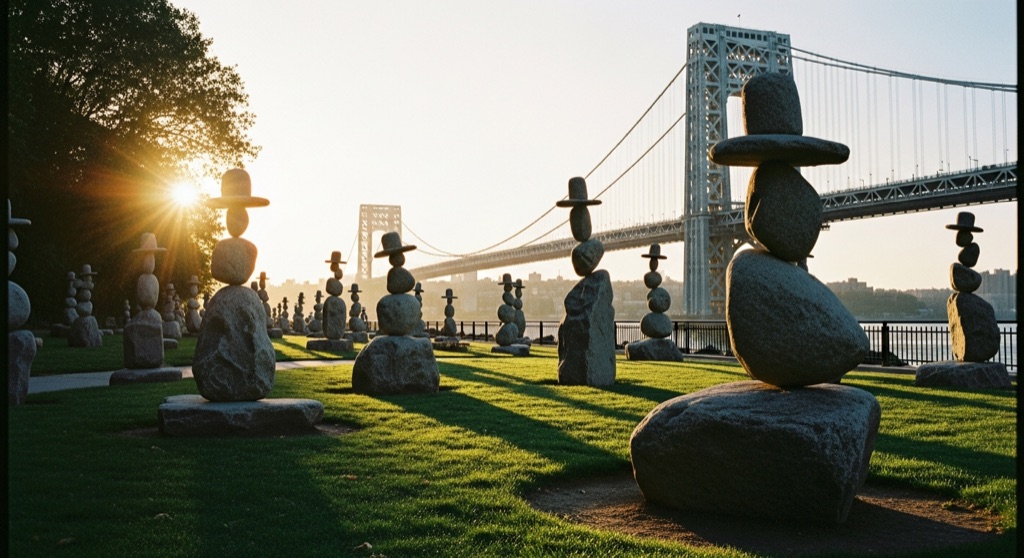
Albanian-born artist Uliks Gryka has been stacking shards of glittering Manhattan schist into precarious, human-shaped figures along the Hudson shoreline in Fort Washington Park since July 2017. At its peak the installation held around 300 standing figures, each a balanced stack of stones with a body, head, and "hat" — some individual rocks weighing up to 300 pounds. Gryka rebuilds them constantly after storms, tides, vandals, and riverbank repairs knock them down, an endless task that gives the project its Sisyphean name. Hand-lettered signs note the stones are neither glued nor cemented, held up by nothing but balance.
→ Three more weird outdoor & roadside oddities in New York City — never the same twice
The story
In July 2017, an Albanian-born artist named Uliks Gryka began hauling heavy slabs of Manhattan schist out of the mud along the Hudson River shoreline in Fort Washington Park. Without mortar, cement, or hidden rebar, he started stacking them into upright, vaguely human-shaped forms—each figure built with a distinct torso, head, and top rock or "hat." Some of the individual boulders weigh up to 300 pounds, held in place by nothing more than precise weight distribution and raw friction. Hand-lettered signs placed at the edge of the rocks remind passersby that no glue or hardware is holding the heavy stone upright.
At the installation's peak, roughly 300 of these stone figures stood in crowded rows along the water's edge beneath the George Washington Bridge. Their existence, however, is deliberately precarious. High tides, winter storms, municipal riverbank repairs, and human interference knock them down on a regular cycle. Gryka repeatedly returns to haul the heavy schist back up and balance the figures all over again—an ongoing effort that gave the shoreline project its Sisyphean name.
What it's like
Follow the Hudson River Greenway path into Fort Washington Park until you hit the rocky riverbank near West 165th Street. You won't find a set museum display; the exact footprint and stone count shift constantly depending on recent high tides, weather, and Gryka's rebuilding schedule. Visit on a clear, calm day near golden hour when the sun lights up the mica in the schist and casts long shadows across the tidal rocks. Mind your footing on the wet gravel, and resist the temptation to tap or push the figures—a single nudge can shatter a balance point that took hours to find.
The move: Walk the greenway under the George Washington Bridge at golden hour and play the game of guessing which gravity-defying stack will still be standing next visit.
📍 Before you go These are constantly rebuilt and occasionally knocked down by weather or river work; the field's size and exact spot shifts. Best in dry, calm conditions.
- 📍 Washington Heights, Manhattan
- 💸 Free
- ⚡ Up for anything
- 🌗 Outdoors
Where: Hudson River Greenway, Fort Washington Park, near W 165th St, New York, NY
Hours: Added 2026-06-23 — confirm current hours before you go.
⚠ Seasonal or scheduled — always check before you go.
Pair it with
- Morris-Jumel Mansion — Walk less than a mile east from the riverbank to explore Manhattan's oldest surviving house, built in 1765.
- Socrates Sculpture Park — Pair this rogue shoreline art field with a formal waterfront park created on a former landfill site along the East River.
- Derfner Judaica Museum — Continue north along the river to visit a quiet Judaica collection housed inside a senior residence overlooking the Hudson.
More weird in New York City
Good to know
Are the stones glued or pinned together?
No. Hand-lettered signs at the site state that the sculptures are held upright entirely by natural balance, friction, and gravity.
Where are the stones located in the park?
They sit directly on the rocky Hudson shoreline in Fort Washington Park, near West 165th Street, reachable via the Hudson River Greenway.
How many stones are usually standing?
It varies daily. While the installation held around 300 standing figures at its peak, tides, storms, and human interference knock them down frequently.
Who builds and maintains them?
Albanian-born artist Uliks Gryka created the installation in July 2017 and continuously rebuilds the figures when they fall.
Plan a visit & invite your people →
Further reading: Atlas Obscura · gothamist.com · thecuriousuptowner.com · patch.com · The New York Times · theworld.org
last checked: 2026-06-23