Entry No. 84 — the New York City file — filed under: outdoor
Boonton Iron Works Ruins
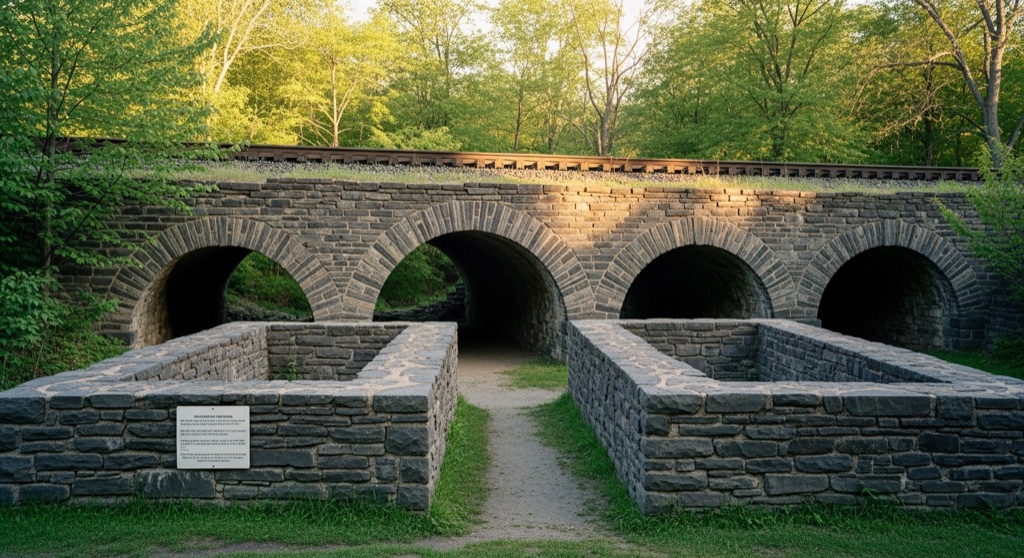
Established in 1830, the Boonton Iron Works was a massive iron manufacturing complex that utilized the Morris Canal and Rockaway River to produce nail rods and bar iron. After closing in 1911, the sprawling industrial site was reclaimed by nature and eventually integrated into Grace Lord Park. Today, visitors can explore the remnants of stone foundations, arched blast furnace tunnels, a historic 1866 Stone Arch Bridge, and a 1906 railroad trestle.
→ Three more abandoned & forgotten places in New York City — never the same twice
The story
Samuel Ogden started working iron on this six-acre tract along the Rockaway River around 1770, but it wasn't until 1830 that the site exploded into a full-scale industrial powerhouse. Fed by the newly dug Morris Canal, the Boonton Iron Works spent the 19th century pounding out nail rods, bar iron, and pig iron. When the fires finally went cold in 1911, the town didn't bother leveling the heavy masonry—they simply let the forest swallow it.
Today, the complex sits submerged inside Grace Lord Park. What looks like natural cliff face from the main trail often turns out to be stacked fieldstone, retaining walls, and arched blast furnace conduits sticking out of the mud and ivy. Nature has taken back the valley, but the sheer volume of stone moved here makes it impossible to hide the skeleton of the mill.
If you know where to look along the riverbanks, you can trace the old water-power infrastructure directly into the rock. The highlight is the 1866 Stone Arch Bridge spanning the gorge alongside a 1906 steel railroad trestle, framed by the 36-foot drop of Boonton Falls. It is an honest piece of industrial salvage, sitting right in plain sight in a suburban town park.
What it's like
You will start on the manicured walking paths of Grace Lord Park, where informational kiosks map out the historic layout. To see the actual furnace tunnels and heavy masonry, you need to head down toward the Rockaway River banks. Some of the most unstable masonry and sheer drops are walled off behind security fencing—respect the barriers, as the stone is loose and wet from the spray off Boonton Falls. Visit in early spring or late fall when the tree canopy drops, or the dense summer brush will hide half the archways from view.
The move: Take a scenic hike through Grace Lord Park to admire the 36-foot Boonton Falls, then follow the trails to photograph the historic Stone Arch Bridge and search for the hidden stone furnace tunnels.
📍 Before you go The ruins are located within Grace Lord Park, a public municipal park in Boonton, New Jersey, with established walking trails that allow legal access to the historic structures, though some specific areas are fenced off for safety.
- 📍 Boonton
- 💸 Free
- ⚡ Low-key
- 🌗 Outdoors
Where: Boonton, NJ 07005, USA
Hours: Added 2026-07-20 — confirm current access before you go.
Pair it with
- Old Ogden Mine — Follow the iron trail from manufacturing mill to the raw mountain mine later bought up by Thomas Edison.
- Andover Mine — Pair Boonton's 19th-century manufacturing ruins with a Revolutionary-era mine that supplied George Washington's army.
- Ringwood Iron Plant Mine — Head north to explore the massive 500-acre district that drove New Jersey's early iron production.
More weird in New York City
Good to know
Is visiting the Boonton Iron Works ruins legal?
Yes. The ruins are situated within Grace Lord Park, a public municipal park in Boonton with free entry and designated trail networks.
What original structures can you still see on the site?
Visible remnants include stone foundation walls, arched blast furnace tunnels along the riverbank, the 1866 Stone Arch Bridge, and a 1906 steel railroad trestle.
Can you go inside the stone furnace tunnels?
No. Hazardous areas and structural ruins are fenced off for public safety, but you can view and photograph the stone archways directly from the lower trails.
Are there other natural features at the site?
Yes, the park encompasses the 36-foot Boonton Falls along the Rockaway River, which originally supplied water power to the ironworks.
Plan a visit & invite your people →
Further reading: Wikipedia · abandonedonline.net · Tripadvisor
last checked: 2026-07-20