Entry No. 87 — the New York City file — filed under: military
Ruined Military Structures of Fort Hancock
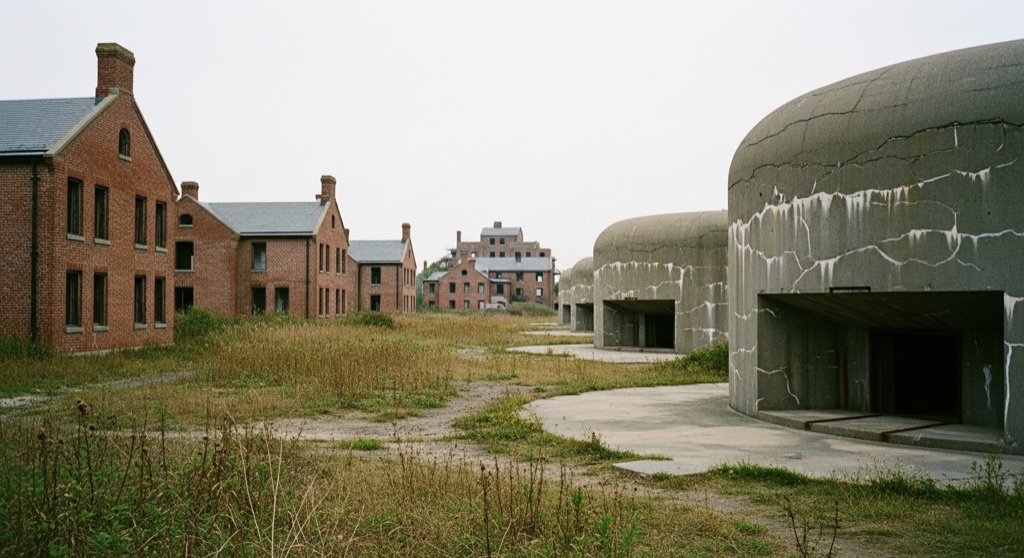
Situated on the Sandy Hook peninsula, these coastal defense ruins represent a century of military history guarding the entrance to New York Harbor. The site features decaying brick barracks, crumbling Officers' Row mansions, and massive concrete gun batteries dating from the late 19th century through the Cold War. Today, these imposing structures are slowly being reclaimed by coastal vegetation, offering a haunting contrast to the surrounding beaches.
→ Three more abandoned & forgotten places in New York City — never the same twice
The story
Stick out onto the Sandy Hook spit, and you are standing on ground that spent over a century guarding the mouth of New York Harbor. Between the Sandy Hook Proving Ground—which tested ordnance here from 1874 to 1919—and Fort Hancock's heavy defensive emplacements that operated through the Cold War, this narrow ribbon of sand was engineered to stop an offshore naval strike. Today the troops are long gone, leaving a sprawling complex of coastal defenses to decay into the seaside brush.
The landscape is split between two distinct styles of ruin. Along Officers' Row, late-19th-century yellow-brick mansions sit behind chain-link fences, their wide porches sagging and paint flaking under the Atlantic salt mist. Further along the trails, massive concrete gun batteries sit half-swallowed by coastal shrubs and sand dunes. It is a slow-motion collapse of military architecture, sitting just yards from public beach paths.
What it's like
Arriving here feels like a cross between a beach outing and a walk through an architectural graveyard. You will walk or bike paved multi-use trails through Gateway National Recreation Area, moving past coastal thickets directly into the shadow of hollow concrete bunkers. Bring a bicycle to cover the distance between battery emplacements. Keep your camera focused from the outside and respect the chain-link barriers: the National Park Service keeps the fenced-off yellow-brick interiors and crumbling concrete battery rooms strictly off-limits due to structural instability.
The move: Take a scenic bike ride or walk along the multi-use paths of Sandy Hook, stopping to photograph the imposing concrete batteries and the decaying, yellow-brick Officers' Row mansions from the safety of the public trails.
📍 Before you go The ruins are located within the Gateway National Recreation Area, which is open to the public; visitors can freely walk the grounds and view the structures from the outside, though entering the interiors of the fenced-off, structurally unstable buildings is strictly prohibited.
- 📍 Highlands
- 💸 Free
- ⚡ Low-key
- 🌗 Outdoors
Where: Highlands, NJ 07732, USA
Hours: Added 2026-07-20 — confirm current access before you go.
Pair it with
- Staten Island Boat Graveyard (Witte Marine Scrapyard) — Pair Fort Hancock's decaying coastal defenses with a view of rusting tugs and wooden ship hulks rotting in the mud across the bay on Staten Island.
- Heyerdahl Ruins — Trade Sandy Hook's massive 19th-century military ruins for a solitary set of 1860s stone residential ruins hidden inside Staten Island's woods.
- Conference House (Billopp Manor) — Compare Fort Hancock's modern harbor defense systems with a 1680 stone manor at the southern tip of Staten Island that hosted Revolutionary War peace talks.
More weird in New York City


Good to know
Can you go inside the yellow-brick mansions or concrete bunkers?
No. Entering the interiors of the fenced-off buildings and decaying concrete battery structures is strictly prohibited due to structural instability and falling debris hazards.
Where is Fort Hancock located?
The site is located at the northern tip of the Sandy Hook peninsula in Highlands, New Jersey, situated within Gateway National Recreation Area.
Is there an entry fee to see the military ruins?
Access to the historic grounds and multi-use walking and biking paths is free, though beach parking fees apply at Gateway National Recreation Area during summer operational seasons.
Plan a visit & invite your people →
Further reading: Wikipedia · nps.gov
last checked: 2026-07-20