Entry No. 75 — the New York City file — filed under: ruins
Andover Mine
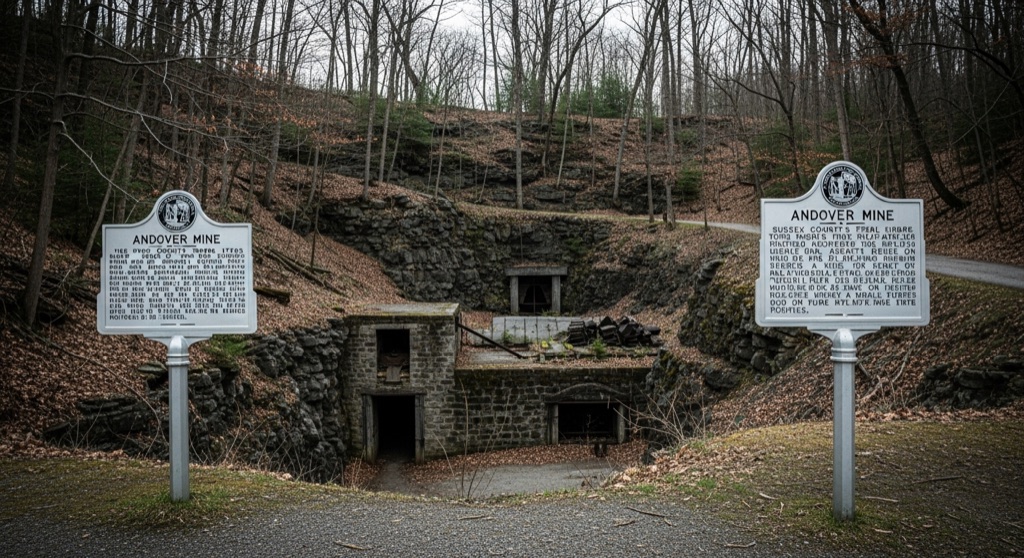
Dating back to before 1763, the Andover Mine was once one of New Jersey's most prolific iron mines, famously confiscated during the Revolutionary War to supply steel for George Washington's army. Under the management of Cooper and Hewitt in the mid-19th century, its high-grade ore was used to manufacture the country's first structural steel and cable wire for the Niagara Falls suspension bridge. Today, the long-abandoned site features a dramatic 70-foot-deep open pit, sealed adit portals, and overgrown waste dumps along a rocky cliffside.
→ Three more abandoned & forgotten places in New York City — never the same twice
The story
Long before Sussex County was quiet woods and suburban sprawl, it was an industrial engine pulling high-grade iron out of the earth. The Andover Mine was operating before 1763, cut directly into a 250-foot-wide band of rock. When the Revolutionary War broke out, the Continental Congress took no chances leaving that strategic ore body in private hands—they confiscated the entire operation to supply crucial steel for George Washington’s army.
By the mid-19th century, industrial heavyweights Peter Cooper and Abram Hewitt took over management, pushing Andover's exceptionally pure iron into foundational national infrastructure. The metal pulled from this hillside was forged into the nation's very first structural steel beams and spun into the suspension cables supporting John A. Roebling’s bridge at Niagara Falls. Unlike deep underground shaft operations elsewhere in the Highlands, most of Andover was excavated near the surface, carving out an immense open cut.
What remains today is a quiet, shadowed scar along the rocky hillside: a sheer 70-foot open pit, brush-choked sealed adits, and steep banks of overgrown waste rock. It sits off Wharton Road like an ancient quarry, largely forgotten despite having supplied the raw backbone for early American civil engineering.
What it's like
If you go looking for the mine workings, respect the boundaries: the actual historical pit sits on private property guarded by active 'No Trespassing' signs. The terrain itself is treacherous, marked by sheer 70-foot drops and crumbly cliff edges hidden under leaf litter. The smart move is to park nearby and hike the Sussex Branch Trail instead. The trail skirts the surrounding woods at a safe distance and offers historic markers that break down the region's 18th-century industrial footprint without risking a fall or a citation.
The move: Take a scenic hike along the nearby Sussex Branch Trail to enjoy the local woods and view the historic markers detailing Sussex County's early industrial history from a safe distance.
📍 Before you go The historic mine workings are located on private property with active 'No Trespassing' signs, and the terrain contains highly dangerous open pits and unstable cliffs.
- 📍 Newton
- 💸 Free
- ⚡ Low-key
- 🌗 Outdoors
Where: 1 Wharton Rd, Newton, NJ 07860, USA
Hours: Added 2026-07-20 — confirm current access before you go.
Pair it with
- Waterloo Mine — Continue your Sussex and Warren County mining tour seven miles south at Waterloo Mine in Allamuchy Mountain State Park.
- Old Ogden Mine — Head nine miles east to Sparta Mountain to see where Thomas Edison later attempted to revolutionize iron ore separation at Old Ogden Mine.
- Boonton Iron Works Ruins — Follow the path of regional iron manufacturing down to the 1830s Boonton Iron Works ruins along the Rockaway River.
- Staley Mine — Pair this site with another 19th-century magnetite extraction point that fed the historic Oxford Furnace complex in Warren County.
More weird in New York City
Good to know
Can I legally walk up to the open pit or portals?
No. The historic mine site is located on private property with posted 'No Trespassing' signs, and the terrain contains hazardous drops.
What is the best way to explore the area safely?
Hike the adjacent Sussex Branch Trail, a public multi-use trail featuring historical markers about Sussex County's early iron industry.
Why was the Andover Mine historically significant?
It was confiscated during the Revolutionary War to make steel for Washington's troops, and later supplied iron under Cooper and Hewitt for America's first structural steel and the Niagara Falls suspension bridge cables.
What physical ruins exist at the site today?
The area retains a dramatic 70-foot open pit, sealed entrance adits, and overgrown waste-rock piles along the cliffside.
Plan a visit & invite your people →
Further reading: Wikipedia · njskylands.com · nysga-online.org · dep.nj.gov
last checked: 2026-07-20