Entry No. 6 — the Washington, D.C. file — filed under: cabinet of curiosities
The Mansion on O Street
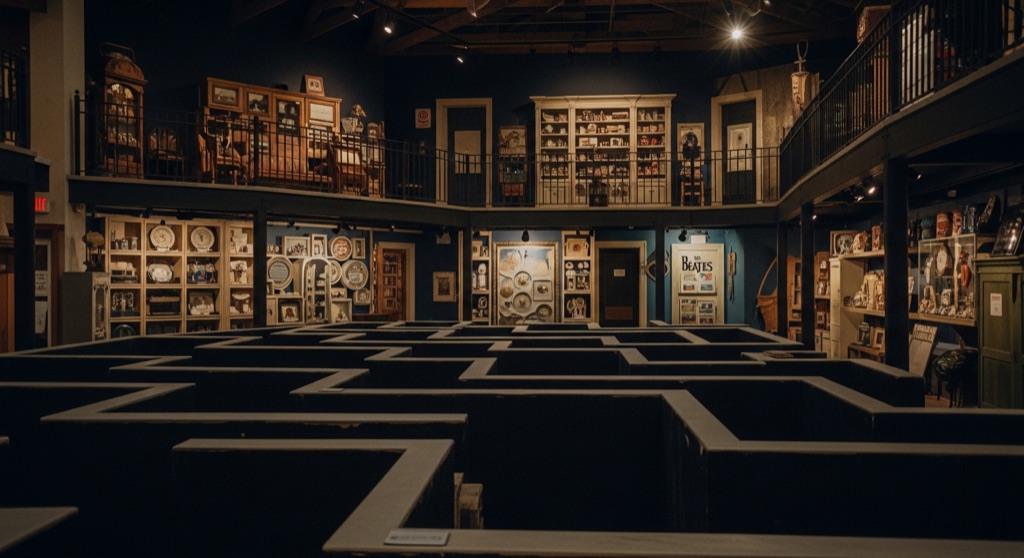
A 30,000-square-foot, 100-room mansion of maze-like passageways and hidden doors — chronicled in James Patterson's novel Four Blind Mice — where the collection ranges from a two-story log cabin to an art-deco penthouse to a Beatles-themed room, and nearly every object on display is for sale.
→ Three at a time, never the same twice — explore weird Washington, D.C.
The story
In 1980, H.H. Leonards bought a single Victorian rowhouse at 2020 O Street—originally designed in 1892 by Edward Clark, an architect of the U.S. Capitol—and began quietly snapping up its neighbors. Over four decades, five interconnected townhouses merged into a 30,000-square-foot maze spanning four floors, roughly 100 rooms, and over 70 hidden passageways. It served as a haven for Rosa Parks, who lived here rent-free for nearly a decade starting in 1994, and as an off-grid sanctuary for touring musicians, political dissidents, and obscure collectors.
The result is equal parts Victorian museum, rogue hotel, and high-end hoarding operation. Inside, you'll crawl through a wine cellar rack to find a hidden hallway, push open a full-length mirror into a Beatles-dedicated lounge, or stumble into a two-story log cabin built inside the structure. The kicker: almost every single item you touch—from vintage Gibson guitars and signed sports gear to oil paintings and obscure paperback novels—is priced for sale. The money helps support the museum's artist-in-residence and veteran programs.
The mansion is so famously labyrinthine that James Patterson set key scenes of his Alex Cross novel *Four Blind Mice* within its walls. But navigating it in real life requires ignoring standard museum instincts: there are no velvet ropes, no directional arrows, and nobody to tell you which bookshelf conceals an entire wing of the building.
What it's like
You'll be handed a brief orientation and let loose into the clutter. The atmosphere hits like an eccentric relative's attic multiplied by a fever dream—smelling faintly of old paper and wood polish, packed floor-to-ceiling with turn-of-the-century furniture, rock 'n' roll relics, and pop-culture debris. Finding more than four or five secret doors without asking for a hint is rare, so take your time scanning bookcases, floorboards, and framed artwork for hidden latches. Wear comfortable walking shoes with good traction; you will be climbing narrow stairs, crouching through small hatches, and retracing your steps when you hit dead ends.
The move: Buy timed tour tickets and hunt for the secret doors room by room together, then debate which piece of the collection you'd actually buy on the way out.
- 📍 Dupont Circle, Washington, DC
- 💸 $$
- ⚡ Up for anything
- 🌗 Indoors
Where: 2020 O Street NW, Washington, DC 20036
Hours: Added 2026-07-19 — confirm current hours before you go.
⚠ Seasonal or scheduled — always check before you go.
Pair it with
- The Mirror — After spending hours hunting for secret doors hidden behind bookcases and mirrors, walk south to McPherson Square to push through a literal full-length mirror hiding a basement bar.
- Left Door — Continue the unmarked-entry theme by heading north toward Shaw to find a cocktail den hidden behind a thin door squeezed beside a dry cleaner.
- Church of Two Worlds — Trade the tactile, material clutter of O Street for a brief walk into Georgetown to visit a historic Spiritualist congregation.
More weird in Washington, D.C.
Good to know
How many secret doors will I actually find?
Most visitors locate around 3 to 6 during a standard self-guided tour. There are over 70 secret passageways in total, but many are seamlessly disguised as mirror frames, bookcases, or wall panels.
Can I really buy the items on display?
Yes. Nearly every item in the building—from art and rare books to chandeliers and memorabilia—is for sale, with proceeds supporting the mansion's foundation programs.
Do I need to book tickets in advance?
Yes, self-guided tours require advance online reservations with timed entry slots, especially on weekends when capacity is strictly capped.
Is the mansion wheelchair accessible?
Because of its historic 19th-century architecture, narrow corridors, step-ups, and hidden staircases, large portions of the upper floors and secret passages are not ADA accessible.
Plan a visit & invite your people →
Further reading: Official site · Wikipedia
last checked: 2026-07-19