Entry No. 51 — the Washington, D.C. file — filed under: ruins
Seneca Mill and Quarry Ruins
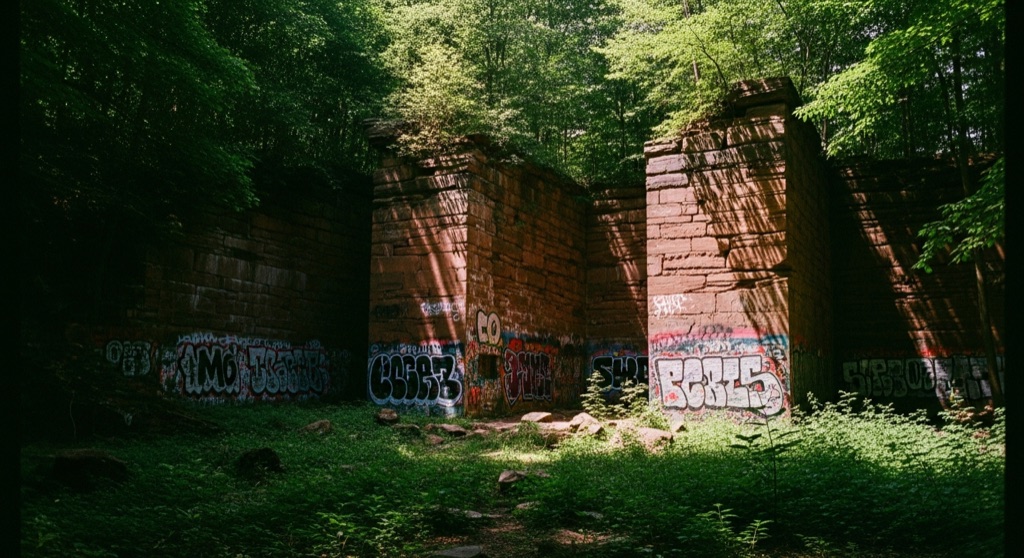
Hidden in the woods near the C&O Canal, these red sandstone ruins are all that remain of a once-bustling 19th-century stone cutting mill and quarry that operated from 1781 to 1901. The quarry provided the iconic rust-red Seneca sandstone used to construct the Smithsonian Castle and numerous other historic Washington, D.C. landmarks. Today, the roofless stone walls of the mill stand overgrown with forest vegetation, covered in graffiti, and accessible via a short trail from the Seneca Aqueduct.
→ Three more abandoned & forgotten places in Washington, D.C. — never the same twice
The story
If you’ve stood on the National Mall and looked up at the rust-red turrets of the Smithsonian Castle, you’ve stared directly at Seneca sandstone. What almost nobody tells you is that the rock was carved right here, in a timbered bend where Seneca Creek spills toward the Potomac River. From 1781 to 1901, this stone-cutting mill and quarry chewed through river bluffs to construct 19th-century Washington's landmark buildings before the machinery stopped and the timber canopy closed back in.
What remains today isn’t an orderly historic monument with braided velvet ropes or brass plaques. It is a hollowed-out, roofless stone shell standing tall inside the woods, its rust-colored walls heavily layered in decades of bright graffiti. Trees push up through where timber floors once sat, and the damp river air keeps the red masonry slick with moss. Standing inside the open-air mill feels less like a sanctioned park visit and more like stumbling across an overgrown industrial ruin.
What it's like
Park near the Seneca Aqueduct at the end of Tschiffely Mill Road and catch the short, established spur trail branching off the C&O Canal towpath into the woods. The walk is brief, but the trail along the creek gets slick after rain. You'll come up on massive, roofless red sandstone walls hidden beneath the tree cover—no rangers on post, no gift shop, just raw masonry and spray paint. Watch your footing on uneven rock, and confirm park access before you go.
The move: Take a scenic hike along the C&O Canal towpath starting from the Seneca Aqueduct, then follow the wooded trail to photograph the towering, graffiti-covered red sandstone walls of the historic mill ruins.
📍 Before you go The ruins are located on public park land within the Chesapeake and Ohio Canal National Historical Park and Seneca Creek State Park, accessible via a short, established trail branching off the C&O Canal towpath.
- 📍 Poolesville
- 💸 Free
- ⚡ Low-key
- 🌗 Outdoors
Where: 13201 Tschiffely Mill Rd, Poolesville, MD 20837, USA
Hours: Added 2026-07-20 — confirm current access before you go.
Pair it with
- Ruins of Clopper Mill — Stay inside Seneca Creek State Park to see another set of 18th-century stone mill walls quietly dissolving into the forest.
- Maryland Gold Mine National Historic Landmark — Head south toward Potomac to trade stone quarrying for the surface ruins of a Civil War-era gold mining operation.
- Cooke's Mill (ruins) — Cross toward the Virginia side of the river for a parallel set of 18th-century stone gristmill and canal lock ruins.
More weird in Washington, D.C.
Good to know
Where are the Seneca Mill ruins located?
They sit at 13201 Tschiffely Mill Road in Poolesville, Maryland, reachable via a short wooded trail branching off the C&O Canal towpath near the Seneca Aqueduct.
What were these stone ruins originally used for?
The site was a 19th-century stone-cutting mill and quarry active from 1781 to 1901, responsible for cutting the red sandstone used to build the Smithsonian Castle in D.C.
Do I need tickets or a reservation to visit?
No ticket is required; the ruins sit on public land shared between the C&O Canal National Historical Park and Seneca Creek State Park, accessible via public footpaths.
Plan a visit & invite your people →
Further reading: Wikipedia · Atlas Obscura
last checked: 2026-07-20