Entry No. 48 — the Washington, D.C. file — filed under: ruins
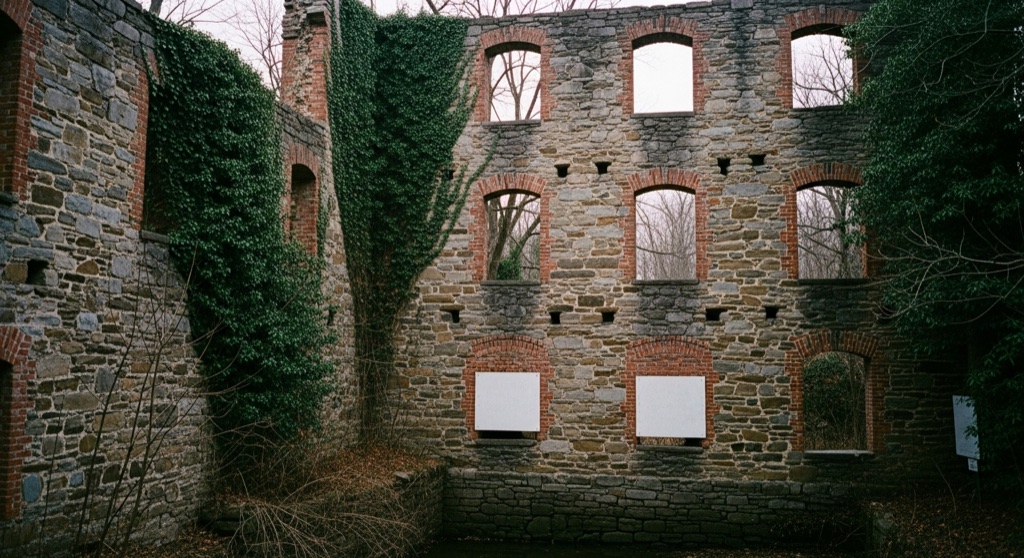
Ruins of Clopper Mill
Located within Seneca Creek State Park, these three-story stone and brick ruins are all that remain of a water-powered gristmill dating back to the late 18th century. Expanded in 1834 by local businessman Francis Cassatt Clopper, the mill was destroyed by a devastating fire in 1947. Notably, Lincoln assassination co-conspirator George Atzerodt hid here for a night while fleeing Washington, D.C. in 1865.
→ Three more abandoned & forgotten places in Washington, D.C. — never the same twice
The story
In the late 18th century, Seneca Creek was an industrial spine, powered by gristmills grinding grain for local farmers. Prominent Montgomery County businessman Francis Cassatt Clopper bought into the action, expanding this particular stone and brick operation in 1834. For over a century, the mill hummed with water wheels and heavy machinery until a devastating fire in 1947 burned it to the ground, leaving behind three-story skeletal walls that the surrounding forest immediately started reclaiming.
The real reason to seek out these ruins isn't just rural industrial archaeology—it's a panicked midnight flight in April 1865. John Wilkes Booth wasn't working alone when he assassinated Abraham Lincoln; he assigned co-conspirator George Atzerodt to murder Vice President Andrew Johnson. Atzerodt chickened out, got drunk instead, and fled D.C. on foot and horseback toward Germantown. On the run from federal troops, Atzerodt used the dark, secluded interior of Clopper Mill as a hideout for a night before moving on to his cousin's nearby property, where he was eventually captured.
Today, the mill stands as a massive three-story tombstone hidden inside Seneca Creek State Park. Most hikers stomping along nearby trails have no idea that the crumbling brickwork tangled in thick ivy was once a temporary safehouse for one of the most wanted men in American history.
What it's like
Don't come expecting a polished historic site with bronze plaques and a paved path. There is no official park trail leading directly to the ruins. You'll need to park at a designated trailhead in Seneca Creek State Park near Clopper Road and Waring Station Road, then navigate through the trees toward the creek. You'll spot the towering, ivy-choked walls rising above the banks. Keep your distance—the remaining three-story masonry is structurally unstable and unsafe to climb around, so set up across the water to get your photographs.
The move: Park safely at a designated trailhead within Seneca Creek State Park and take a scenic walk to view and photograph the towering, ivy-draped stone walls from a safe distance across the creek.
📍 Before you go While the ruins are on state park land, there are no official trails leading directly to them, and the remaining three-story masonry walls are structurally unstable and unsafe to enter.
- 📍 Germantown
- 💸 Free
- ⚡ Low-key
- 🌗 Outdoors
Where: Intersection of Waring Station Road and, Clopper Rd, Germantown, MD 20874, USA
Hours: Added 2026-07-20 — confirm current access before you go.
Pair it with
- Davis Mill ruins — Stay on the 18th-century industrial trail by heading less than five miles north to see another set of gristmill remnants rotting quietly in Germantown.
- Seneca Mill and Quarry Ruins — Follow Seneca Creek downstream toward Poolesville to explore red sandstone quarry ruins that supplied building stone across the region.
- Maryland Gold Mine National Historic Landmark — Continue your tour of overgrown Civil War-era Montgomery County history with a stop at these forgotten gold mining shafts hidden in Great Falls.
More weird in Washington, D.C.
Good to know
Can you go inside the mill ruins?
No. The remaining three-story masonry walls are structurally compromised and unsafe. View and photograph them from a safe distance across the creek.
What is the historical connection to the Lincoln assassination?
George Atzerodt, tasked by John Wilkes Booth with killing Vice President Andrew Johnson, lost his nerve and fled D.C. in April 1865. He hid overnight inside Clopper Mill during his escape.
How do you find the site?
The ruins sit near the intersection of Clopper Road and Waring Station Road inside Seneca Creek State Park, though you will need to walk through the woods as there is no formal, marked trail straight to the brickwork.
When was the mill destroyed?
After running for over 150 years, the mill was completely gutted by a fire in 1947, leaving only the exterior stone and brick structure behind.
Plan a visit & invite your people →
Further reading: Atlas Obscura · patch.com · lincolnconspirators.com · montgomeryplanning.org
last checked: 2026-07-20