Entry No. 46 — the Washington, D.C. file — filed under: ruins
Maryland Gold Mine National Historic Landmark
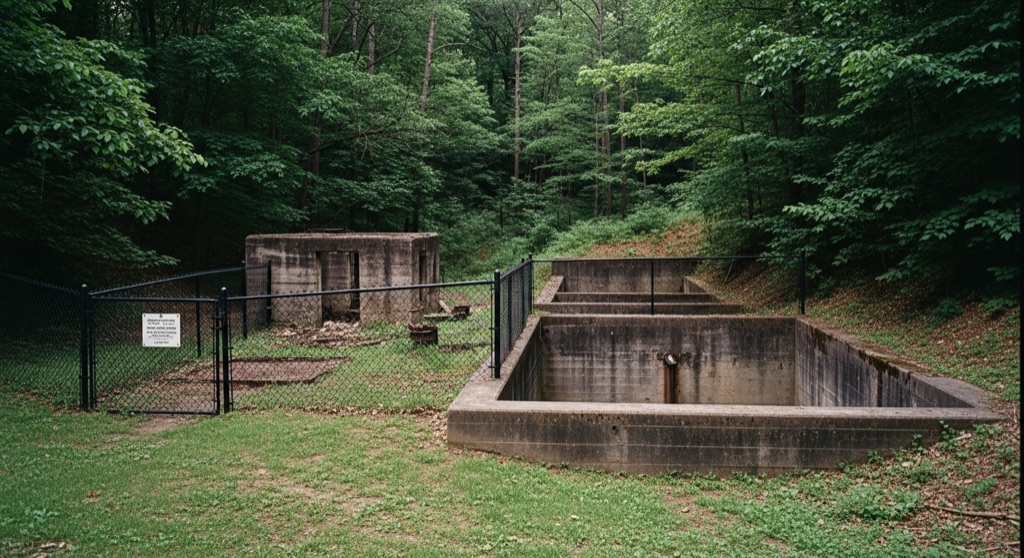
Discovered during the Civil War by a Union soldier, the Maryland Mine was the largest of several gold mining operations in the area, active from 1867 until 1939. Today, the site contains the fenced-off ruins of a blacksmith shop, the concrete foundation of a 25,000-gallon water tank, and sealed mine shafts. These historic remnants are slowly being reclaimed by the surrounding Piedmont forest within the C&O Canal National Historical Park.
→ Three more abandoned & forgotten places in Washington, D.C. — never the same twice
The story
A Union soldier stationed along the Potomac River during the Civil War happened to spot a glint of quartz beneath his boots, recognizing the telltale sign of gold from his pre-war years out west. By 1867, heavy extraction began on what became the Maryland Mine—the largest of several gold operations in the area, dragging gold-bearing quartz out of the earth right up until the mine was abandoned in 1939.
What remains today sits hidden under the Piedmont canopy within the C&O Canal National Historical Park. The forest has spent nearly a century reclaiming the footprint, but if you look through the trees along the trail, you can still pinpoint the crumbling stone and brick remnants of the old blacksmith shop, the mossy concrete pad of a 25,000-gallon water tank, and vertical mine shafts capped and sealed from the surface.
What it's like
Head to the Great Falls Tavern Visitor Center off MacArthur Boulevard to pick up the three-mile Gold Mine Loop trail. It's a wooded hike, but do not arrive expecting an illicit underground expedition—the National Park Service maintains strictly locked chain-link perimeter fences around all mine shafts, foundations, and stone ruins for safety and site preservation. You will view the blacksmith shop wall and water tank foundation entirely from designated trail view points and historical wayside markers.
The move: Hike the scenic three-mile Gold Mine Loop trail starting from the Great Falls Tavern Visitor Center, stopping to read the historical wayside exhibits and photograph the fenced-off ruins of the old blacksmith shop.
📍 Before you go The ruins and sealed mine shafts are located within the C&O Canal National Historical Park, but are strictly fenced off by the National Park Service for safety and preservation; they can only be viewed from the designated trail.
- 📍 Potomac
- 💸 Free
- ⚡ Low-key
- 🌗 Outdoors
Where: 11400-11798 Macarthur Blvd, Potomac, MD 20854, USA
Hours: Added 2026-07-20 — confirm current access before you go.
Pair it with
- Seneca Mill and Quarry Ruins — Pair two distinct 19th-century industrial ruins hidden in the forest along the C&O Canal corridor.
- Glenstone Museum — Alex Da Corte's Rubber Pencil Devil (Hell House) — Swap overgrown 1930s mine shafts and concrete foundations for ultra-refined modern art nearby in Potomac.
- Glen Echo Glassworks — Follow MacArthur Boulevard south from the silent mine ruins to watch molten glass glowing at 2,000°F inside a historic trolley park building.
More weird in Washington, D.C.
Good to know
Where does the trail start?
The Gold Mine Loop begins near the Great Falls Tavern Visitor Center at 11400-11798 MacArthur Blvd in Potomac.
Can you enter the mine shafts or touch the ruins?
No. The National Park Service strictly fences off all shaft openings, the water tank base, and the blacksmith shop ruins to protect visitors and preserve the site.
How long is the trail?
It is a three-mile loop trail through the woods, passing the historical wayside markers.
When was gold actually mined here?
Gold was discovered during the Civil War, and active mining operations ran at the site from 1867 until 1939.
Plan a visit & invite your people →
Further reading: Atlas Obscura · nps.gov · canaltrust.org
last checked: 2026-07-20