Entry No. 44 — the Washington, D.C. file — filed under: ghost fleet
Mallows Bay Ghost Fleet
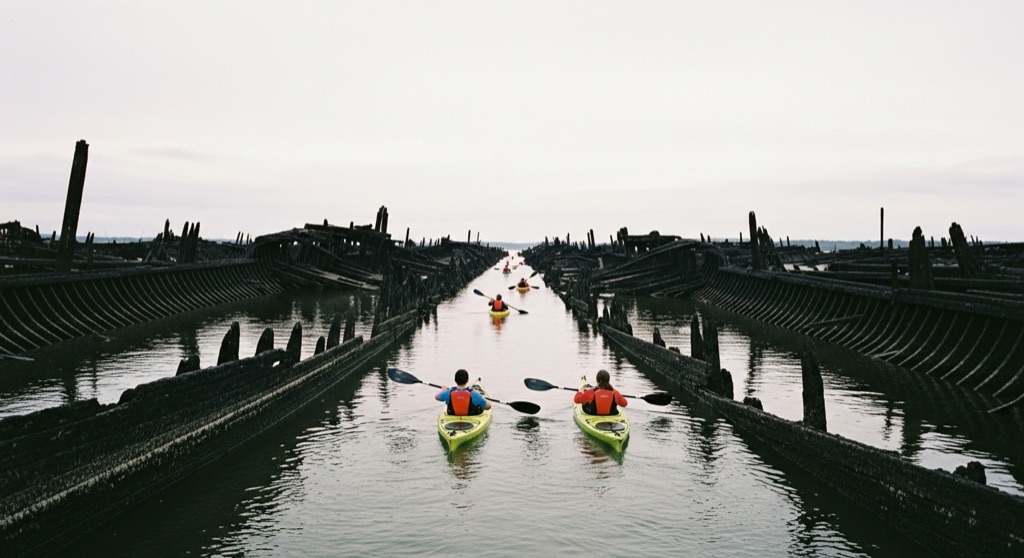
Around 100 wooden WWI 'Ghost Fleet' steamships — part of a roughly 200-vessel wreck field, the largest in the Western Hemisphere — were built too slowly to ever see the war, then towed here, burned for scrap, and left to rot; their charred ribs now poke out of the Potomac shallows as a sunken armada you can paddle straight through.
→ Three more abandoned & forgotten places in Washington, D.C. — never the same twice
The story
When the U.S. entered World War I in 1917, federal maritime authorities panicked about German U-boat destruction and ordered hundreds of wooden steamships built as fast as humanly possible. By the time the fleet was ready, the war was already over. Left holding an armada of obsolete wooden vessels that nobody wanted, the government sold them off for scrap. Salvage companies towed the ships a few at a time up the Potomac to Alexandria to strip them of valuable metal before hauling them down to the shallow waters of Mallows Bay.
To easily reach the remaining iron fasteners holding the hulls together, salvage crews torched the ships to the waterline right where they sat. What was left—around 100 burned wooden steamships out of a total wreck field of roughly 200 vessels—was simply left to rot in the mud. Over the next century, nature pulled off a slow takeover: vegetation took root inside flooded holds, ospreys nested on protruding sterns, and the largest shipwreck fleet in the Western Hemisphere turned into a massive sunken reef, now legally protected as a National Marine Sanctuary.
What it's like
Drive down to the end of Wilson Landing Road in Charles County, unload your boat at the public launch, and push into the Potomac shallows. Timing is everything here—check local tide charts before you go. At high tide, most of the fleet hides just beneath the water; hit low tide, and rows of charred, century-old timber ribs stick out five to ten feet above the waterline. Stick to the marked water trail, watch out for hidden rusted bolts and jagged wooden snags sitting just below your hull, and take the 0.8-mile trail along the shore to see the old salvage basin from land.
The move: Bring or rent kayaks and paddle the marked route through the shipwreck reef at low tide, when the burned hulls show clearest above the waterline, then walk the 0.8-mile shoreline loop around the old salvage basin.
- 📍 Nanjemoy, MD (Charles County)
- 💸 $$
- ⚡ Up for anything
- 🌗 Indoors
Where: 1440 Wilson Landing Road, Nanjemoy, MD 20662
Hours: Added 2026-07-19 — confirm current hours before you go.
Pair it with
- Surratt House Museum — Stop at this Prince George's County roadside tavern on your drive back north to see where John Wilkes Booth retrieved stashed weapons along his escape route.
- Torpedo Factory Art Center — Trace the Potomac's wartime history back upstream to Alexandria, where many of these ghost ships were stripped of metal before being towed down to the bay.
- Stabler-Leadbeater Apothecary Museum — Pair an outdoor paddle through 1920s naval debris with a trip to an unmolested 18th- and 19th-century apothecary shop in nearby Old Town.
More weird in Washington, D.C.
Good to know
When is the best time to see the shipwrecks?
Low tide is critical. As the Potomac drops, the buried ship outlines and burned wooden ribs pop up clearly above the waterline.
Do I need to bring my own kayak?
You can launch your own kayak, canoe, or paddleboard from the public park ramp for free. If you need a rental or a guided tour, you'll need to arrange that with regional outfitters ahead of time.
Is paddling through the fleet dangerous?
The bay is generally shallow and calm, but you have to stay sharp. Rusted iron bolts, submerged timbers, and hidden metal spikes sit inches below the surface outside the main channels.
Plan a visit & invite your people →
Further reading: Wikipedia · sanctuaries.noaa.gov · arlingtonmagazine.com
last checked: 2026-07-19