Entry No. 4 — the Salt Lake City file — filed under: cemetery
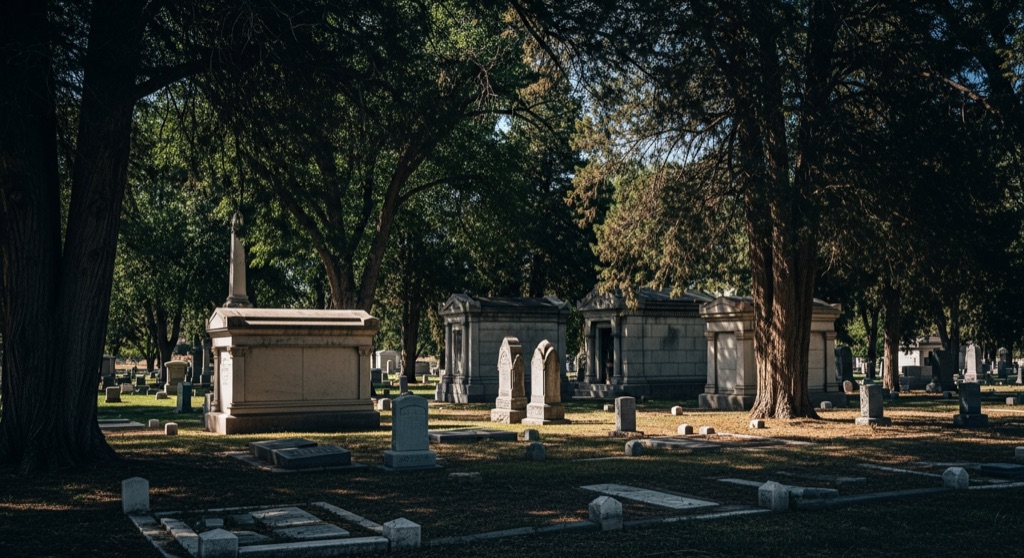
Salt Lake City Cemetery
The cemetery's own gravedigger, Jean Baptiste, confessed in 1862 to robbing roughly 300 graves for burial clothes and shrouds before a mob nearly lynched him and authorities exiled him to a barren island in the Great Salt Lake, where he vanished for good. A short walk away, Lilly E. Gray's 1958 headstone reads 'Victim of the Beast 666' — not a satanic marker, but a bitter political inscription her anti-government husband commissioned.
→ Three more occult & metaphysical spots in Salt Lake City — never the same twice
The story
In 1862, Salt Lake City discovered its municipal gravedigger, Jean Baptiste, had been systematically looting the dead. Hired to maintain the grounds, Baptiste spent years opening fresh plots, stripping roughly 300 corpses of their burial clothes, and hoarding suits, dresses, and shrouds in his home. When an outraged mob nearly lynched him, territorial authorities stepped in and banished him to a desolate island in the Great Salt Lake. He eventually constructed a makeshift raft and vanished for good, leaving behind only severed leg irons and local legend.
Deep in the terraced hillside of the cemetery sits another eccentric piece of Utah lore: the 1958 headstone of Lilly E. Gray. Carved into the stone are the words 'Victim of the Beast 666.' Local urban legends prefer to frame it as occult ritual, but the story is far more terrestrial. Her husband, Elmer Gray, was a paranoid anti-government eccentric who harbored a venomous grudge against local bureaucracy and law enforcement, choosing to etch his bitter political conspiracy theories directly onto his late wife's monument.
Holding roughly 120,000 interments, this isn't a sleepy plot—it is one of the largest municipally operated cemeteries in North America. Sloping across the hillside, the grounds pack pioneer graves, church patriarchs, and forgotten outcasts into a steep grid that mirrors the city's early expansion.
What it's like
Expect a steep, wind-exposed grid that feels more like a mountain park than a manicured memorial garden. Stop by the sexton's house near the main entrance at 200 N Street to grab a paper plot map, or pull up the city's online database on your phone—trying to find specific markers among 120,000 graves without plot numbers is a losing game. Wear comfortable shoes for the hill climbs, keep an eye out for birdwatchers scanning the pine canopy, and visit late in the afternoon so you can walk downhill into the Avenues for dinner when you finish.
The move: Grab a printed plot map at the sexton's house, hunt down Lilly Gray's stone and the old pioneer rows on foot at dusk, then walk down the hill into the Avenues for dessert.
- 📍 The Avenues
- 💸 $$
- ⚡ Up for anything
- 🌗 Indoors
Where: 200 N St, Salt Lake City, UT 84103
Hours: Added 2026-07-20 — confirm current hours before you go.
Pair it with
- Limekiln Gulch Pioneer Kilns — Located just up in the nearby foothill gullies, these 19th-century stone kilns share the early pioneer vintage of the cemetery's oldest rows.
- Gilgal Sculpture Garden — Follow up the cemetery stroll with a visit to this hidden backyard filled with eccentric LDS stone carvings and symbolic masonry.
- Golden Braid Books — Walk down the hill from the cemetery into the surrounding neighborhood for a drink and metaphysical books.
More weird in Salt Lake City


Good to know
How do you locate specific graves like Lilly E. Gray?
Grab a plot map at the sexton's house near the main gate or search Salt Lake City's online cemetery tool before you start walking, as the hillside blocks are massive.
Is the cemetery free to visit?
Yes. It is a public city-run cemetery open to visitors on foot or by vehicle free of charge.
What is the story behind 'Victim of the Beast 666'?
It was commissioned by Lilly Gray's anti-government husband, Elmer Gray, who held a bitter lifelong grudge against public officials and state institutions.
Plan a visit & invite your people →
Further reading: Wikipedia
last checked: 2026-07-20