Entry No. 7 — the Salt Lake City file — filed under: observatory
Willard Eccles Astronomy Observatory (WEAO)
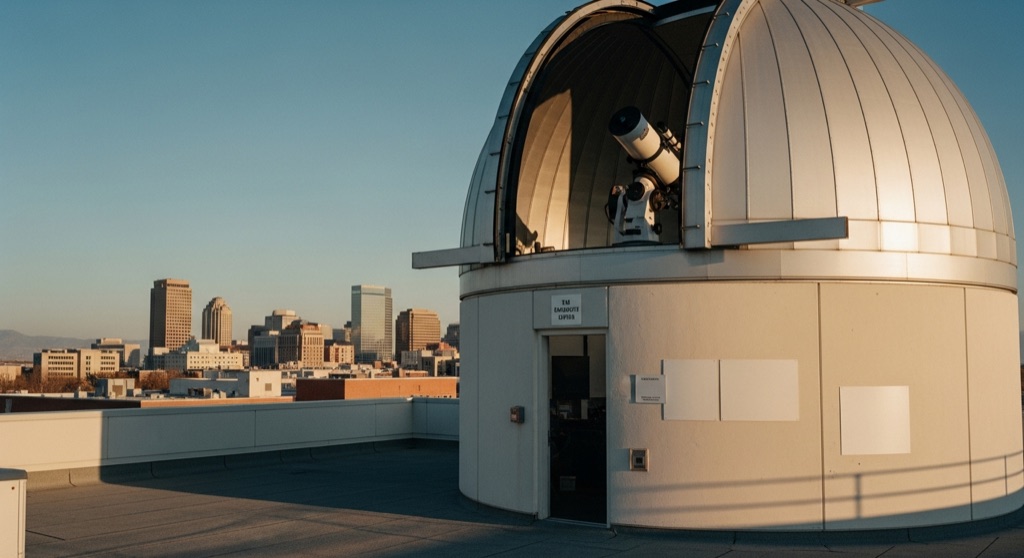
A rotating-dome observatory sits on the roof of a University of Utah science building, run by physics grad students who point a 14-inch Meade LX200GPS and a row of 10- and 12-inch scopes at whatever's up — and who post real-time status updates like closing the dome for a week because they were 'traveling to the Badlands National Park Astrofest.'
→ Three at a time, never the same twice — explore weird Salt Lake City
The story
Most people cutting through the University of Utah campus after dark assume the science complex is locked down tight to anyone without a keycard. But if you head up to the roof of the L.S. Skaggs Applied Science Building, you'll find a white rotating dome sitting high above the concrete. This is the Willard Eccles Astronomy Observatory, a teaching facility run by the Department of Physics & Astronomy where the roof opens directly to the night sky.
Inside the dome sits a 14-inch Meade LX200GPS telescope, backed up by a row of 10- and 12-inch scopes stationed nearby. Under observatory director Paul Ricketts and a rotation of physics students, the gear gets dialed in on whatever is sharpest that evening—from the clean gap in Saturn's rings to deep-sky nebulae. It is one of the few places in the city where you can look through serious university optical hardware without enrolling in a degree program.
What it's like
Reaching the rooftop feels like sneaking into an off-limits facility, but once you step onto the deck, the vibe is strictly informal. Physics students hang around the scopes, adjusting drive motors and explaining stellar mechanics without pulling rank. The only catch is weather and human availability: if cloud cover moves into the Salt Lake Valley or the team packs up for field trips like out-of-state astrofests, the dome stays shut. You'll want to check their site or social feed for live status updates before making the climb.
The move: Show up right at sunset on a clear Wednesday (check the site's live open/closed status first), climb to the rooftop dome, and let a grad student walk you through Saturn's rings or a nebula for free — no ticket, no reservation, just clear sky.
- 📍 University of Utah campus, Salt Lake City
- 💸 $
- ⚡ Low-key
- 🌗 Outdoors
Where: 270 S 1400 E, Salt Lake City, UT 84112 (rooftop of the L.S. Skaggs Applied Science Building)
Hours: Added 2026-07-20 — confirm current hours before you go.
⚠ Seasonal or scheduled — always check before you go.
Pair it with
- Sound Bath at the JCC — Pair an afternoon vibrational frequency session on the East Bench with a rooftop look into deep space later that night.
- Gilgal Sculpture Garden — Trade Thomas Child's eccentric stone masonry tucked in Central City for celestial views through a 14-inch scope on campus.
- Salt Lake City Cemetery — Follow up an afternoon wandering the historic plots of The Avenues with a trip up to the science building roof to gaze light-years into the past.
More weird in Salt Lake City
Good to know
Is there any cost or ticket required to visit?
No. Public viewing nights at the observatory are entirely free, with no tickets or advance reservations needed.
Where is the observatory located on campus?
It sits on the rooftop of the L.S. Skaggs Applied Science Building at 270 S 1400 E in Salt Lake City.
How do I check if the observatory is open before going?
Because viewings depend on clear weather and staff availability, check the observatory's official webpage (physics.utah.edu/weao/) or Instagram account (@uofu_weao) for real-time open/closed updates.
What equipment is used during star parties?
The primary dome houses a 14-inch Meade LX200GPS telescope, supplemented by portable 10-inch and 12-inch telescopes set up on the deck.
Plan a visit & invite your people →
Further reading: physics.utah.edu · attheu.utah.edu
last checked: 2026-07-20