Entry No. 6 — the Salt Lake City file — filed under: land art
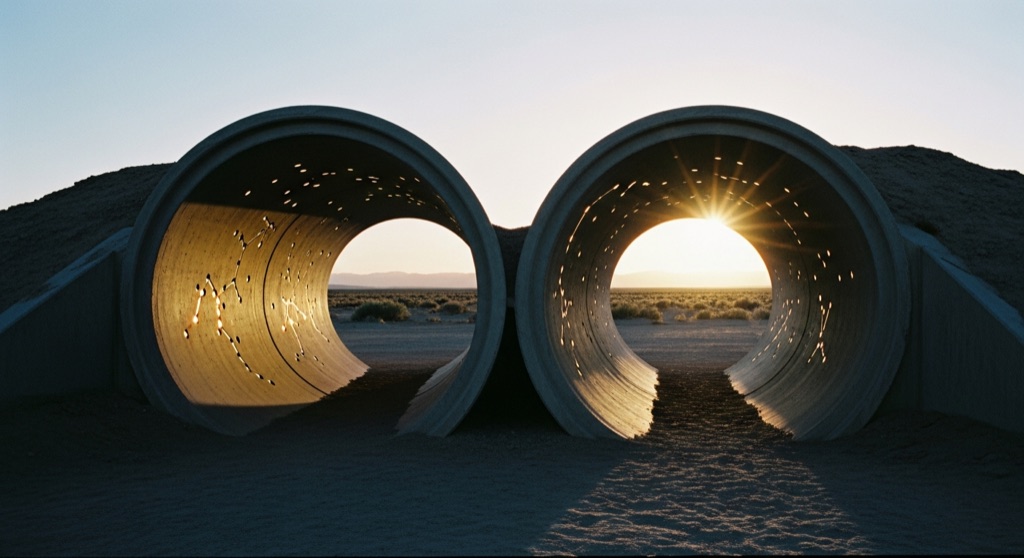
Sun Tunnels
Nancy Holt sank four 18-foot-long, 9-foot-diameter concrete culverts into open desert in 1976 and drilled holes through their walls in the pattern of four constellations, aiming the tunnels so the rising and setting sun frames perfectly inside on the summer and winter solstices — no fence, no visitor center, no cell service, just empty land in every direction.
→ Three more weird outdoor & roadside oddities in Salt Lake City — never the same twice
The story
In 1976, artist Nancy Holt hauled four 18-foot-long, nine-foot-diameter concrete sewer culverts out to a desolate stretch of the Great Salt Lake Desert near Lucin and arranged them in a open cross formation. There was no gallery, no ribbon cutting, and no staff. Now preserved by the Dia Art Foundation in partnership with the Holt-Smithson Foundation, the installation sits exactly where she left it: naked concrete resting on dirt, miles past where your cell signal dies.
The genius of the arrangement is purely astronomical. Holt drilled precise holes through the thick concrete walls in the shapes of four constellations. On the summer and winter solstices, the rising and setting sun aligns straight down the center axis of the pipes, framing the burning horizon in a circular concrete vault. During the day, harsh desert sunlight cuts through the drilled perforations, casting shifting speckles of star-shaped light onto the interior concrete floors.
What it's like
Getting here requires committed desert driving—you'll head west out of Salt Lake City on I-80 past the Bonneville Salt Flats before turning onto roughly 10 miles of washboard dirt off Route 30. When you finally roll up Little Pigeon Road, don't expect a ticket booth, a restroom, or a fence. It is just you, four gigantic concrete cylinders, and a flat expanse extending toward the Nevada line. Lie flat inside one of the pipes during the heat of the day to watch the light spots crawl across the concrete, and stick around past dusk—without city light pollution for dozens of miles, the real night sky puts on a second show.
The move: Time it for a solstice sunrise or sunset, lie inside a tunnel to watch the drilled "stars" throw light patterns across the concrete walls as the sun moves, then stay after dark for genuinely unpolluted night sky.
- 📍 Near Lucin, Box Elder County (west desert, near Nevada line)
- 💸 Free
- ⚡ Up for anything
- 🌗 Outdoors
Where: Little Pigeon Rd, Lucin, UT 84314 (via ~10 miles of dirt road off Route 30)
Hours: Added 2026-07-20 — confirm current hours before you go.
Pair it with
- Spiral Jetty — Pair Utah's two great 1970s land art monuments—created by married artists Nancy Holt (Sun Tunnels) and Robert Smithson (Spiral Jetty)—in a single monumental Box Elder County road trip.
- Stansbury Park Observatory Complex (SPOC) — Double down on your stargazing by following up the Sun Tunnels' solar alignments with volunteer-run telescopes on the edge of Tooele County.
- Union Station (Ogden) — Break up the absolute isolation of the west desert by stopping in Ogden on your return to trek through a historic 1927 underground pedestrian rail tunnel.
More weird in Salt Lake City
Good to know
How do I reach the Sun Tunnels from Salt Lake City?
Drive roughly 151 miles west along I-80 toward Wendover, then head north through Box Elder County, finishing the final stretch on 10 miles of unpaved dirt along Little Pigeon Road near Lucin.
Is there an admission fee or visitor center?
No. The site is free, outdoors, and completely unstaffed. There are no facilities, water spigots, or restrooms, so bring everything you need.
When is the best time of year to visit?
The summer and winter solstices (mid-June and late December) are the headline events when the sun aligns directly through the cylinders at sunrise and sunset, but any clear day offers the light-projection effect and dark-sky stargazing.
Who owns and maintains the installation?
Nancy Holt created the site in 1976. In 2018, the Dia Art Foundation acquired the land art work with support from the Holt-Smithson Foundation.
Plan a visit & invite your people →
Further reading: Roadside America · Wikipedia · diaart.org · umfa.utah.edu
last checked: 2026-07-20