Entry No. 55 — the Phoenix file — filed under: ruins
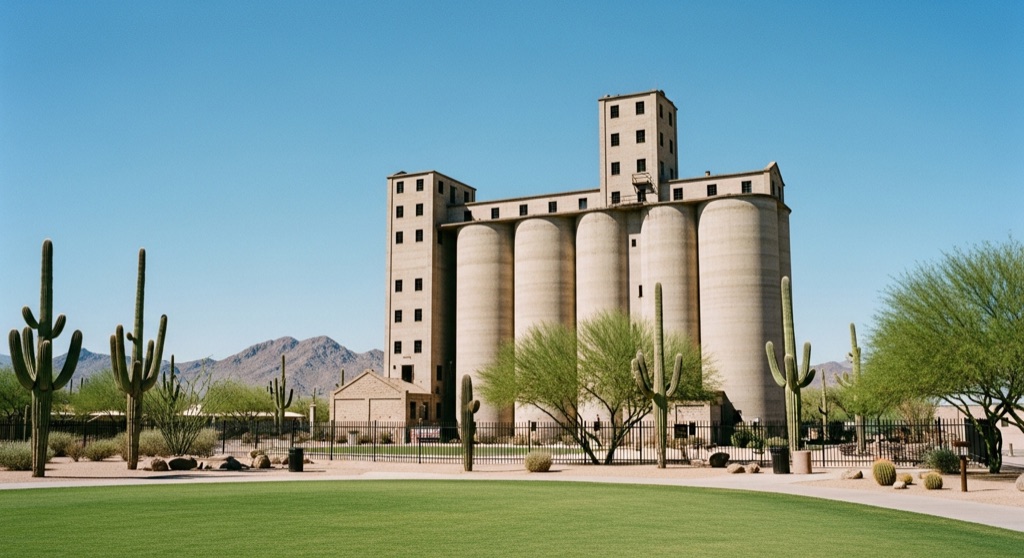
Hayden Flour Mill
Constructed in 1918 to replace earlier structures lost to fire, this reinforced concrete mill and its 1951 grain silos stand as iconic landmarks of Tempe's agricultural past. The facility operated continuously for over a century before closing its doors in 1998, leaving behind a striking, vacant industrial shell. Today, the fenced-off ruins are surrounded by a public event lawn while awaiting a major planned redevelopment.
→ Three more abandoned & forgotten places in Phoenix — never the same twice
The story
You're staring at a 140-foot-tall concrete tombstone for the era when Tempe was a dusty agricultural mill town rather than a sprawling college metropolis. Charles Trumbull Hayden established a flour mill on this exact site near Hayden Butte in 1874, but fire flattened the wood and brick structures multiple times. The brutalist monolithic shell standing today—built out of reinforced concrete in 1918 to finally defeat the blazes, with massive silos added in 1951—is the oldest continuously used industrial structure in the Salt River Valley, grinding grain for 124 straight years until the machinery fell silent in 1998.
What makes the site weird isn't just its scale; it's the stark juxtaposition at the foot of A Mountain. The city wrapped a plush public event lawn around the perimeter, so you can sit on manicured grass under palm trees while staring directly into a towering, hollowed-out concrete relic with sun bleaching its rusted corrugated metal and faded painted lettering. Long-discussed redevelopment plans periodically threaten to turn the parcel into a boutique hotel or commercial hub, but for now, the 1918 mill sits in a suspended state between active industrial ruin and manicured civic lawn.
What it's like
Don't bring wire cutters—the mill complex is heavily chain-link fenced, padlocked, and monitored, so your visit is strictly a perimeter walk. Arrive late afternoon when the sun hits the weathered concrete silos against the backdrop of Tempe Butte, or swing by after grabbing a coffee on Mill Avenue. It takes about fifteen minutes to walk the boundary, check out the historical signage, and peek through the fence at the rusted grain elevators and empty window frames.
The move: Stroll through the surrounding public park at the base of the mill to admire the towering concrete silos and historic architecture, then grab a coffee nearby on Mill Avenue.
📍 Before you go The historic mill building and silos are fenced off and locked to the public due to structural safety concerns and upcoming redevelopment, but they can be easily viewed from the adjacent public park and sidewalks.
- 📍 Tempe
- 💸 Free
- ⚡ Low-key
- 🌗 Outdoors
Where: 119 S Mill Ave, Tempe, AZ 85281, USA
Hours: Added 2026-07-20 — confirm current access before you go.
Pair it with
- Casey Moore's Oyster House (W.A. Moeur House) — Follow up a walk around Tempe's oldest industrial concrete ruin with a pint on the porch of a 1910 historic home turned neighborhood pub just down the road.
- Air Apparent (James Turrell Skyspace) — Pair the industrial, sun-bleached concrete of the flour mill with a sleek, light-manipulating architectural installation on the nearby ASU campus.
- Great Papago Escape Tunnel Marker — Keep the local history dive going by driving two miles north to the obscure roadside plaque marking the site of a 1944 WWII German POW tunnel escape.
More weird in Phoenix
Good to know
Can you go inside the Hayden Flour Mill?
No. The interior is strictly off-limits and sealed due to structural safety hazards, rot, and ongoing development prep. You can only view it from behind the fence on the surrounding park grounds.
Where do I park when visiting?
Use the paid street parking along Mill Avenue or Rio Salado Parkway, or park in one of the nearby downtown Tempe parking garages a short walk away.
When did the mill officially stop operating?
The mill ceased industrial flour production in 1998 after more than a century of continuous operation.
Plan a visit & invite your people →
Further reading: saltriverstories.org · downtowntempe.com · tempe.gov
last checked: 2026-07-20