Entry No. 57 — the Phoenix file — filed under: prehistoric
Casa Grande Ruins National Monument
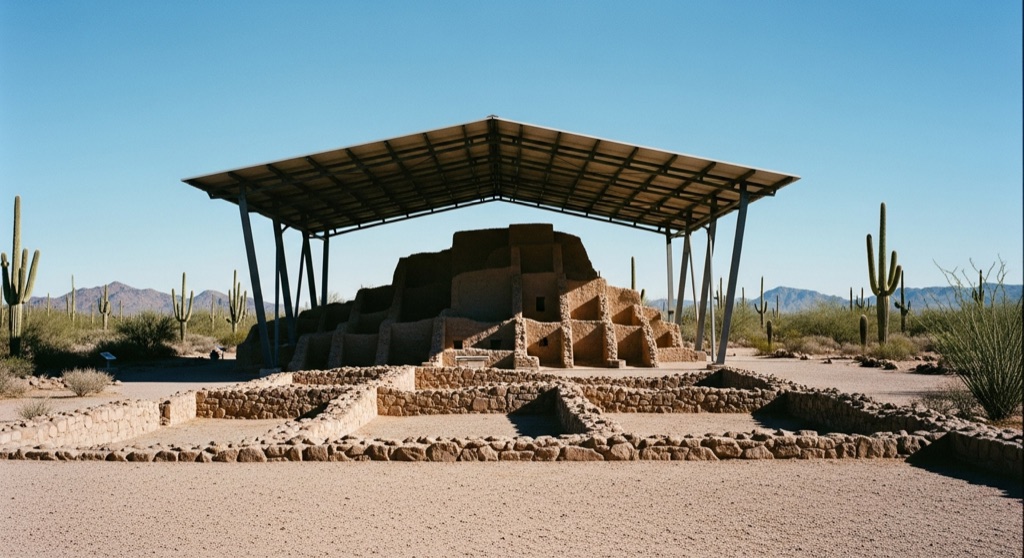
Built in the 14th century by the Ancestral Sonoran Desert (Hohokam) people, this prehistoric farming community was abandoned around 1450 CE. The centerpiece of the site is the 'Great House,' a massive four-story structure constructed of caliche mud that is now protected under a landmark steel canopy. Visitors can also see the remnants of surrounding compound walls and ancient irrigation canals that once sustained the village.
→ Three more abandoned & forgotten places in Phoenix — never the same twice
The story
Out in the desert dust of Coolidge sits a four-story tower constructed entirely out of raw, packed dirt. Built in the 14th century by the Ancestral Sonoran Desert people, the Great House was constructed using caliche—a concrete-hard natural slurry of sand, clay, and calcium carbonate mined right out of the desert subsoil. Without draft animals or metal tools, builders carried hundreds of tons of wet earth by hand, layering it into thick structural walls that have managed to hold their shape for over seven hundred years.
around 1450 CE, the inhabitants abandoned the site, leaving behind a massive village compound and a sprawling network of hand-dug irrigation canals that once watered thousands of acres across the Gila River Valley. In 1892, the federal government designated the location as the country's first prehistoric reserve. To keep the ancient mud from dissolving under Arizona rainstorms, engineers in 1932 erected a giant, bizarre steel canopy over the centerpiece ruins. The result is a striking sight: a 700-year-old earthen skyscraper sitting under a massive piece of New Deal-era industrial shade.
What it's like
Drive down Highway 87 into Coolidge, where the steel roof of the monument pops out unexpectedly against the flat desert landscape. Start in the National Park Service visitor center to inspect the museum displays detailing the ancient canal system, then walk the paved loop trail out to the main compound. You cannot step inside the delicate mud walls, but the paved path brings you close enough to spot small wall openings built to align with astronomical events. Go early in the day—shade on the outdoor path is nonexistent outside the shadow of the giant steel canopy, and summer temperatures in the area easily cross triple digits.
The move: Take a self-guided walk along the paved interpretive trail to photograph the towering Great House, then explore the visitor center's museum exhibits to learn about the ancient Hohokam canal system.
📍 Before you go The site is a federally protected National Monument managed by the National Park Service, open daily to the public with paved trails surrounding the ruins.
- 📍 Coolidge
- 💸 Free
- ⚡ Low-key
- 🌗 Outdoors
Where: 1100 W Ruins Dr, Coolidge, AZ 85128, USA
Hours: Added 2026-07-20 — confirm current access before you go.
Pair it with
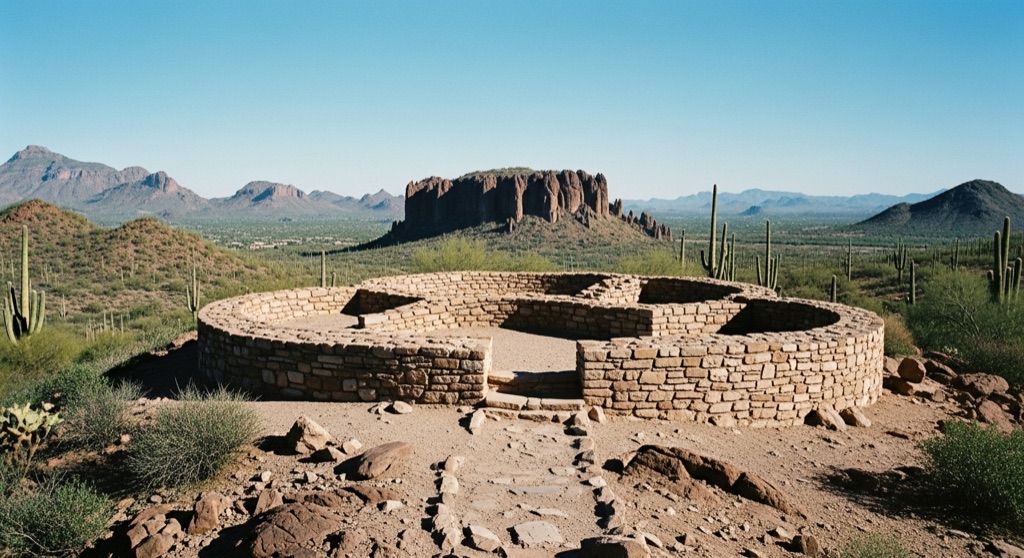
- Queen Valley Overlook Ruins — Pair a major caliche mud village with a hilltop stone fort ruin to compare how different prehistoric desert groups built using local earth and rock.
- Gilbert Rotary Centennial Observatory (Riparian Preserve at Water Ranch) — Trade ancient wall openings engineered for celestial tracking for modern telescopes operated by local astronomy enthusiasts.
More weird in Phoenix

Good to know
Can you go inside the Great House structure?
No. To protect the fragile caliche mud walls from collapsing or eroding, access inside the main structure is prohibited, though the paved loop trail takes you right up to its perimeter.
Why is there a giant metal roof over the ruins?
The National Park Service built the massive steel umbrella canopy in 1932 to shelter the unreinforced mud walls from water damage and weather erosion.
How old is the site?
The Great House was constructed during the 14th century (1300s CE) and was inhabited until the community abandoned the area around 1450 CE.
Plan a visit & invite your people →
Further reading: nps.gov · Wikipedia
last checked: 2026-07-20