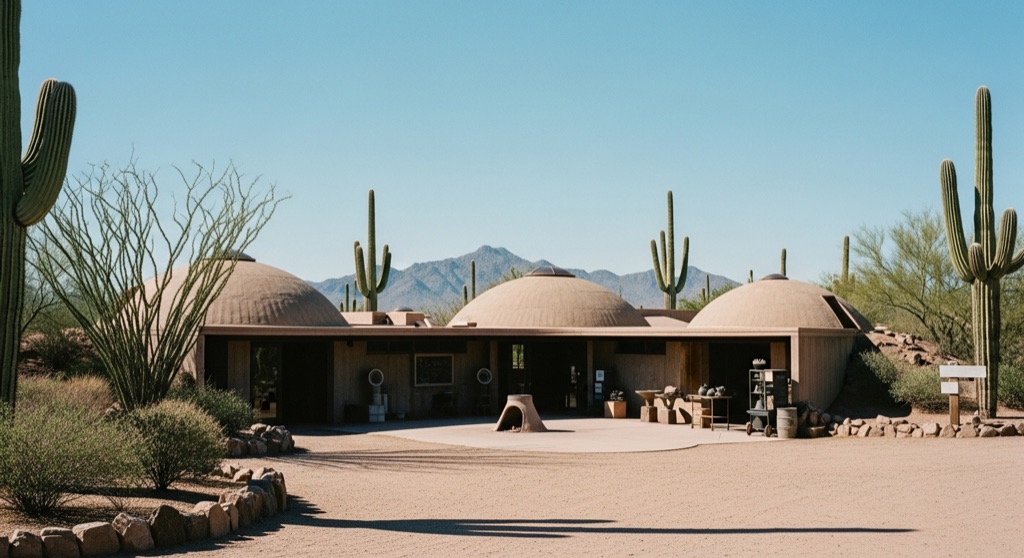
Entry No. 2 — the Phoenix file — filed under: windbells
Cosanti
Architect Paolo Soleri's home studio, where bronze and ceramic windbells are still cast in earthen molds exactly as he designed in the 1950s to fund his 'arcology' urban experiments — the buildings themselves are half-buried concrete domes he poured by hand.
→ Three at a time, never the same twice — explore weird Phoenix
The story
Long before multi-million-dollar sprawling haciendas swallowed Paradise Valley, Italian architect Paolo Soleri stepped onto a patch of raw Sonoran dirt in the 1950s and started pouring concrete directly over mounded piles of earth. Once the concrete shells set, he scooped the dirt out from underneath by hand, leaving behind a semi-subterranean labyrinth of concrete domes, apses, and terraced vaults designed to naturally buffer the desert heat without heavy air conditioning.
To fund his studio and his grander urban planning experiments—what he dubbed 'arcology,' a mashup of architecture and ecology—Soleri began designing and casting windbells. For over six decades, artisan founders at Cosanti have kept the process unchanged: carving geometric patterns into damp silt molds, pouring 2,000-degree molten bronze directly into the earth, and smashing the molds open to release bronze and ceramic bells whose sales still finance the non-profit Cosanti Foundation.
What it's like
Stepping off Doubletree Ranch Road onto the dirt paths feels less like visiting an architectural site and more like stumbling upon an unearthed prehistoric village or an alien foundry hidden behind suburban hedges. You'll wander beneath low concrete arches and terraced tunnels hung with hundreds of bronze and ceramic bells chiming softly in the breeze. If you drop by on a weekday morning, you can stand back in the dusty courtyard and watch the crew in heavy leather aprons pour glowing yellow metal into sand pits. The site is free to walk through, but you'll likely end up inside the foundry shop splitting a hand-cast bell to take home.
The move: Free self-guided tour through the bell-casting yard (watch molten bronze poured most weekday mornings), then split a bell to take home from the on-site foundry shop.
- 📍 Paradise Valley
- 💸 $
- ⚡ Up for anything
- 🌗 Indoors
Where: 6433 E Doubletree Ranch Rd, Paradise Valley, AZ 85253
Hours: Added 2026-07-19 — confirm current hours before you go.
Pair it with
- Cattle Track Arts Compound — Drive three miles south to explore another surviving piece of mid-century desert artisan history, where working artists still build in a compound centered on a 1937 redwood pipeline house.
- The Hermosa Inn (Lon's at the Hermosa) — Head five minutes west for a drink at cowboy artist Lon Megargee's 1930 hand-built adobe hacienda, constructed during the same era of handmade desert studios.
- One-Eyed Jack — Head five miles south into Old Town Scottsdale to trade Soleri’s hand-poured earth domes for a 26-foot-tall painted-steel jackrabbit sitting on its haunches.
More weird in Phoenix
Good to know
When can you watch the bronze foundry team at work?
Molten bronze pours typically happen on weekday mornings in the open-air yard, depending on weather and production schedules.
Is there an admission fee to walk around Cosanti?
Self-guided walks through the foundry grounds and bell yard are free, though you can book formal guided tours on their website.
What does 'Cosanti' mean?
The name comes from two Italian words: 'cosa' (thing) and 'anti' (before or against), roughly translating to 'against things' or anti-materialism.
Plan a visit & invite your people →
Further reading: Official site · eichlernetwork.com · Wikipedia · Reddit
last checked: 2026-07-19