Entry No. 14 — the Phoenix file — filed under: sensory space
Air Apparent (James Turrell Skyspace)
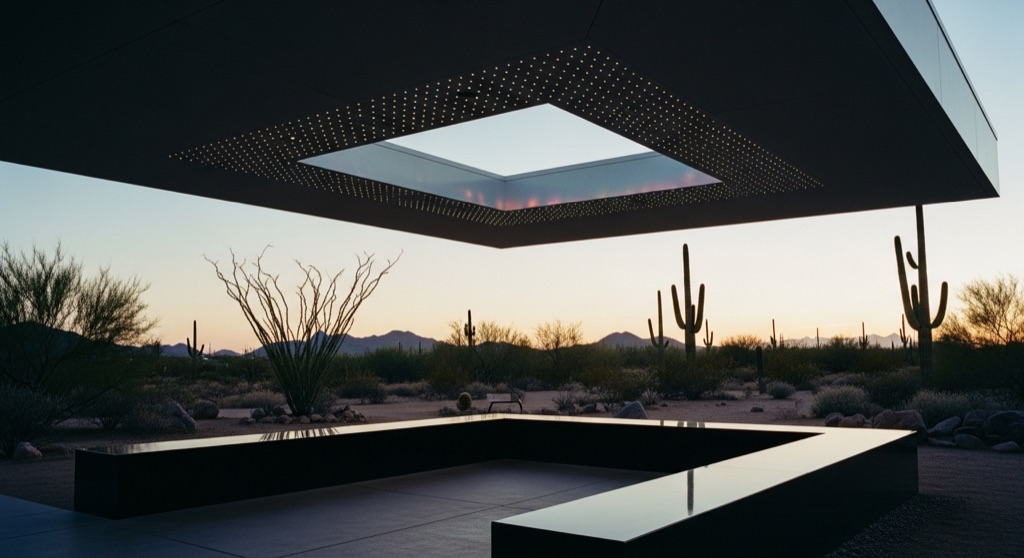
A James Turrell "Skyspace" that from outside looks like a futuristic bus stop with a hole cut in the roof — sit on the polished black granite bench as 480 LED fixtures Turrell programmed himself shift color around a precise 15-foot square opening framing the changing sky.
→ Three more weird outdoor & roadside oddities in Phoenix — never the same twice
The story
Tucked behind ASU’s Biodesign Institute off Tyler Street, the structure looks less like world-renowned contemporary art and more like a high-end futuristic transit shelter or a stray piece of sci-fi infrastructure. Unveiled in October 2012, *Air Apparent* is one of James Turrell’s signature Skyspaces—a permanent open-air pavilion designed specifically to alter your perception of the sky using precise color theory and architectural geometry.
Turrell, a light artist best known for spending decades carving the nearby Roden Crater volcano into a celestial observatory, built the Tempe structure around a brutalist frame held together by suspension cables. Inside, you sit along a perimeter bench made of polished black granite. Above you, a canopy opens into a precise 15-foot square aperture, rimmed by 480 custom-programmed LED fixtures hidden from direct view.
The illusion is entirely optical. As the sun sets, Turrell's automated light show floods the interior canopy with subtle, shifting washes of saturated color—electric magenta, soft amber, deep violet. Because your brain automatically calculates sky color based on the frame surrounding it, the open square of actual Arizona sky appears to shift into impossible colors, turning vivid emerald, indigo, or obsidian while it is still clear twilight outside.
What it's like
The space is completely free, unstaffed, and open 24 hours a day in the Diane and Bruce Halle Skyspace Garden. Aim to arrive about 20 minutes before sunset. Take a seat on the cold granite bench, lean back against the angled wall, and look straight up through the square cut in the ceiling. It stays relatively quiet away from the main campus thoroughfares, though you might occasionally share the bench with a quiet student. Stay through full darkness: watching the sky's perceived depth collapse as the hidden LEDs recalibrate your vision is the whole point.
The move: Arrive 20 minutes before sunset, sit on the perimeter bench together, and stay through full dark while the programmed lights recalibrate how the sky's color actually reads to your eyes — it's free, unstaffed, and open 24/7.
- 📍 Tempe (ASU campus)
- 💸 $$
- ⚡ Up for anything
- 🌗 Indoors
Where: Near 797 E Tyler St, behind the Biodesign Institute, ASU Tempe campus, Tempe, AZ 85281
Hours: Added 2026-07-19 — confirm current hours before you go.
Pair it with
- ReVibeU Wellness Spa — Double down on visual and sensory resets by pairing Turrell's optical illusions with a sensory-deprivation float tank a short walk away.
- Casey Moore's Oyster House (W.A. Moeur House) — Follow up your quiet sky-gazing session with pints, oysters, and local ghost stories on a classic wraparound porch under a mile down the road.
- Vintage Lasers and Holograms — Keep the light-manipulation theme going by visiting a nearby strip-mall storefront housing 1970s laser holography.
More weird in Phoenix
Good to know
Is there an admission fee or ticket required?
No. The installation is public art on the ASU campus, completely free and open to anyone.
What is the best time to visit?
Sunset is the prime window. Arrive roughly 20 minutes before sunset so you can sit through the full transition as the twilight sky shifts against the programmed LEDs.
Where exactly is it located?
It sits in the garden directly behind the Biodesign Institute, near 797 E. Tyler Street on the ASU Tempe campus.
Can you visit at night?
Yes, the site is outdoors and accessible 24/7, though the primary light-shifting program is synchronized around dusk and dawn.
Plan a visit & invite your people →
Further reading: cfo.asu.edu · kjzz.org · Atlas Obscura · news.asu.edu
last checked: 2026-07-19