Entry No. 25 — the Phoenix file — filed under: hidden tunnel
Great Papago Escape Tunnel Marker
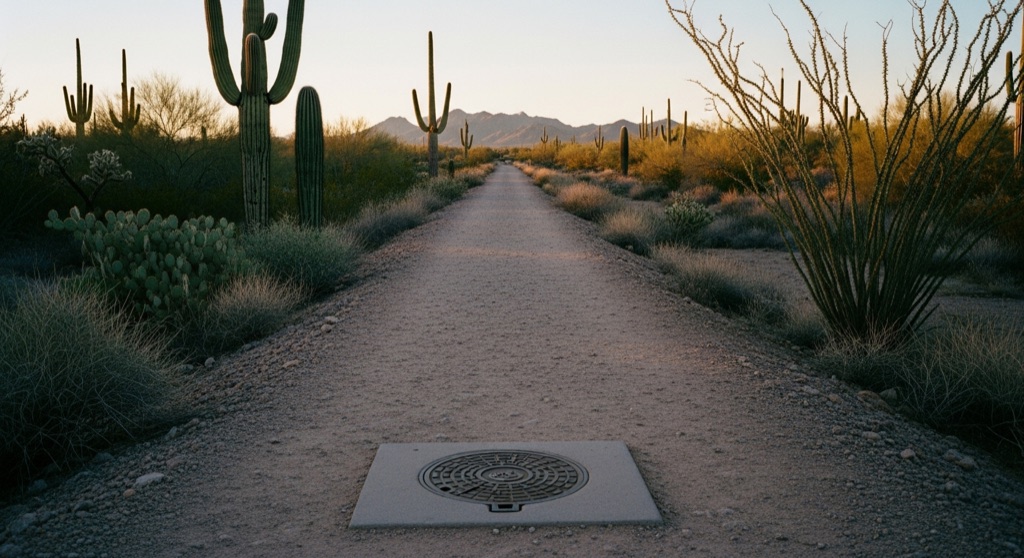
On the night of December 23, 1944 — the breakout wasn't discovered until Christmas Eve — 25 German POWs (a mix of U-boat officers, including six submarine commanders, and enlisted men) escaped through a 178-foot tunnel out of Camp Papago Park, using a volleyball court as their dirt-disposal cover story: the largest Axis POW escape on American soil. A bronze manhole cover set into the Crosscut Canal path, two blocks north of where E Oak St dead-ends, marks the tunnel exit — an escape doomed by blue map lines of the Salt River that turned out to be nearly dry.
→ Three at a time, never the same twice — explore weird Phoenix
The story
On the night of December 23, 1944, twenty-five German prisoners of war—a mix of U-boat crew, enlisted men, and six submarine commanders—crawled through a 178-foot hand-dug tunnel out of Camp Papago Park. To hide the tons of excavated earth coming out of the ground, they used an ingenious cover story: building an official dirt volleyball court in the compound. Camp guards didn't discover the massive hole in their security until Christmas Eve, making it the largest Axis POW escape on American soil.
The escape masterminds had acquired local maps showing blue lines for the Salt River, so they packed homemade folding rafts and gear, planning to float down toward the Gila River and slip across the border into Mexico. What the German naval officers didn't account for was Arizona hydrology. When they reached the riverbank expecting navigable water, they found dry gravel, baked mud, and trickles of water. The river was essentially bone dry, marooning navy captains in the middle of a desert manhunt.
Suburban housing subdivisions swallowed Camp Papago Park in the late 1950s, erasing the camp's barracks, fences, and guard towers. But if you walk the paved path along the Crosscut Canal, two blocks north of where East Oak Street dead-ends, you'll find a single brass monument set right into the trail surface: a bronze marker shaped like a manhole cover, marking the exact spot where the tunnel breached the surface outside the barbed wire.
What it's like
You won't find a visitor center or a docent here—just a quiet stretch of multi-use path running along the Crosscut Canal behind suburban backyard fences. Park at the East Oak Street dead-end, step onto the concrete canal trail heading north, and keep your eyes on the pavement beneath your feet. It's easy to stride right past the flush bronze marker without noticing it. Go around dusk, read the inscription stamped into the bronze, and trace the two-block walk south toward the dry riverbed, imagining 25 U-boat officers dragging useless canvas rafts through the desert brush in the dark.
The move: Walk the Crosscut Canal path at the Oak Street dead-end at dusk, find the bronze marker, and read the inscription aloud — then trace the two-block walk the fugitives actually took toward the water they thought would carry them to Mexico.
- 📍 Crosscut Canal, Papago Park / Scottsdale border
- 💸 $$
- ⚡ Up for anything
- 🌗 Indoors
Where: Crosscut Canal Trail at the E Oak St dead-end, Scottsdale, AZ 85257
Hours: Added 2026-07-19 — confirm current hours before you go.
Pair it with
- El Molino Mexican Cafe at the Scottsdale Elks Lodge (former POW Officers' Club) — This building was Building #40 of Camp Papago Park—the camp's officers' club—making it the closest surviving physical structure from the compound where the escape was staged.
- Hunt's Tomb — Located less than a mile away in Papago Park, this white pyramid sits on a red-rock butte overlooking the desert landscape the escaped POWs tried to navigate.
- Hayden Flour Mill — Standing along the dry Salt River bed down in Tempe, this massive 1918 concrete mill anchors the river stretch that unexpectedly stranded the raft-carrying fugitives.
More weird in Phoenix


Good to know
Where exact is the tunnel marker located?
It is set directly into the surface of the Crosscut Canal Trail, approximately two blocks north of the dead-end at East Oak Street on the Scottsdale and Phoenix border.
Can you go inside or see the escape tunnel?
No. The 178-foot tunnel was collapsed shortly after the escape in 1944, and the land was built over with residential housing in the late 1950s. Only the bronze trail marker remains.
How did the prisoners hide the tunnel dirt from guards?
They got official permission to build a dirt volleyball court inside the camp compound, using the project to haul away, spread, and blend tons of dirt excavated from the tunnel.
What happened to the escapees?
Because the Salt River was dry, their raft plan failed immediately. All 25 escapees were hunted down and recaptured across Arizona over the following weeks.
Plan a visit & invite your people →
Further reading: hmdb.org · wheninyourstate.com · phoenixmag.com · Wikipedia · Atlas Obscura
last checked: 2026-07-19