Entry No. 16 — the Las Vegas file — filed under: folk-art-environment
Goldwell Open Air Museum
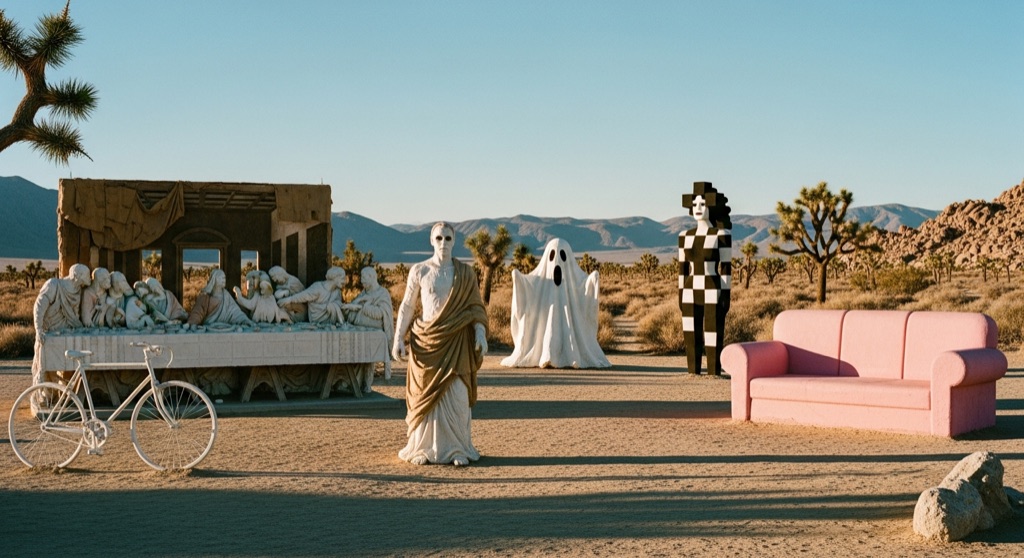
Since 1984, Belgian sculptor Albert Szukalski's ghostly plaster-and-burlap recreation of "The Last Supper" has stood life-sized out in the open desert, next to a cyclist-shaped ghost, a pixelated cinderblock "Venus," and a giant pink concrete couch — a free, unattended, 24-hour sculpture park sitting right beside the crumbling gold-rush ruins of Rhyolite.
→ Three more abandoned & forgotten places in Las Vegas — never the same twice
The story
In 1984, Belgian sculptor Albert Szukalski traveled to the Mojave Desert with a pile of burlap and buckets of wet plaster. He draped live human models in the soaked fabric, waited for the relentless desert sun to bake the shapes rigid, and pulled the living bodies out from underneath—leaving hollow, hood-and-robe shells standing against the dirt. The result was 'The Last Supper,' a cluster of life-sized plaster ghosts frozen under the open Nevada sky.
Over the following decades, other artists added their own odd monuments to the 7.8-acre plot. Hugo Heyrman built a blocky, pixelated cinderblock 'Venus of Nevada.' Fred Bervoets assembled 'Lady Desert,' a bright pink concrete couch resting under the sun. Szukalski returned to add 'Ghost Rider,' a draped white silhouette straddling a bicycle. The entire complex evolved into an unstaffed, open-air gallery sitting right on the periphery of the old Bullfrog Mining District ruins.
What makes Goldwell strange isn't just the white figures staring into the void off Highway 95; it's the complete absence of modern museum control. You walk straight off a dirt pull-off into an unstaffed 24-hour art sanctuary run by a non-profit organization that has kept these fragile hollow forms intact against the wind and heat for four decades.
What it's like
Drive 115 miles north of Las Vegas on Highway 95 until you see white draped forms looming out of the scrubland near Beatty. There are no ticket gates, turnstiles, or guards watching your every move. You park on the dirt shoulder, walk right up to the hollow burlap figures, and listen to the desert wind whistle through their empty torsos. Golden hour hits the plaster best, casting long shadows across the valley floor. Keep an eye out for snakes in the brush, bring water, and plan to walk two minutes down the road afterward to check out Rhyolite's shattered glass-bottle house before driving back.
The move: Wander the sculptures at golden hour, then walk two minutes into Rhyolite for the shattered glass-bottle house and old train depot before the ~2-hour drive back to Vegas — a natural add-on to a Death Valley run.
- 📍 Rhyolite ghost town, near Beatty, NV
- 💸 Free
- ⚡ Up for anything
- 🌗 Outdoors
Where: 1 Golden St, Beatty, NV 89003
Hours: Added 2026-07-20 — confirm current hours before you go.
Pair it with
- Griffith Mine — Trade the sun-bleached burlap ghosts near Beatty for a cool mountain trek to an early 20th-century lead mine hidden in Mount Charleston's pine forests.
- Potosi Mine — Follow up a surreal desert art environment with a trip to Nevada's oldest lode mine, established by Mormon settlers back in 1856.
- Azurite Mine — Double down on desolate mining history by pairing Szukalski's ghostly sculptures with an exploration near Sandy Valley's turn-of-the-century copper and gold workings.
More weird in Las Vegas
Good to know
How much does it cost to visit?
It is completely free and open to the public 24 hours a day, 365 days a year.
How far is the museum from Las Vegas?
It is approximately 115 miles north of Las Vegas along US Highway 95, near the town of Beatty, making it about a two-hour drive.
What else can I see right next to the sculpture park?
The park sits directly at the entrance to the Rhyolite ghost town, where you can explore the historic 1906 bottle house made of glass bottles, old bank ruins, and the historic train depot.
Are there indoor facilities or staff on site?
There is a red visitor barn on the property, but hours vary; the outdoor sculpture grounds themselves are completely unstaffed and self-guided at all times.
Plan a visit & invite your people →
Further reading: Official site · Wikipedia
last checked: 2026-07-20