Entry No. 81 — the Grand Junction file — filed under: after-dark
Grand Mesa Observatory
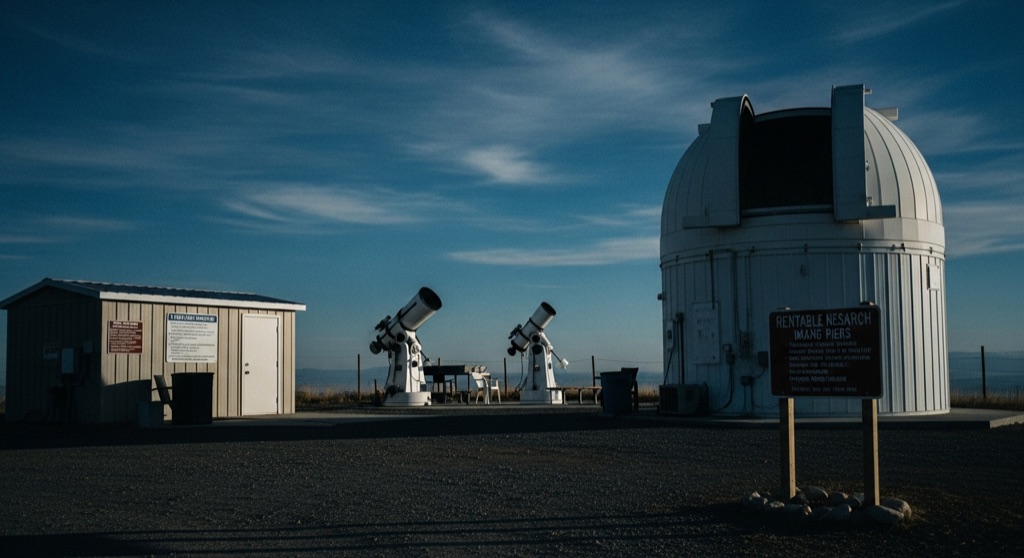
A volunteer-run nonprofit research observatory perched at roughly 6,150 feet on the flank of the Grand Mesa, where the sky hits Bortle-3 darkness barely 30 minutes from downtown Grand Junction. Public nights pair real telescope and astrophotography rigs with rentable imaging piers, and the schedule leans into deep-sky targets like the Lagoon, Trifid, and Eagle Nebulae rather than a quick peek at the Moon. It's a working facility, not a tourist trap: a small donation gets you in, but tickets open only a few weeks ahead of each new-moon weekend and the good slots evaporate fast.
→ Three more after-dark & night-sky spots in Grand Junction — never the same twice
The story
Thirty minutes south of downtown Grand Junction, the pavement gives way to Purdy Mesa Road and the valley's artificial light dies out. At 6,150 feet up the flank of the Grand Mesa, you land in a Bortle-3 dark sky zone—a pitch-black corridor built specifically for serious astrophotography. Grand Mesa Observatory wasn't slapped together as a gift-shop-heavy tourist trap. It's a volunteer-run nonprofit facility founded by hard-core astrophotographers, outfitted with high-end imaging rigs and rentable piers used by deep-sky imagers around the world.
Because it's a working facility, you won't get canned slide shows or a two-second peek at a blurry Moon. The research team works alongside Colorado Mesa University and the U.S. Air Force Academy—meaning you're walking into a venue where students actually clean massive telescope mirrors and collect real astronomical data. On public nights, the instruments target objects light-years deep into space: the swirling, glowing clouds of the Lagoon, Trifid, and Eagle Nebulae.
You won't find crowd control or velvet ropes here. It’s a low-key, high-altitude research outpost that opens its doors to the public on select new-moon weekends, offering a rare look through glass that's usually reserved for deep-space research.
What it's like
You'll drive out into near-total dark along Purdy Mesa Road—don't expect giant neon entrance signs, so trust your odometer. Once parked, step out into crisp high-desert air that plunges in temperature the second the sun disappears (bring heavy winter layers even in July). You'll spend the evening taking turns at eyepiece stations and live astrophotography monitors while volunteer astronomers explain precisely what deep-sky targets you're staring into. The catch is the calendar: ticket slots tie directly to new-moon weekends, drop only four to six weeks in advance, and disappear fast due to strictly limited capacity.
The move: Snag a pair of public-night tickets the morning they post, then spend the evening taking turns at the eyepiece on summer nebulae while an astronomer talks you through what you're seeing.
📍 Before you go Public-night calendar drops only 4-6 weeks ahead and prime weekend slots sell out fast; suggested donation roughly $5-$10. Bring warm layers even in summer at altitude.
- 📍 Whitewater (Purdy Mesa)
- 💸 $
- ⚡ Low-key
- 🌗 Outdoors
Where: 7475 Purdy Mesa Road, Whitewater, CO 81527
Hours: Added 2026-06-23 — confirm current hours before you go.
⚠ Seasonal or scheduled — always check before you go.
Pair it with
- Unaweep Canyon — Pair a night staring into deep space with a daytime drive through the world's only canyon that drains out both ends.
- Palisade Insectary — Contrast an evening of high-tech astrophotography with a daytime tour of Colorado's state-run weed-eating bug factory.
- Colterris Winery Barrel Cave — Go underground inside a hillside cave filled with 250 oak barrels in Palisade before heading up Purdy Mesa for Bortle-3 stargazing.
- Scallywags Bar and Grill — Ground your deep-sky stargazing adventure with a beer and a few rounds of pinball back near Grand Junction.
More weird in Grand Junction
Good to know
How do I get tickets for a public stargazing night?
Tickets post to the observatory's website roughly 4 to 6 weeks before each new-moon weekend. Slots are limited to prevent overcrowding and sell out quickly, with a suggested donation of $5–$10.
What kind of objects will I see through the telescopes?
Instead of basic lunar views, public nights focus on deep-sky targets like the Lagoon, Trifid, and Eagle Nebulae using both direct eyepieces and live-feed astrophotography rigs.
What should I bring to a public event?
Heavy layers, gloves, and warm hats are non-negotiable. At 6,150 feet on an exposed mesa, high-desert temperatures drop rapidly as soon as night falls.
Where is the observatory located?
It is located at 7475 Purdy Mesa Road in Whitewater, Colorado, about a 30-to-40-minute drive from downtown Grand Junction.
Plan a visit & invite your people →
Further reading: Official site · guidestar.org · coloradomesa.edu
last checked: 2026-06-23