Entry No. 177 — the Denver file — filed under: outdoor
Mestaa'ehehe Mountain Fire Lookout
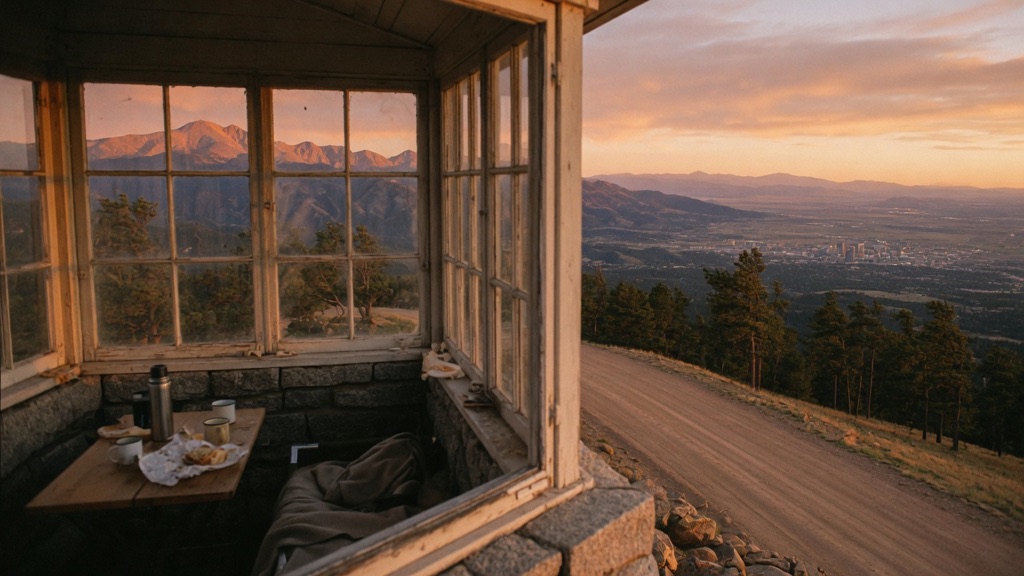
Almost everyone driving CO-103 toward Mount Blue Sky blows right past this one: a squat 14x14 granite cab ringed with windows, built by the CCC in the 1940s, perched at 11,494 feet. There's no flashy trailhead sign, just a dirt pull-off and a service road grinding uphill through the pines. Walk it about two miles and the trees fall away to a 360-degree payoff almost no one earns: Longs Peak and the Front Range, Pikes Peak to the south, downtown Denver glinting on the plains. The real secret is that the tower itself can be rented overnight, a working-feeling fire lookout you can actually sleep in.
→ Three more weird outdoor & roadside oddities in Denver — never the same twice
The story
Most people speeding along Squaw Pass Road toward Mount Blue Sky blow right past the unmarked dirt pullout at Forest Road 192.1. In 1925, Denver built a small 16-by-20-foot cabin near this summit to watch for forest fires threatening its growing system of mountain parks. By 1940, the Civilian Conservation Corps hauled native granite up to 11,494 feet to replace it, constructing a sturdy stone base topped with a 14-by-14-foot wood-and-glass cab surrounded by a timber catwalk. In late 2021, the U.S. Board on Geographic Names officially discarded the peak's former slur of a name, renaming it Mestaa’ėhehe Mountain in honor of Owl Woman, a 19th-century Cheyenne negotiator who mediated peace between Native nations and European settlers on the plains.
What makes this high-altitude roost strange isn't just its survival; it's the weird juxtaposition of historic forest guard post and modern telecommunications hub. Active radio towers hum right alongside the stone tower on the summit. Yet step onto the wooden catwalk and the antenna arrays fade against a 360-degree panorama that sweeps from Longs Peak in the north down to Pikes Peak, with the glass towers of downtown Denver glinting like toy blocks on the eastern horizon.
Instead of letting the cab rot when modern fire detection evolved, the Forest Service wired it directly to the grid. While almost every other historic lookout in the West requires grueling backcountry primitive camping, Mestaa'ehehe is equipped with electric wall heaters, a small refrigerator, a stove, and an incinerating toilet. You're effectively standing inside a functioning 1940s watchtower while wind howls against the glass and your coffee stays hot on an electric burner.
What it's like
Arrive early and pull into the unmarked dirt shoulder along CO-103 across from Echo Mountain. The hike follows a rocky dirt service road roughly two miles uphill through lodgepole pines. The 800-foot elevation gain sounds gentle, but starting above 10,000 feet means your lungs will notice the thin air long before your legs do. Day hikers can walk right up to the catwalk for free, but if you want to sleep inside, you'll need to snag a competitive reservation on Recreation.gov months ahead or stalk the site for last-minute cancellations. Winds up top are ferocious, summer afternoon lightning turns the metal roof into a hazard by 2 p.m., and there is zero running water, so carry in every drop you need. Distant gunfire from nearby forest shooting is normal, so don't panic if you hear popping down in the trees.
The move: Make the walk up the date. It's a wide service road, not a scramble, so you can talk the whole way instead of staring at your feet, and the climb is just hard enough to feel earned. Pack a thermos and something to split, and time it so you crest the last stretch with the light going gold over Denver and the high peaks. Crowd the windows of the old cab, pick out the city you drove out of, and let the wind do the dramatic part. If you want to go all in, reserve the lookout itself and stay the night up there.
📍 Before you go Roughly 4 miles round trip with about 800 feet of gain on a steady dirt service road, no technical sections, but it tops out near 11,500 feet so the altitude makes it feel moderate, not easy. Day-hiking is free with no permit; the road parking is free. The lookout cab itself is a separate, fee-based overnight reservation that books out far ahead (reserve via recreation.gov; assume it's competitive). In summer a high-clearance 4WD can drive FR 192.1 partway; most cars park on CO-103 and walk the whole road. Open year-round, but the practical window for an easy day-hike is roughly late spring through fall. Snow lingers on this aspect well into spring, so microspikes or snowshoes are smart shoulder-season, and winter turns it into a 2-mile snow trek. Real cautions: it's a high, exposed metal-roofed tower, so high winds are common and afternoon lightning is a genuine summer hazard up top, turn back if storms build. Bring all your own water; there is none. Note that recreational shooting is allowed in the surrounding forest, so distant gunfire is normal. (This is the Squaw Mountain lookout, since renamed Mestaa'ehehe, and is a different tower than Devil's Head.)
- 📍 Bergen Park / Clear Creek County (near Evergreen)
- 💸 Free
- ⚡ Up for anything
- 🌗 Outdoors
Where: Unmarked highway pull-off on Colorado 103 (Squaw Pass Rd), west of Bergen Park near the base of Forest Road 192.1, roughly across from Echo Mountain ski area and just before the Chief Mountain Trailhead. From Denver, take I-70 west to Exit 252 (Evergreen Pkwy/CO-74), follow CO-74 through Bergen Park, then turn onto CO-103 (Squaw Pass Rd) and climb several miles to the pullout on the left if coming from the east. In summer, high-clearance 4WD can drive FR 192.1 a mile to a gate; everyone else parks on the highway and walks the road up.
Hours: Day-use, free. Best season: Late spring through fall (summer best for day-hiking; winter needs snowshoes or spikes). Confirm trail & road conditions before you go.
⚠ Seasonal or scheduled — always check before you go.
Pair it with
- Chief Mountain Trail — Chief Mountain Trailhead sits less than a mile down Squaw Pass Road, making it simple to pair both for a double-summit day above 11,000 feet.
- Indian Hot Springs Geothermal Caves — Drop down into Idaho Springs after enduring the freezing winds at the tower to soak in dark, 100-plus-degree mineral caves carved into the rock.
- Edgar Experimental Mine — Head down the mountain into Idaho Springs to tour a real underground working research mine operated by Colorado School of Mines students.
- Charlie Tayler Water Wheel — Stop along Clear Creek in Idaho Springs to see a 30-foot wooden waterwheel built in 1893 by a grizzled miner before taking the pass road back to Denver.
More weird in Denver

Good to know
How do I access the trail and where do I park?
Park at the unmarked dirt pull-off on Colorado Highway 103 (Squaw Pass Road) near the base of Forest Road 192.1, roughly across from Echo Mountain ski area. Walk up the dirt service road approximately two miles to the summit. High-clearance 4WD vehicles can drive one mile up FR 192.1 in summer to a gate, but most visitors park along CO-103 and walk the whole road.
Do I need a permit or fee to hike to the fire lookout for the day?
No. Day-hiking to the summit and viewing the exterior of the lookout is completely free and requires no permits. Fees and reservations are only required if you rent the interior cab overnight.
What amenities are provided inside the overnight lookout rental?
The cab has electric wall heat, an electric stove, a refrigerator, beds, table and chairs, cooking utensils, and an exterior incinerating toilet. There is no running water, so guests must haul in all water for drinking and cleaning, bring sleeping bags, and pack out all trash.
What weather and safety precautions should I take?
Sitting near 11,500 feet, the tower experiences severe winds year-round, and snow lingers well into spring, requiring microspikes or snowshoes. Summer afternoon thunderstorms bring serious lightning risks to this exposed peak, so plan to descend immediately if clouds begin building.
Plan a visit & invite your people →
Further reading: fs.usda.gov · recreation.gov · simplyshauna.com · followtiffsjourney.com · Reddit
last checked: 2026-06-10