Entry No. 152 — the Denver file — filed under: 1893-waterwheel
Charlie Tayler Water Wheel
“a grizzled miner who swore off bathing and kissing as his personal health regimen”
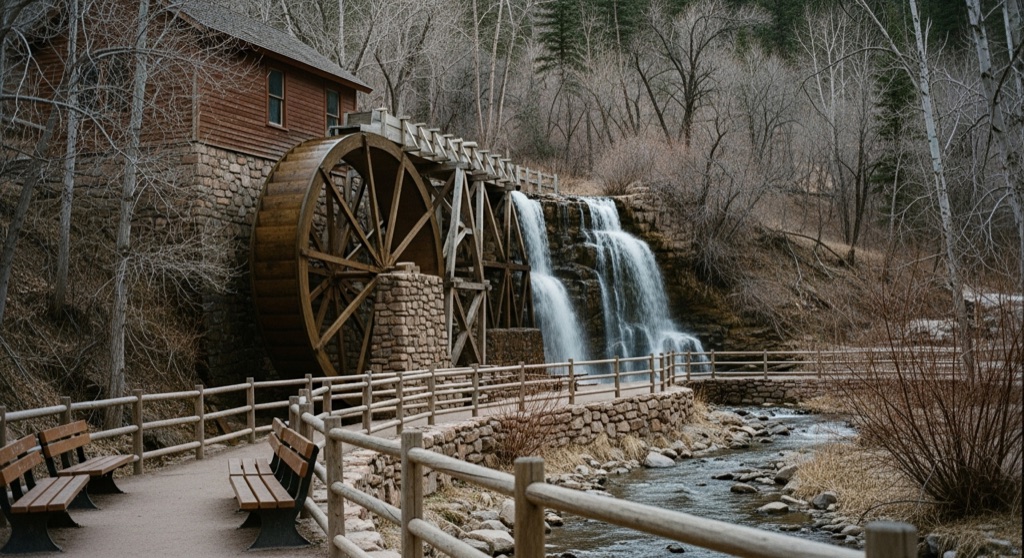
Colorado's largest wooden waterwheel — all 30 feet of it — still turns beside a cascading waterfall, built in 1893 by a grizzled miner who swore off bathing and kissing as his personal health regimen. The wheel is free, accessible year-round, and reached via a short paved path under I-70 from Harold A. Anderson Park.
→ Three more weird outdoor & roadside oddities in Denver — never the same twice
The story
In 1893, a solitary prospector named Charlie Tayler built a 30-foot wooden waterwheel on Ute Creek to power a five-stamp ore mill. Tayler had been obsessed with waterwheels ever since spotting one near Black Hawk as a young man in the 1880s, vowing to build a bigger one himself. He lived alone in a three-room cabin up the creek, working his claim and famously attributing his good health to three non-negotiable habits: he never shaved, he never bathed, and he never kissed a woman.
When Tayler died in an Idaho Springs rooming house in 1939, his estate willed the massive timber structure to the town. In 1946, local officials moved it down to the base of Bridal Veil Falls along Clear Creek, right where motorists on the highway corridor would spot it in their periphery. After weathering decades of mountain ice rot, the wheel stood dormant until 1988, when town volunteers logged nearly 3,800 hours rebuilding it timber by timber before re-dedicating it during Gold Rush Days.
Today, the 30-foot wheel still turns in the splash of Bridal Veil Falls, spinning right beneath four lanes of I-70 concrete overhead. It sits as an odd, surviving piece of 19th-century milling infrastructure—and an accidental monument to one man's lifelong boycott of soap and affection.
What it's like
Expect a quick, odd detour squeezed between mountain geology and interstate concrete. You park behind City Hall off Miner Street and take a flat, 750-foot paved path that leads directly beneath the underbelly of I-70. The rumble of semi-truck brakes overhead quickly gives way to the spray of Bridal Veil Falls and the steady creak of thirty feet of wet wood. You observe the wheel from across Clear Creek at a fenced lookout about 60 feet away—you cannot touch the structure, but the viewpoint gives you an unobstructed look at the cascading water hitting the buckets. The entire stop takes 20 to 30 minutes, placing you right on the edge of downtown Idaho Springs for a pint or lunch.
The move: Park behind Idaho Springs Town Hall, walk the 750-foot paved path under the I-70 overpass to the viewing benches beside Clear Creek, watch the massive wheel churn next to Bridal Veil Falls, then stroll back into town for a meal or a beer at a local spot along Miner Street — the whole stop is free and takes about 30–45 minutes.
📍 Before you go This is a mountain day trip — Idaho Springs sits about 30 miles west of Denver up I-70 (exit 240). Don't trust your map app to the letter; aim for downtown and park in the free lot behind City Hall off Miner Street, or along Water Street, then follow the paved walkway. The route under the interstate is short, flat, and ADA-friendly, so it works in any season, though summer and early fall bring the fullest flow and easiest mountain driving; winter means icy patches and possible chain checks on I-70. There's nothing to buy here, so build the visit around lunch or a brewery crawl on historic Miner Street a block away.
- 📍 Idaho Springs
- 💸 Free
- ⚡ Up for anything
- 🌗 Outdoors
Where: I-70 exit 240, Harold A. Anderson Park, Idaho Springs, CO 80452
Hours: Mined 2026-06-07 — confirm current hours before you go.
Pair it with
- Indian Hot Springs Geothermal Caves — Walk two blocks from the mist of Clear Creek into pitch-dark, 100-plus-degree geothermal rock caves dug into the mountain in the early 1900s.
- Edgar Experimental Mine — Trade Charlie’s 1893 surface machinery for a working underground research mine less than a mile away where engineering students still run drills.
- Underhill Museum — Contrast Charlie Tayler’s bath-free hermit lifestyle with the preserved Victorian home and office of a 19th-century deputy mineral surveyor right in town.
More weird in Denver

Good to know
How much does it cost to visit the waterwheel?
It is completely free. The viewing area sits in a public park and is accessible year-round.
How far is the walk from parking?
It is roughly 750 feet along a flat, paved greenbelt path that runs from the public parking behind City Hall.
Can you walk up and touch the waterwheel?
No. Clear Creek sits between the viewing area and the wheel, keeping visitors at a safe distance of about 60 feet behind a safety fence.
Is the trail accessible for wheelchairs and strollers?
Yes. The paved walkway is level, short, and ADA-friendly year-round, though you should watch for icy patches in winter.
Plan a visit & invite your people →
Further reading: historycolorado.org · Tripadvisor · hmdb.org
last checked: 2026-06-07