Entry No. 115 — the Denver file — filed under: public art
Cold War Horse
“Drivers pass it daily without ever knowing what the red horse is guarding”
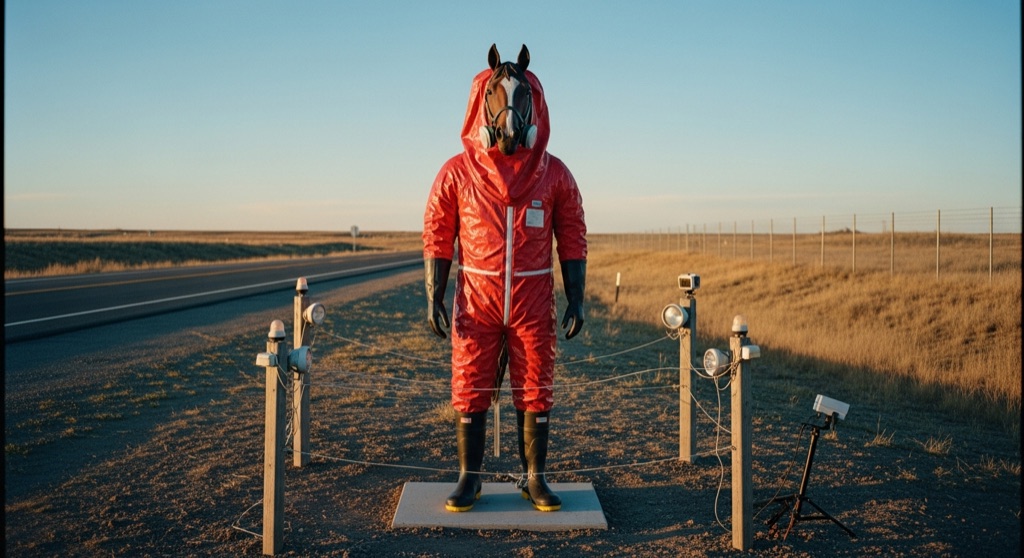
On a lonely stretch of Highway 72 northwest of Denver, a life-size horse stands in an electric-red hazmat suit, black rubber boots and a respirator. Artist Jeff Gipe (whose father worked the plant for 20 years) built it as a memorial to Rocky Flats, the nuclear weapons site beneath your feet that churned out more than 70,000 plutonium triggers for warheads from 1951 to 1989. It was sledgehammered by vandals within two weeks of going up; Gipe rebuilt it in his mother's Arvada garage and added a fence, sensor lights and a camera. Drivers pass it daily without ever knowing what the red horse is guarding.
→ Three more haunted places & dark-history spots in Denver — never the same twice
The story
Drive past the tract homes of the Candelas development along Highway 72, and on a grassy rise just west of Indiana Street, you will spot a life-size horse clad in an electric-red hazmat suit, black rubber boots, and a gray respirator. It is not a prank. It is a privately funded alarm bell. Artist Jeff Gipe—whose father spent two decades working inside the nearby Rocky Flats plant—built the fiberglass, steel, and resin sculpture in 2015 to ensure nobody forgets what sits in the dirt beneath their feet. Between 1951 and 1989, the federal facility churned out more than 70,000 plutonium warhead triggers, leaving behind radioactive fires, unregulated waste burials, and a 1989 FBI-EPA raid that shuttered the plant for environmental crimes.
Gipe spent two years going door-to-door across Jefferson County before property owners Bruce and Janice Roberts agreed to let him place the sculpture on their land along Coal Creek Canyon Road. Within two weeks of going up in late summer 2015, someone rammed the horse with a vehicle and attacked its flank with a sledgehammer. Gipe hauled the broken piece back to his mother's garage in Arvada, spent months restoring it, and brought it back—this time encased in a security fence rigged with motion-sensor floodlights and cameras.
Today, the red horse stares out at commuters heading into new subdivisions built on the periphery of the former Superfund site, while right next door, the Rocky Flats National Wildlife Refuge offers public hiking trails over ground where locals still fiercely debate how clean the soil actually is. Beside the horse, an engraved stone slab outlines the plant's toxic legacy alongside memorial plaques. It stands as a middle finger to local amnesia: a silent, suit-clad sentinel guarding a secret everyone in power wanted buried.
What it's like
Arriving feels like pulling off the highway into a solitary geopolitical watchpost. You will crest the rise on Highway 72, spot the fiery red suit standing out against the dry prairie grass, and have to pull off quickly onto the dirt shoulder—there is no parking lot or visitor center here. The vibe is stark and wind-whipped off the Front Range. If you get too close to the wire enclosure, you will trigger the security setup. Visit during golden hour when the red suit catches the setting sun, read the stone plaque through the fence, and then drive two minutes down Indiana Street to the Rocky Flats National Wildlife Refuge Greenway trailhead if you want to see the contested open space up close.
The move: Drive out at golden hour for the eerie roadside photo op, then read the plaque together and talk about the Cold War history hidden under the open space around you.
📍 Before you go The horse stands on the south side of Highway 72 (Coal Creek Canyon Road) on a low rise just west of Indiana Street, near the Candelas subdivision—easy to blow past at highway speed, so slow as you crest the hill. There's no formal lot; pull onto the shoulder well clear of traffic and view it from the road. It's fenced with motion-sensor lights and a camera after earlier vandalism, so admire it from outside the fence and don't climb in. Daylight or golden hour is best, and there are no facilities out here. Pair it with the free Rocky Flats National Wildlife Refuge, whose Greenway trailhead sits just off Indiana Street—the former plutonium-plant site, now open space with a contested past (some still debate the cleanup, so it's a fitting companion).
- 📍 Arvada / Rocky Flats
- 💸 Free
- ⚡ Low-key
- 🌗 Outdoors
Where: South side of Highway 72 (Coal Creek Canyon Rd), just west of Indiana St near the Candelas development, Arvada area, CO
Hours: Roadside sculpture, viewable anytime; best in daylight. No facilities; pull off safely on Hwy 72.
Pair it with
- National Wildlife Property Repository — Pair a roadside warning about nuclear weapons history with a federal warehouse full of seized illegal wildlife contraband, both housed on former toxic military grounds.
- Cheesman Park Pavilion & Its Buried Dead — Follow up a monument to buried plutonium history with a visit to a leafy Denver park where 2,000 forgotten 19th-century graves still sit beneath the grass.
- Riverside Cemetery History & Mystery Tours — Trade a modern atomic memorial for Denver's oldest, most neglected burial ground to experience two very different sides of local history.
- Manhattan Beach Historical Marker — Swap a hazmat horse warning about Rocky Flats for a overlooked shorefront marker commemorating Denver's forgotten 1880s amusement park.
More weird in Denver

Good to know
How do I get to Cold War Horse and where do I park?
The horse stands on the south side of Highway 72 (Coal Creek Canyon Road), just west of Indiana Street near the Candelas neighborhood in Arvada. There is no official parking lot, so slow down as you crest the hill and pull safely off onto the dirt shoulder.
Why is the sculpture fenced in with security cameras?
Two weeks after artist Jeff Gipe installed the sculpture in 2015, vandals rammed it with a vehicle and struck it repeatedly with a sledgehammer. Gipe repaired the horse in his mother's Arvada garage and reinstalled it with a fence, motion-sensor lights, and cameras to protect it.
Can I touch or walk right up to the horse?
No. The horse is inside a locked security fence on private property with active motion sensors and cameras. You can view it, photograph it, and read the stone memorial plaque clearly from outside the fence.
Are there restrooms or visitor facilities at the site?
No. It is an unstaffed roadside artwork on a highway shoulder with no restrooms, water, or public facilities.
Plan a visit & invite your people →
Further reading: Atlas Obscura · Roadside America · 9news.com · denvergazette.com · Westword
📷 We made a card for this one on Instagram →
last checked: 2026-06-07