Entry No. 117 — the Denver file — filed under: hidden-landmark
National Eagle Repository
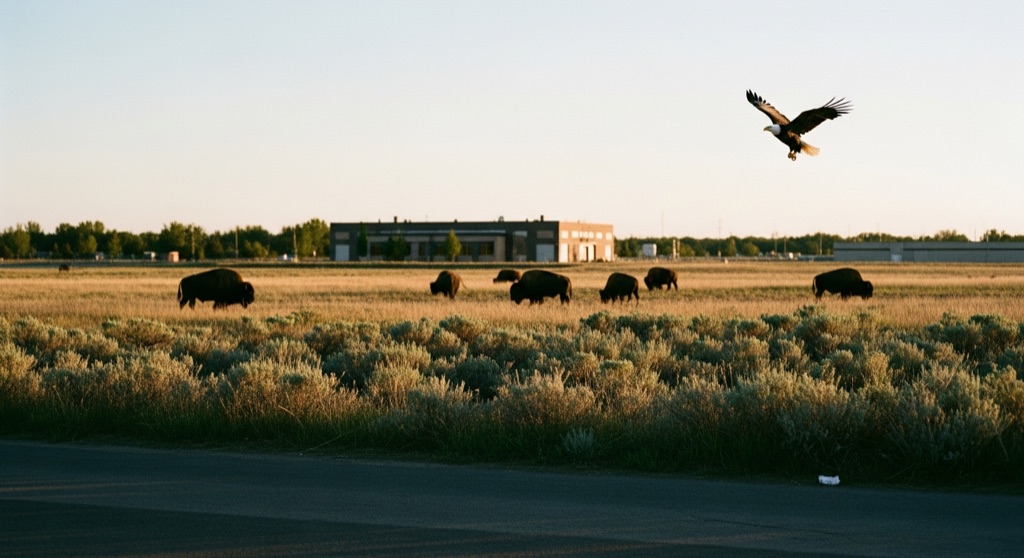
Inside the Rocky Mountain Arsenal National Wildlife Refuge sits a nondescript federal building that is the only place in the entire country where dead bald and golden eagles are legally collected and redistributed. Enrolled members of federally recognized tribes wait years on a list for feathers shipped from this one Commerce City address for religious and ceremonial use — a quiet, almost unknown piece of national infrastructure 20 minutes from downtown Denver. You can't tour the repository itself (it's USFWS law enforcement), but you can drive the refuge it hides in, where live bald eagles and a bison herd roam a former chemical-weapons arsenal turned wildlife sanctuary.
→ Three more unusual museums & collections in Denver — never the same twice
The story
Under the 1940 Bald and Golden Eagle Protection Act, picking up an eagle feather off a hiking trail in America is technically a federal crime. To reconcile strict wildlife laws with Native American religious practices, the U.S. Fish and Wildlife Service created a strange piece of government logistics in 1974. Today, every dead bald or golden eagle found anywhere in the country—whether struck by a semi-truck in Wyoming, electrocuted on a power line in Oregon, or salvaged by state game wardens—gets packed into a box and shipped to one exact address: Building 128 inside Commerce City's Rocky Mountain Arsenal.
In 1994, President Bill Clinton signed an executive order requiring all federal agencies to route dead eagles directly to this single clearinghouse. Inside the nondescript law-enforcement building, specialists in protective coveralls and blue latex gloves unpack frozen carcasses, inspect beak-to-tail condition, count individual wing feathers, and enter each bird into a central database. From there, enrolled members of federally recognized tribes wait on multi-year queues to legally receive whole birds, wings, or feathers shipped to their doors for sacred ceremonial use.
What makes the location deeply surreal is where the federal government hid it. The repository sits inside a 15,000-acre former World War II and Cold War chemical weapons manufacturing plant that once produced mustard gas and incendiary munitions. Today, the toxic soil has been capped, and live bald eagles roost in the lakeside cottonwoods right outside the secret federal vault where thousands of their dead brethren pass through stainless-steel examination tables.
What it's like
You won’t get inside Building 128—it’s an active U.S. Fish and Wildlife Service law enforcement facility with no public tours, no front-door sign, and zero tolerance for drop-ins. Instead, pull off Gateway Road, park free near the visitor center, and take the 11-mile Wildlife Drive auto loop. Tune into the mile-marker audio tour at golden hour, scan the shortgrass prairie for bison herds and black-tailed prairie dogs, and watch for live bald eagles in the trees while knowing you're driving past the country's central dead-eagle repository.
The move: Do the free 11-mile Wildlife Drive auto loop at the Arsenal at golden hour — scan for the bald eagles and bison — then trade the strange-but-true fact that the nation's entire eagle-feather supply runs through one building on this exact refuge.
📍 Before you go The repository is a closed USFWS law-enforcement building — no tour, no sign — so don't expect to see it; the real draw is the refuge it hides inside, about 20 minutes northeast of downtown Denver. Reach it off Quebec Street: east on Prairie Parkway, then north on Gateway Road to the entrance, and park free near the visitor center. The 11-mile Wildlife Drive auto loop takes roughly an hour and has an audio tour keyed to mile markers. Winter brings the most bald eagles, roosting in lakeside cottonwoods, while the bison herd is visible year-round. Pair it with an easy walk around Lake Ladora, and remember the gate closes at dusk — check seasonal hours ahead.
- 📍 Commerce City
- 💸 Free
- ⚡ Low-key
- 🌗 Indoor or outdoor
Where: Inside Rocky Mountain Arsenal National Wildlife Refuge, Commerce City, CO (repository is a non-public USFWS building on refuge grounds; refuge visitor center near 6550 Gateway Rd)
Hours: Repository itself is NOT open to the public (no tours). Surrounding Rocky Mountain Arsenal NWR is free: refuge open sunrise-sunset (to 8pm May 1-Aug 1); visitor center Wed-Sun 9am-4pm, closed federal holidays.
Pair it with
- National Wildlife Property Repository — Housed inside the exact same federal facility building, this sister warehouse stores over 1.2 million seized contraband items from the illegal global wildlife trade, from elephant tusks to taxidermied tigers.
- 88 Drive-In Theatre — Just under three miles away in Commerce City, you can transition straight from a dusk bison-spotting loop to Denver metro's last original 1970s drive-in cinema.
- Forney Museum of Transportation — Five miles south down Brighton Boulevard, swap federal contraband vaults for a giant 70,000-square-foot industrial hall packed with over 800 vintage vehicles.
- Riverside Cemetery — Drive four miles southwest to explore Denver's oldest cemetery, established in 1876 and now marooned among industrial rail yards along Brighton Boulevard.
More weird in Denver
Good to know
Can I tour the National Eagle Repository building?
No. The repository is a closed U.S. Fish and Wildlife Service law enforcement building with no public tours, signage, or walk-in access. However, you can visit the surrounding Rocky Mountain Arsenal National Wildlife Refuge, which is free and open daily.
How do dead eagles end up at the Commerce City facility?
Federal and state wildlife agents, rehabilitation centers, zoos, and power companies across the country are legally required to ship salvaged eagle carcasses—mostly victims of power line electrocutions, vehicle strikes, or natural deaths—directly to Building 128.
Who receives the eagle feathers and parts?
Enrolled members of federally recognized Native American tribes apply through a federal permit system to legally receive whole eagle carcasses, wings, talons, or feathers for religious and ceremonial practices.
What are the hours and costs for visiting the refuge?
Entrance to the Rocky Mountain Arsenal National Wildlife Refuge is completely free. Grounds are open daily from sunrise to sunset (closing at 8 p.m. May 1 through August 1). The visitor center operates Wednesday through Sunday from 9 a.m. to 4 p.m.
What is the history of the surrounding refuge site?
Before becoming a wildlife sanctuary, the 15,000-acre refuge was a major U.S. Army chemical weapons facility during World War II and the Cold War, later designated an EPA Superfund site before being remediated into a nature reserve.
Plan a visit & invite your people →
Further reading: Atlas Obscura · smithsonianmag.com · fws.gov
📷 We made a card for this one on Instagram →
last checked: 2026-06-07