Entry No. 38 — the Denver file — filed under: history
Manhattan Beach Historical Marker
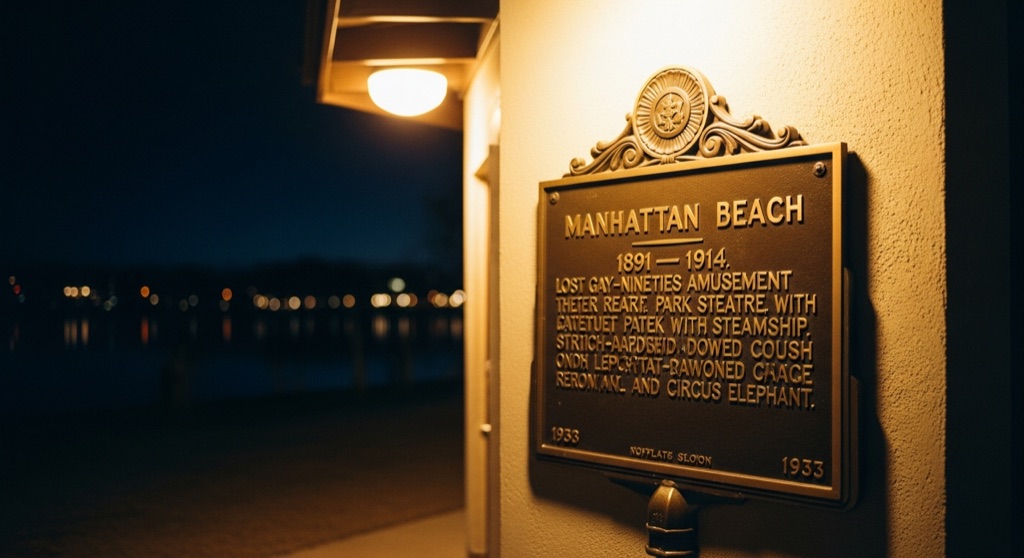
Thousands of people loop Sloan's Lake every week and walk straight past a 1953 bronze plaque bolted to the north-shore restroom building. It marks Manhattan Beach, a Gay-Nineties amusement park that ran 1891-1914 with a theater, a steamship, an ostrich-drawn coach, even a circus elephant -- and left essentially zero physical trace. The theater burned in 1908 and the rest faded by 1914, so the plaque is basically the only evidence it was ever real. If you don't know it's there, it just blends into the wall.
→ Three more haunted places & dark-history spots in Denver — never the same twice
The story
Every weekend, thousands of runners, dog walkers, and strollers circle Sloan's Lake along the 2.6-mile paved path, completely oblivious to what sits at eye level on the southwest corner of the north-shore restroom building. Bolted low to the brick masonry is a dark 1953 bronze plaque erected by the State Historical Society of Colorado and the city. It marks the ghost of Manhattan Beach, a sprawling Gay Nineties amusement complex that once dominated this shoreline with a theater, dance hall, roller coaster, steamship cruises, and exotic animal rides—and then vanished without leaving a single brick behind.
Opened on June 27, 1891, Manhattan Beach was West Denver's premier Gilded Age pleasure ground. Visitors arrived by streetcar, boat, and wagon to ride an ostrich-drawn coach, watch hot-air balloon ascensions, or take rides on Rajah (nicknamed Roger), a circus elephant that famously panicked during an early season run. The park offered steamship rides across the lake and hosted a grand theater until a midwinter fire wiped out the stage on December 26, 1908. Though briefly rebranded as Luna Park, competition and bad luck took their toll, and the remaining attractions faded out entirely by 1914.
Today, there are no charred timbers, rusted tracks, or dock piers sticking out of the water to hint that Denver's first lakeside amusement park ever stood here. The 1953 bronze plaque is literally the only physical evidence left on site. If you don't know to look down at the bathroom wall while passing on the lakeside trail, you'll walk right past a lost chapter of Denver history without a second glance.
What it's like
Approaching from the lakeside trail on the north shore is key—if you come from the parking lot side, you'll be staring at the wrong wall. Look low on the southwest corner of the brick boathouse/restroom building, facing the trail and the water. Sloan's Lake Park gets packed on summer weekends with crowded parking lots near Sheridan Boulevard and West Byron Place, so aiming for a quiet weekday morning or early afternoon gives you room to scan the wall in peace. Read the plaque's lost-park history, then do the flat, 2.6-mile loop around the shoreline to take in the downtown skyline across the water.
The move: Find the plaque on the lake's north-shore bathroom building, read the lost-park history off it, then walk the shore picturing where the steamship and elephant were while you loop the lake.
📍 Before you go The plaque sits on the southwest corner of the building, facing the trail and water, so approach from the lakeside path rather than the parking-lot side and scan low on the wall. The biggest lots are at the park's northwest corner near Sheridan Boulevard and West Byron Place, a short walk away. This is one of Denver's busiest parks; on summer weekends the lots fill fast, so a weekday or earlier arrival is calmer. Pair it with the flat, paved roughly 2.6-mile loop around the lake, which opens up downtown-skyline views from the eastern shore.
- 📍 Sloan's Lake
- 💸 Free
- ⚡ Low-key
- 🌗 Outdoors
Where: Mounted on the Sloan's Lake north-shore bathroom/boathouse building (SW corner of the structure), Sloan's Lake Park, Denver, CO
Hours: Outdoor marker in a public park; accessible any time, best in daylight. The restroom building it's mounted on is on the lake's north shore.
Pair it with
- Highland Park / Scottish Village Historic District — Continue exploring West Denver's hidden urban layout by wandering the curving, non-grid street pattern of Highland Park just northeast of Sloan's Lake.
- Lumber Baron Inn & Gardens — Head a few minutes northeast into Highland to see an ornate 1890 Queen Anne mansion built during the exact era Manhattan Beach opened.
- Cheesman Park Pavilion & Its Buried Dead — Pair a public park built over a vanished 1890s amusement ground with another city park built directly on top of Denver's forgotten first cemetery.
- Oxford Hotel Room 320 — Head east into LoDo to visit Denver's grand 1891 hotel, built the very same year Manhattan Beach welcomed its first crowds.
More weird in Denver

Good to know
Where exactly on the building is the historical marker?
The bronze plaque is mounted low on the southwest corner of the Sloan's Lake north-shore bathroom/boathouse building, directly facing the walking path and the lake.
What were the operating dates of Manhattan Beach?
The park opened on June 27, 1891. Its main theater burned down on December 26, 1908, and after a short run as Luna Park, all remaining attractions closed by 1914.
Is there any cost or ticket needed to visit the plaque?
No, it is located in a free public city park and is accessible 24 hours a day, though daylight hours are best for reading the inscription.
Where is the best place to park when visiting?
The largest public parking lots are located at the northwest corner of Sloan's Lake Park near Sheridan Boulevard and West Byron Place, just a short walk from the north-shore building.
Are there any physical ruins or structures from Manhattan Beach left in the park?
None above ground. The 1953 bronze plaque mounted on the restroom wall is the sole surviving physical marker of the park left on the lake shore.
Plan a visit & invite your people →
Further reading: hmdb.org · cpr.org · Wikipedia
last checked: 2026-06-07