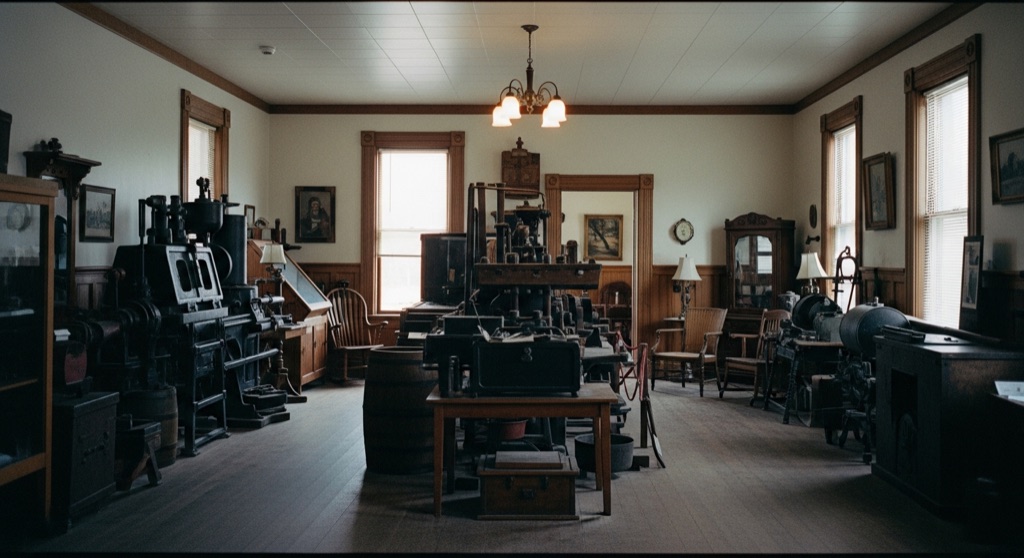
Entry No. 38 — the Coeur d'Alene file — filed under: offbeat-museum
Shoshone County Mining & Smelting Museum (Staff House Museum)
Housed in the 1906 mansion built for Stanley Easton, general manager of the Bunker Hill & Sullivan mine, this three-floor museum packs more than a dozen exhibits mixing hard-rock mining and smelting artifacts with the domestic life of an early-20th-century company-town manager. It's a quirky historic-house museum where ore-processing gear sits a room away from period parlors.
→ Three at a time, never the same twice — explore weird Coeur d'Alene
The story
In 1906, the Bunker Hill & Sullivan Mining & Concentrating Company raised a Colonial Revival mansion on McKinley Avenue for its general manager, Stanley Easton. You aren't just standing in a manager's home; this was the quiet command post for the region's dominant industrial giant. When Easton moved his family to Coeur d'Alene in 1923, the company kept the property, using it as guest quarters and housing for unmarried staff—which is how it earned the name 'Staff House.' In 1940, company engineers literally jacked the entire structure off its foundation and moved it 300 feet east down the street just to clear space for another manager's residence.
When the Bunker Hill operations finally shut down in 1981 after nearly a century of extracting silver, lead, and zinc from the Silver Valley, the mansion sat abandoned and unheated. Demolition crews were ready to tear it down until a group of local residents bought the building for $1.00 in 1986 and began converting it into the Shoshone County Mining & Smelting Museum. What makes the space jarring is its split personality: you step out of period residential parlors directly into rooms crammed with heavy ore-processing gear, mine time books, and rock specimens.
Across three floors and more than a dozen exhibit rooms, the house holds the domestic remnants of executive living right alongside the gritty machinery of underground labor. Out in the back yard, sitting on concrete pads, is a 100-year-old, 73.5-ton Nordberg air compressor salvaged from the mine complex, preserved above ground alongside hundreds of commemorative bricks.
What it's like
Expect a self-guided, highly detailed walk through three floors of dense Silver Valley history where vintage wallpaper and formal parlor trim collide with heavy industrial mine artifacts. Volunteers with deep ties to local mining history run the desk, and you'll spend your time browsing old company archives, mineral specimens, and smelting tools. The catch is that the museum operates seasonally (generally late spring through early fall), so call ahead to verify they are open before making the drive out to Kellogg.
The move: Tour the old manager's mansion floor by floor, then walk Kellogg's quirky 'Smelterville'-era downtown and find the gondola base for a view over the Silver Valley.
📍 Before you go About 36 miles east in Kellogg; seasonal hours, so confirm it's open (call 208-786-4141) before the drive.
- 📍 Kellogg
- 💸 $
- ⚡ Up for anything
- 🌗 Indoors
Where: 820 McKinley Ave, Kellogg, ID 83837
Hours: Added 2026-06-24 — confirm current hours before you go.
Pair it with
- Crystal Gold Mine — Pair the executive house museum with an actual underground tour of an 1880s hard-rock mine located just two miles away in Kellogg.
- Sunshine Miners Memorial — Follow up the corporate manager's history at the Staff House with a four-mile trip to pay respects at the site honoring the 91 men lost in the 1972 Sunshine Mine disaster.
- The Snake Pit (Enaville Resort) — Balance the company town manager's mansion tour with a meal at an 1880 boomtown tavern and former railroad layover six miles down the valley.
- Last Chance Mine — Visit the site of the historic 1885 mine less than two miles away that helped fuel the silver boom managed from this very house.
More weird in Coeur d'Alene
Good to know
Where is the museum located and how do I contact them?
The museum is located at 820 McKinley Ave in Kellogg, Idaho. You can contact them by phone at 208-786-4141.
What are the operating hours?
The museum runs on seasonal hours (typically open Wednesday through Sunday from 11 a.m. to 4 p.m. during the summer season), but hours vary, so you should call ahead to confirm before visiting.
Why is it called the Staff House?
After original occupant Stanley Easton moved his family in 1923, the mine manager's residence was converted into quarters for unmarried Bunker Hill Company staff and visiting company executives.
Has the building always been at 820 McKinley Avenue?
No, it was originally built 300 feet west at 912 McKinley Ave in 1906 and was physically relocated to its present address in 1940 to make room for a new general manager's home.
Plan a visit & invite your people →
Further reading: Official site · idahoheritagetrust.org · visitidaho.org · spokesman.com
last checked: 2026-06-24