Entry No. 72 — the Coeur d'Alene file — filed under: mine
Last Chance Mine
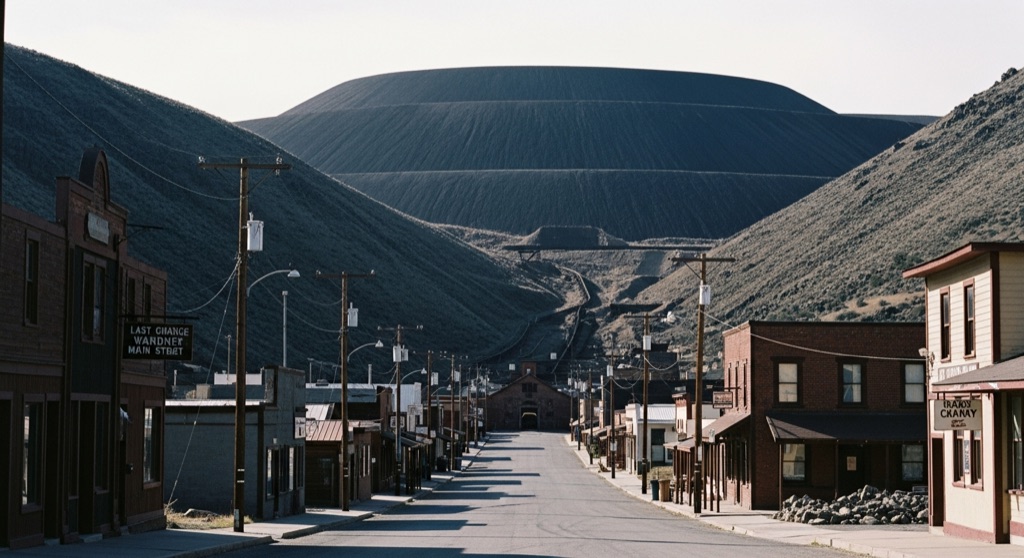
Discovered in 1885, the Last Chance Mine was a prolific silver and lead producer in Idaho's historic Silver Valley before being acquired by the Bunker Hill Company in 1910. Today, the extensive underground workings are sealed and flooded, and the historic surface structures have been dismantled. The site has been heavily reclaimed under the Bunker Hill Superfund program, leaving a massive capped tailings pile visible at the end of Wardner's Main Street.
→ Three more abandoned & forgotten places in Coeur d'Alene — never the same twice
The story
In 1885, prospectors struck a rich lead and silver vein in the narrow canyon above Wardner, naming it the Last Chance Mine. For twenty-five years, it was one of the Silver Valley’s most aggressive producers—and one of its most bitterly contested properties, locked in subterranean claim disputes with its giant neighbor, the Bunker Hill & Sullivan Mining Company. Before Bunker Hill swallowed Last Chance whole in a 1910 stock deal, this canyon was a violent labor battleground. In April 1899, union miners protesting non-union wage undercutting and company spies hijacked a train from Burke, packed it with dynamite, and detonated Bunker Hill's nearby concentrator mill right down the slope.
You won’t find standing headframes or decaying wooden ruins sitting out in the open here. Decades of heavy metal extraction left vast quantities of toxic tailings across the canyon, prompting massive environmental remediation. Under the Bunker Hill Superfund program, historic surface structures were dismantled and the underground workings were permanently sealed and flooded to contain heavy-metal drainage.
What looms at the end of Wardner’s Main Street is an engineered earthwork: a massive, smoothed-over capped tailings mound sitting right where public pavement terminates against the gulch. Millions of tons of silver and lead waste lie buried beneath that contoured grass cap. Standing at the end of the asphalt looking up, you're staring at the literal burial cap of the mine that ignited Idaho's industrial labor wars.
What it's like
Driving up Wardner’s narrow canyon road feels like entering a town clinging to the steep gulch walls. At the far end of Main Street, the public road ends directly before the fenced reclamation boundary, giving you an unobstructed view of the capped tailings mound. There are no docents, gift shops, or interpretive center plazas—just quiet canyon streets terminating at an environmental containment area. Obey all private property fences and no-trespassing postings, photograph the site strictly from the public road right-of-way, and pair your stop with a drive through Wardner to see the layout of the historic mining gulch.
The move: Take a scenic drive through the historic canyon town of Wardner, stopping to photograph the massive capped tailings pile at the end of Main Street and reading about the area's dramatic 1899 mining riots.
📍 Before you go The underground workings are sealed and the mine site is private property undergoing Superfund reclamation, but the capped tailings pile can be safely viewed from public roads.
- 📍 Wardner
- 💸 Free
- ⚡ Low-key
- 🌗 Outdoors
Where: Last Chance Mine, Wardner, ID 83837, USA
Hours: Added 2026-07-20 — confirm current access before you go.
Pair it with
- Shoshone County Mining & Smelting Museum (Staff House Museum) — Located 1.4 miles away in Kellogg, this museum occupies the 1906 mansion built for Stanley Easton, general manager of the Bunker Hill company that acquired Last Chance in 1910.
- Crystal Gold Mine — Just 2.4 miles away, this restored 1880s underground mine lets you walk into real hard-rock shafts similar to the sealed tunnels at Wardner.
- Sunshine Miners Memorial — A 4.3-mile drive brings you to this memorial honoring the 91 men killed in the 1972 Sunshine Mine fire, capturing the lethal reality of Silver Valley underground work.
- The Snake Pit (Enaville Resort) — End your trip 5.9 miles away at Idaho's oldest restaurant, an 1880s riverfront bar where Silver Valley miners historically drank.
More weird in Coeur d'Alene
Good to know
Can you enter the Last Chance Mine underground workings?
No. The subterranean workings are sealed and flooded for safety and environmental containment, and the mine property is private.
Where is the best place to safely view the site?
You can safely view the massive capped tailings mound from public roads at the end of Main Street in Wardner.
Why was the site capped under the Superfund program?
Decades of lead and silver production left toxic heavy-metal waste behind. The Bunker Hill Superfund program dismantled contaminated surface structures and capped the tailings pile to prevent runoff.
What was the Last Chance Mine's connection to the 1899 mining riots?
The mine operated in Wardner during the violent labor clashes of 1899, when striking miners commandeered a train loaded with dynamite and blew up the neighboring Bunker Hill mill.
Plan a visit & invite your people →
Further reading: westernmininghistory.com · Wikipedia · lib.uidaho.edu
last checked: 2026-07-20