Entry No. 37 — the Chicago file — filed under: outdoor-weird
Montrose Point Bird Sanctuary (The Magic Hedge)
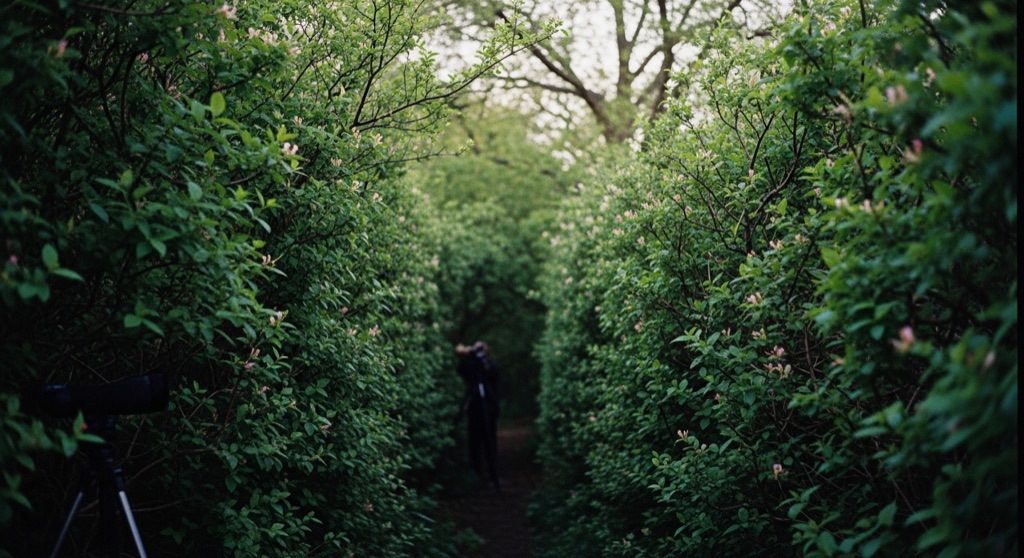
A 150-yard tangle of shrubs and trees on a lakefront point that draws an absurd density of migratory birds, over 300 species recorded here including vagrants like Painted Bunting and Kirtland's Warbler. The hedge is an accident of history: the Army planted honeysuckle in the mid-1900s to screen barracks, then left, and the invasive growth became a world-class birding magnet. On a good migration morning it is crowded with birders training scopes on a wall of leaves.
→ Three more weird outdoor & roadside oddities in Chicago — never the same twice
The story
During the Cold War, the U.S. Army decided a landfill peninsula jutting into Lake Michigan was an ideal spot for a Nike missile installation. To hide their barracks and radar gear from civilian eyes on Lake Shore Drive, soldiers planted a dense screen of non-native honeysuckle. When the military pulled out in the 1970s, they razed the barracks but left the sprawling, unkempt shrubbery behind.
Exhausted songbirds making nocturnal flights along the lakefront flyways saw a lone green oasis on a heavily urbanized shore and dropped straight into the cover. Local birders noticed that a ridiculous density of migratory species was squeezing into this 150-yard thicket, dubbing it 'The Magic Hedge.' Over 300 species have been recorded at Montrose Point—including rare vagrants like the Kirtland's Warbler and Painted Bunting—turning a forgotten Cold War camouflage screen into one of the Midwest's top birding magnets.
What it's like
Arrive at dawn during May spring migration, and you'll run into a quiet crowd of hyper-focused locals with telephoto lenses and high-end spotting scopes trained on a wall of leaves. Bring your own optics—without binoculars you're just staring at bushes, but with them you'll spot warblers flitting inches away. Free street parking along Simonds Drive fills quickly on warm mornings. Midsummer and winter are dead quiet by comparison, though the offshore harbor holds wintering waterfowl if you can take the bitter lake wind.
The move: Borrow binoculars and walk the Magic Hedge at dawn during spring migration to spot warblers most Chicagoans never notice.
📍 Before you go Best during spring and fall migration; far quieter (and birdless) midsummer and winter.
- 📍 Uptown / Lincoln Park lakefront
- 💸 Free
- ⚡ Up for anything
- 🌗 Outdoors
Where: 4400 N Simonds Dr, Chicago, IL 60640
Hours: Added 2026-06-23 — confirm current hours before you go.
⚠ Seasonal or scheduled — always check before you go.
Pair it with
- Graceland Cemetery and Arboretum — Head 1.6 miles west to swap living, migrating songbirds for Victorian monuments and quiet canopy trees where Chicago's historic titans rest.
- Woolly Mammoth Antiques & Oddities — Drive two miles west into Andersonville after your morning in nature to inspect taxidermy and preserved specimens in a crammed curiosity shop.
- Music Box Theatre Midnight Movies — Combine a dawn birding trek along the lake with a late-night cult film under a 1929 movie palace's simulated twilight sky, under two miles inland.
More weird in Chicago

Good to know
When is the best time of year to go?
Spring (especially May) and fall migration offer the highest density of birds. Arrive around dawn when incoming migrants drop in to rest and feed.
Why is it called 'The Magic Hedge'?
Birders coined the name in the 1970s because songbirds seemed to magically materialize out of nowhere inside the 150-yard honeysuckle hedge left behind by the military.
Is there an entry fee or ticket required?
No. The sanctuary is part of Lincoln Park, maintained by the Chicago Park District, and is free and open daily from dawn to dusk.
What birds have been spotted here?
More than 300 species have been documented, ranging from dozens of warbler species and sparrows to rare sightings like the Painted Bunting and Kirtland's Warbler.
Plan a visit & invite your people →
Further reading: Wikipedia · chicagoparkdistrict.com · chicagobirdalliance.org · birdinghotspots.org
last checked: 2026-06-23