Entry No. 39 — the Chicago file — filed under: outdoor-weird
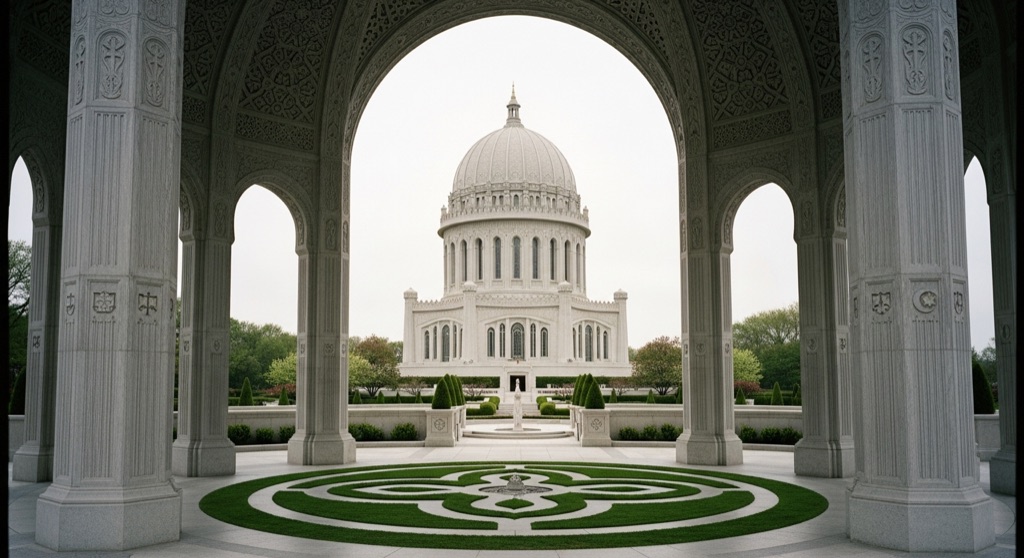
Bahá'í House of Worship Gardens
A white temple that rises 190 feet over Lake Michigan, its lacework dome looking like carved stone. The concrete is mixed with quartz so the whole structure quietly shimmers, and it stands on nine sides with nine doors, ringed by nine fountains and formal gardens. Look close at the pillars: the cross, the Star of David, the star and crescent and more sit side by side. It is the oldest surviving Bahá'í House of Worship in the world, and one of only a handful on the planet.
→ Three more weird outdoor & roadside oddities in Chicago — never the same twice
The story
If you drive north along Sheridan Road past Evanston, a bone-white, lacework dome suddenly looms over the suburban tree line like an ornate space vessel docked beside Lake Michigan. This is the oldest surviving Bahá'í House of Worship on Earth and the only one in North America. Designed by French-Canadian architect Louis Bourgeois and dedicated in 1953 after four decades of delays brought on by two world wars and the Great Depression, the sanctuary stands 190 feet tall. To get its pale, luminescent surface, concrete specialist John Earley ground up white quartz stone and blended it with white Portland cement, molding precast panels that glisten under direct sunlight and catch the glow of interior lights after dark.
Walk around the exterior columns and you'll find an understated piece of architectural subversion. Carved into the concrete pillars, sitting side by side, are the Christian cross, the Jewish Star of David, the Islamic star and crescent, and other ancient religious symbols—a physical manifestation of the Bahá'í principle that all major faiths stem from a single divine source. The entire complex is organized around the number nine, considered the digit of completion and unity. Nine main pillars support the structure, leading to nine outer doors, nine fountain basins, and nine symmetrical garden quadrants sprawling across seven acres.
A lesser-known piece of local lore: during World War II, military pilots training out of the nearby Glenview Naval Air Station relied on the shimmering, unfinished dome rising off the lakefront as a primary visual landmark for practice runs over Lake Michigan, referring to it in flight logs as 'Point Oboe.' Today, the temple remains one of the Midwest's most singular structures—a hand-carved, quartz-infused concrete sculpture hidden in plain sight between quiet Wilmette streets and the lake shore.
What it's like
Expect a remarkably serene, highly disciplined environment where sound carries. Start at the Welcome Center near the main parking lot for construction models and historical context, then head up the monumental stairs to the grounds. The nine gardens are meticulously landscaped with seasonal floral arrangements, reflecting pools, and benches, though Lake Michigan breezes right across Sheridan Road can make the outdoor paths chilly. Inside the auditorium, the vibe shifts instantly into complete silence: there are no altars, icons, or organ pipes, just a soaring vault of carved lace and natural light. Photography and loud talking are strictly banned inside the sanctuary hall. For the best visual payout, visit near twilight on a summer evening—the white quartz exterior holds the dying sunlight before the indoor floodlights turn the dome into a glowing lantern.
The move: Stroll the nine symmetrical garden quadrants beneath the lace-like dome, then sit in the quiet of the temple interior.
- 📍 Wilmette
- 💸 Free
- ⚡ Up for anything
- 🌗 Outdoors
Where: 100 Linden Ave, Wilmette, IL 60091
Hours: Added 2026-06-23 — confirm current hours before you go.
Pair it with
- Dearborn Observatory (Northwestern University) — Trade one lakefront dome for another by heading 1.3 miles south to gaze through a historic 18.5-inch refractor telescope inside Northwestern's 1888 limestone observatory.
- Armadillo's Pillow — Continue your search for quiet knowledge four miles south in Rogers Park, where floor-to-ceiling shelves hold rare books on Eastern philosophy, history, and the occult.
- Malliway Bros. Magic & Witchcraft — Pivot from sacred universal architecture to hands-on European folk magic at this shop under five miles away stocking custom spell oils and herbal roots.
- Leaning Tower of Niles — Follow up one suburban architectural oddity with another six miles west to see a 94-foot half-scale replica of Pisa's leaning tower complete with a seven-foot tilt.
More weird in Chicago

Good to know
Is it free to visit the Bahá'í House of Worship?
Yes. Admission to the sanctuary, the Welcome Center, and all nine surrounding gardens is entirely free.
Can I take photographs inside the temple?
No. Photography, video recording, and phone use are strictly prohibited inside the silent auditorium hall, though you are free to photograph the building exterior and gardens.
Is visitor parking available on site?
Yes. There is a dedicated free parking lot on the grounds near the Welcome Center, accessible off Linden Avenue.
Why is the building designed around nine sides, nine doors, and nine gardens?
In Bahá'í scripture, the number nine is the highest single digit and symbolizes completeness and unity. The nine entrances represent welcoming visitors from all directions and backgrounds.
Plan a visit & invite your people →
Further reading: Wikipedia · bahai.us · architecture.org · Atlas Obscura · Reddit
last checked: 2026-06-23