Entry No. 40 — the Chicago file — filed under: outdoor-weird
Indian Boundary Park
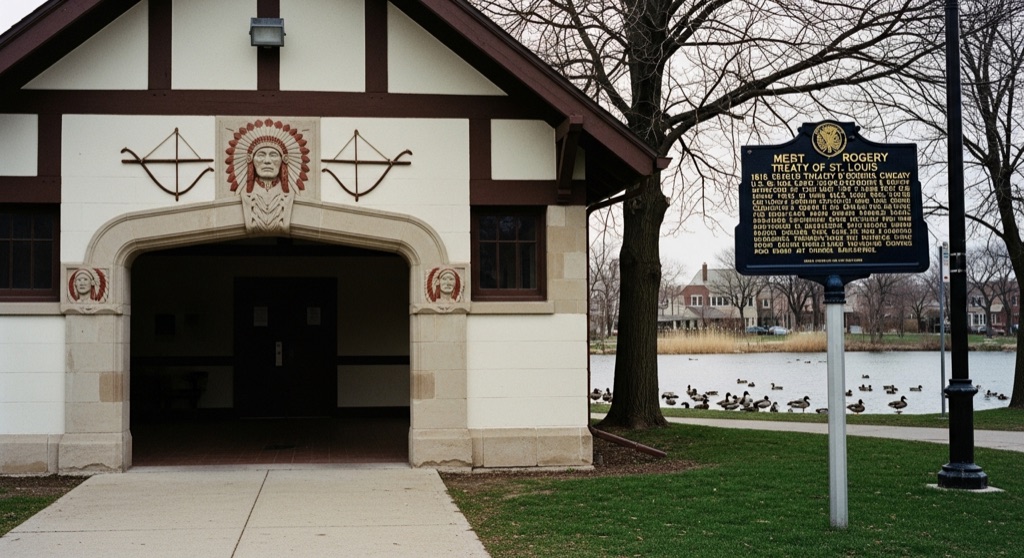
A small Tudor-revival park in West Ridge whose 1929 field house is studded with eccentric details: a carved Indian-chief keystone over the entry, Indian-head reliefs on the walls, and banquet-hall chandeliers shaped like drums strung with bows and arrows. The park sits on the 1816 Treaty of St. Louis boundary line, where the U.S. took the land that became much of Chicago. A couple miles east, a plaque marking that same boundary at Clark and Rogers now sits oddly half-hidden behind a traffic-control box. A duck-filled lagoon and restored natural area round out the strangeness.
→ Three more hidden bars & speakeasies in Chicago — never the same twice
The story
Before Chicago was organized into a grid of brick two-flats, it was split by an invisible line. In the 1816 Treaty of St. Louis, the U.S. government extracted a 20-mile-wide strip of land from the Potawatomi, Ottawa, and Chippewa tribes—a corridor linking Lake Michigan to the Illinois River that effectively handed over the territory that became Chicago. Rogers Avenue still follows the diagonal native trail that marked that boundary. If you follow Rogers two miles east to Clark Street, you'll find the city’s official 1937 bronze plaque commemorating the treaty—except you’ll have to peek around a bulky traffic-control box that the city installed directly in front of it.
At 2500 West Lunt, the boundary line cuts straight through Indian Boundary Park, where architect Clarence Hatzfeld erected a Tudor Revival field house in 1929. The building is a strange study in architectural appropriation. Over the main entry, a carved stone Native chief’s head serves as the keystone. Indian-head reliefs are embedded directly into the exterior brickwork, and if you step into the auditorium, you'll look up at custom chandeliers forged to resemble rawhide drums strung with brass bows and arrows. It’s an eerie, highly specific period piece of 1920s civic myth-making frozen in plaster and timber.
The rest of the 13-acre park carries its own odd quirks. For nearly ninety years, it housed a small neighborhood zoo that started in the 1920s with a single black bear before morphing into a home for goats and ducks until its closure in 2013. Today, the duck lagoon and prairie-restoration island are bordered by lawns that flow directly into the unfenced front yards of surrounding homes, giving the park the uncanny feel of a private estate.
What it's like
Visiting feels less like hitting a typical city park and more like slipping into a quiet, mid-century residential pocket that forgot what century it is. Start by examining the carved stone reliefs on the field house facade, then loop the lagoon to watch the ducks around the prairie island. Because the field house functions as an active Chicago Park District cultural center, interior spaces like the auditorium are only accessible during scheduled classes or community events—so check the schedule before you go if you want a look at the bow-and-arrow chandeliers. Afterwards, take a five-minute drive east to the corner of Clark and Rogers to hunt down the utility-box-hidden treaty plaque.
The move: Hunt down the carved Native American details on the old field house, then loop the lagoon and find the boundary-line story.
- 📍 West Ridge
- 💸 Free
- ⚡ Up for anything
- 🌗 Outdoors
Where: 2500 W Lunt Ave, Chicago, IL 60645
Hours: Added 2026-06-23 — confirm current hours before you go.
Pair it with
- Malliway Bros. Magic & Witchcraft — Head 1.4 miles east to stock up on folk-magic herbs and hand-blended spell oils from a shop run by two practitioner brothers.
- Armadillo's Pillow — Head northeast to browse an eccentric selection of rare paperbacks, occult studies, and psychology texts stacked floor to ceiling.
- George Bangs Tree-Trunk Grave, Rosehill Cemetery — Drive under two miles south to hunt for a tombstone carved as a dead tree trunk featuring a miniature stone railway mail car.
- Chicago Industrial Arts & Design Center (CIADC) — Swap historic architecture for hands-on heavy craft at this nearby non-profit makerspace inside a converted warehouse.
More weird in Chicago
Good to know
Where was the original Indian Boundary Line?
The line ran diagonally through modern-day Chicago along the path of Rogers Avenue, marking the northern border of a 20-mile-wide strip ceded in the 1816 Treaty of St. Louis by the Potawatomi, Ottawa, and Chippewa tribes.
Can I go inside the field house to see the chandeliers?
You can enter the field house during regular park district operating hours, but access to the main auditorium holding the drum-and-arrow chandeliers depends on whether classes, performances, or community meetings are in session.
Is there still a zoo at Indian Boundary Park?
No. The park's historic mini-zoo, which operated from the 1920s until 2013 and once housed a black bear and farm animals, was permanently closed, with its surviving animals transferred to Lincoln Park Zoo.
How do I find the hidden boundary plaque at Clark and Rogers?
Head to the northeast corner of Clark Street and Rogers Avenue. The 1937 bronze marker is mounted on the wall, partially concealed directly behind a green electrical traffic-control box.
Plan a visit & invite your people →
Further reading: rpwrhs.org · Wikipedia · blockclubchicago.org · chicagoparkdistrict.com · chicagomonuments.org
last checked: 2026-06-23