Entry No. 59 — the Chicago file — filed under: after-dark
Dearborn Observatory (Northwestern University)
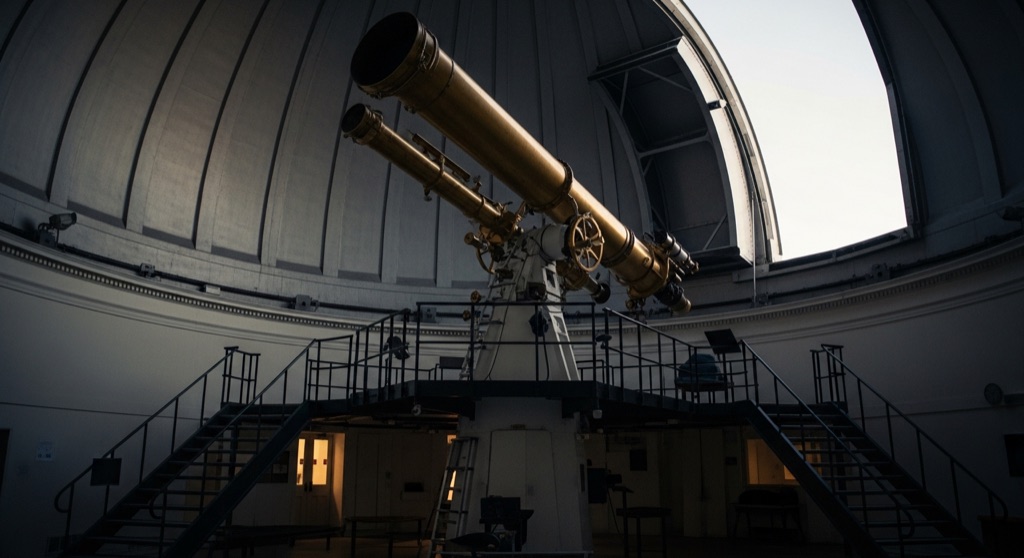
Inside a domed 1888 limestone building on Northwestern's lakefront campus lives an 18.5-inch refractor that was once among the largest in the world. Every Friday night the dome cranks open and physics and astronomy volunteers walk small groups up several staircases to look through the antique brass-and-glass instrument, free of charge, rain or shine. The dome has no heat or air conditioning, so the experience changes dramatically with the season.
→ Three more after-dark & night-sky spots in Chicago — never the same twice
The story
The 18.5-inch lens inside this Richardsonian Romanesque limestone dome was never supposed to end up in Illinois. Originally commissioned in 1860 for the University of Mississippi, the glass was left stranded in Massachusetts when the Civil War broke out. The Chicago Astronomical Society bought the lens in 1863 for $18,187, bringing home what was then the largest refracting telescope lens on the planet—the exact optic lens maker Alvan Clark Jr. looked through when he discovered Sirius B, the white dwarf companion star to Sirius. When the original Old University of Chicago folded in the late 1880s, Northwestern inherited the instrument and built a slate-roofed stone home for it on the Evanston campus in 1888.
The building itself wasn't allowed to stay put, either. In the summer of 1939, engineers placed the entire 2,000-ton limestone structure on rollers and jacked it 100 yards south to make room for the massive Technological Institute next door, moving the delicate glass without cracking a single stone. Today, the antique Alvan Clark lens remains in active service, operating as an 1880s optical masterpiece sitting right in the middle of a modern research campus.
What it's like
Arrive on a Friday night at the edge of the lakefront campus, where physics and astronomy graduate students guide small groups up multiple flights of staircases into the unheated dome. Because air currents from indoor heat would distort the glass optics, the dome is unconditioned; you will feel every degree of Chicago's season, so dress accordingly. During the first hour, reserved visitors take turns looking through the brass-and-glass instrument as a host rotates the dome overhead to target Saturn's rings, Jupiter's moons, or deep space objects. If thick clouds block the view, the team pivots to an architectural and historical tour of the dome and its massive mechanical gears.
The move: Reserve the early Friday hour, climb up to the historic refractor together, and let a grad student point it at whatever is highest in the sky that night.
📍 Before you go Free Friday nights (9-11pm spring/summer, 8-10pm fall/winter); first hour is reservation-only. Not ADA-accessible due to staircases. Cloudy nights still run as building tours.
- 📍 Evanston
- 💸 $
- ⚡ Low-key
- 🌗 Outdoors
Where: 2131 Tech Dr, Evanston, IL 60208
Hours: Added 2026-06-23 — confirm current hours before you go.
⚠ Seasonal or scheduled — always check before you go.
Pair it with
- Bahá'í House of Worship Gardens — Pair an evening look through Dearborn's historic lens with an afternoon walk around this towering 190-foot quartz-and-concrete temple just 1.3 miles north.
- Armadillo's Pillow — Browse the stacks for esoteric paperbacks and vintage astronomy books before heading north to see real stars through an 1880s glass refractor.
- Malliway Bros. Magic & Witchcraft — Trade physical star charts for folk magic remedies and herb blends at this Rogers Park shop before peering into deep space.
More weird in Chicago
Good to know
How much does it cost to visit Dearborn Observatory?
Public Friday night viewing sessions and tours are completely free of charge.
Do I need a reservation to view through the telescope?
Reservations are required for the first hour of Friday viewing (9–10pm spring/summer, 8–9pm fall/winter). The second hour (10–11pm spring/summer, 9–10pm fall/winter) is open to walk-ins on a first-come, first-served basis.
What happens if it rains or is cloudy on Friday night?
Sessions run rain, shine, or cloud cover. If stargazing isn't possible due to weather, student guides lead building and telescope tours inside the historic dome instead.
Is the observatory accessible for visitors using wheelchairs?
No. Reaching the telescope dome requires climbing several flights of stairs inside the historic 1888 building, making it non-ADA accessible.
Why is there no heating or air conditioning inside the dome?
The dome interior must match the outside temperature so warm air doesn't spill through the dome opening and distort the telescope's optical view.
Plan a visit & invite your people →
Further reading: Official site · Wikipedia · enjoyillinois.com
last checked: 2026-06-23