Entry No. 29 — the Charleston file — filed under: colonial history
The Powder Magazine
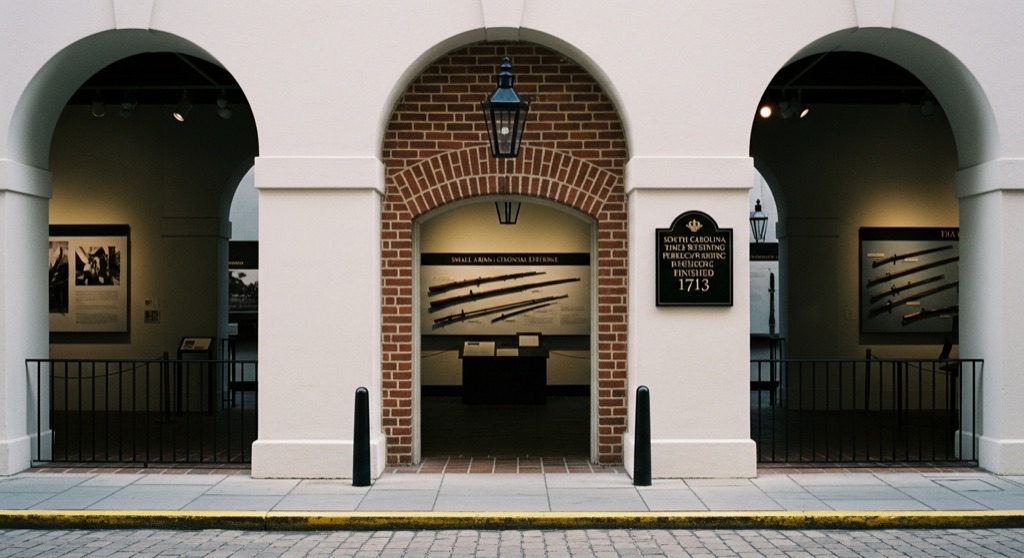
South Carolina's oldest surviving public building (finished 1713) was purpose-built to store gunpowder, with three-foot stuccoed walls and arches engineered to blow the roof off, not the walls, if the magazine ever detonated. It later did time as a wine cellar for a Huguenot merchant family before the Colonial Dames turned it into a one-building, one-subject museum on gunpowder, defense, and the colony's near-constant fear of the French and Spanish.
→ Three more unusual museums & collections in Charleston — never the same twice
The story
In 1713, Charles Town was a deeply paranoid walled enclave squeezed onto a low peninsula, constantly looking over its shoulder for Spanish warships, French fleets, Blackbeard's blockades, and internal revolts. Storing five tons of black powder inside the town limits was necessary for defense, but it presented a terrifying design dilemma: how do you hoard ten thousand pounds of high explosives in the middle of a wooden city without eventually vaporizing yourself? The solution was a 27-by-27-foot bunker at 79 Cumberland Street with three-foot-thick stuccoed brick walls and a roof engineered to direct total annihilation upward instead of sideways.
The physics were grimly calculated. If an accidental spark set off the arsenal, the 32-inch-thick side walls were built to hold steady while the blast shot straight out through the roof. To finish the job, tons of loose sand packed into the roof vaulting would instantly pour downward into the inferno, smothering the fire before it could leap across the street grid. The system was never actually triggered—during the 1780 siege of Charleston, General William Moultrie quietly smuggled 10,000 pounds of powder out of the magazine and hid it behind a false brick wall at the Exchange before the British took the city.
When the military finally retired the building after the Revolution, South Carolina's oldest public structure didn't turn into a monument—it went into trade. Throughout the 19th century, it operated as a print shop, a horse stable, a blacksmith forge, and a subterranean wine cellar for the Huguenot merchant Manigault family, who found the thick, windowless brick ideal for aging prized Madeira. By 1902, developers were ready to tear the structure down, but the Colonial Dames stepped in, purchased the property in Charleston's first intentional historical rescue, and preserved it as a one-room shrine to colonial defense and citywide paranoia.
What it's like
Squeezed onto Cumberland Street between Church and Meeting, the building looks like a heavy, red-tiled brick bunker that the rest of modern Charleston simply grew around. Step through the low doorway and you are standing inside a single 27-foot square room under a vault that once held enough explosive force to wipe out the neighborhood. It is an easy, 20-to-30-minute stop where you can inspect colonial small arms, examine period uniforms, and get a quick lesson from docents on how an 18th-century town organized its architecture around not blowing itself to pieces.
The move: Duck into the low brick doorway between Church and Meeting, read the small-arms and colonial-defense exhibits inside the original magazine, then compare notes on how a city once organized its whole street grid around not blowing itself up.
- 📍 Downtown Charleston
- 💸 $
- ⚡ Up for anything
- 🌗 Indoors
Where: 79 Cumberland Street, Charleston, SC 29401
Hours: Added 2026-07-20 — confirm current hours before you go.
Pair it with
- Circular Congregational Church Graveyard — Walk two minutes south to explore 1690s slate gravestones that predate the powder magazine in Charleston's oldest surviving cemetery.
- Old Slave Mart Museum — Head a block east to visit the last standing 1859 indoor slave auction gallery, another single-subject look into the city's heavy history.
- Confederate Museum at Market Hall — Walk a short block north to Market Hall to see another focused, single-room relic museum run out of a historic 19th-century space.
- Scotty Doesn't Know Speakeasy — Cut over to East Bay Street to wash down 18th-century military defense history with a cocktail hidden behind a candy shop's drink fridge.
More weird in Charleston


Good to know
How was the building engineered to survive an internal explosion?
The magazine was constructed with 32-inch-thick stuccoed brick walls designed to force explosive energy upward through the roof, while tons of loose sand packed into the roof vaulting were intended to collapse inward and smother the fire.
Did the Powder Magazine ever detonate?
No, the blast-containment design was never put to the test, and during the Revolutionary War siege of 1780, 10,000 pounds of gunpowder were secretly moved to a false cellar wall at the Exchange before the city surrendered.
What was the building used for after it stopped storing gunpowder?
Following its military retirement after the Revolution, it served as a print shop, carriage house, blacksmith shop, horse stable, and a wine cellar for the Huguenot merchant Manigault family's Madeira collection.
How long does a visit take?
Because the museum consists of a single 27-by-27-foot historical chamber with colonial defense artifacts and small-arms displays, most visits take between 20 and 30 minutes.
Plan a visit & invite your people →
Further reading: Wikipedia · postandcourier.com · Official site
last checked: 2026-07-20