Entry No. 1 — the Charleston file — filed under: oddities
The Charleston Museum — Early Days Gallery
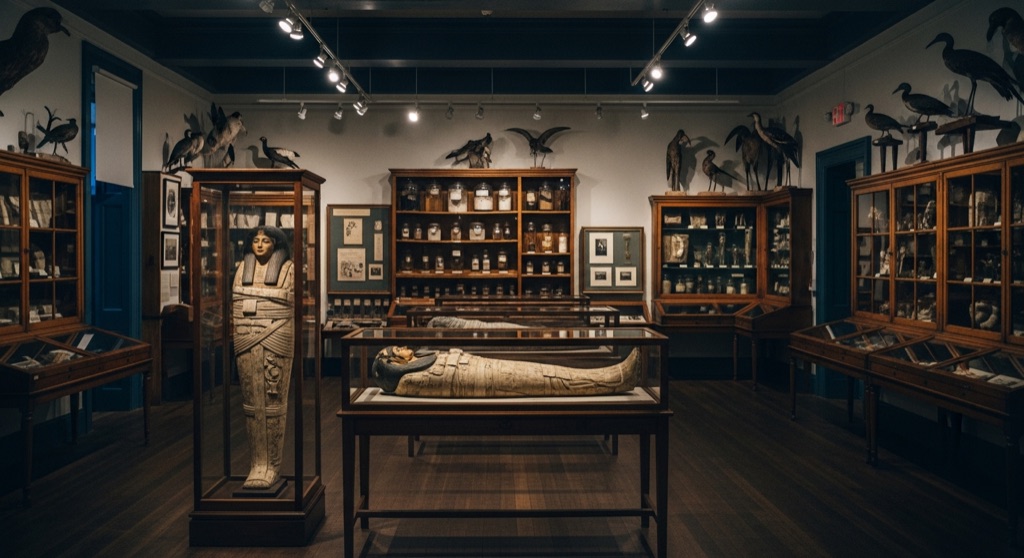
Tucked past the Charleston silver and Revolutionary War galleries of America's first museum (founded 1773) is the deliberately old-fashioned Early Days gallery: a real Roman-period Egyptian mummy (acquired 1893), 19th-century natural-history specimens preserved in jars, and cabinet-of-curiosities displays evoking the museum's earliest decades.
→ Three at a time, never the same twice — explore weird Charleston
The story
When the Charleston Library Society founded America’s first museum in 1773, the mission wasn't just documenting South Carolina—it was building a global window to the world. For over a century, curators snapped up whatever exotic oddities sea captains, naturalists, and diplomats dragged back to port. But in the late 20th century, the museum narrowed its primary focus to Lowcountry history, leaving a century of global hoarding marooned. Rather than sell or stash the loot, curators walled off the upstairs Early Days gallery as a living fossil of 19th-century museum culture, keeping its low lighting, glass vitrines, and unabashed cabinet-of-curiosities layout intact.
You didn't hear it from us, but the objects inside feel like they were lifted straight from a Victorian trade post. Case after case holds preserved oddities: a two-headed snake, 19th-century biological specimens floating in spirit jars of rum, narwhal tusks, a Hawaiian grass helmet acquired in the 1790s, and plaster casts of ancient Egyptian monuments. The centerpiece is the 'Lady of Cairo'—a mummified Egyptian woman from roughly 700 to 300 BCE. Museum curator Gabriel Manigault bought her in 1893 for $200 from an American vice-consul who acquired her near Cairo. To prove the corpse wasn't a papier-mâché scam before handing over the cash, buyers crudely sliced away her facial wrappings, leaving her bare skull visible behind glass to this day.
What it's like
Tucked away on the second floor past the silver showcases and Revolutionary War displays, the Early Days gallery instantly drops the room temperature from formal civic history to dim, dusty curiosity shop. It is quiet and compact, meaning you can stand inches from the mummy case or peer at the two-headed snake without elbowing through tour groups. The room opens directly into the Bunting Natural History Gallery next door, where giant Megalodon jaws, a 13-foot ground sloth skeleton, and extinct bird taxidermy pick up where the jarred specimens leave off. Expect to spend 30 to 45 minutes wandering both spaces, and confirm current operating hours online before heading to Meeting Street.
The move: Wander the low-lit Early Days gallery together hunting for the two-headed snake and the mummy case (nicknamed the "Lady of Cairo," bought by the museum for $200 in 1893), then walk over to the Bunting Natural History Gallery next door for its bird and animal taxidermy mounts before splitting a dessert downtown.
- 📍 Downtown Charleston / Museum Mile
- 💸 $$
- ⚡ Up for anything
- 🌗 Indoors
Where: 360 Meeting Street, Charleston, SC 29403
Hours: Added 2026-07-20 — confirm current hours before you go.
Pair it with
- The Waring Historical Library — Pair the museum's 19th-century jarred specimens with MUSC's rare medical library, home to vintage surgical kits, amputation tools, and historical oddities less than a mile away.
- Macaulay Museum of Dental History — Double down on vintage medical oddities by visiting this single-room university collection featuring a fully reassembled 19th-century dental operator's office.
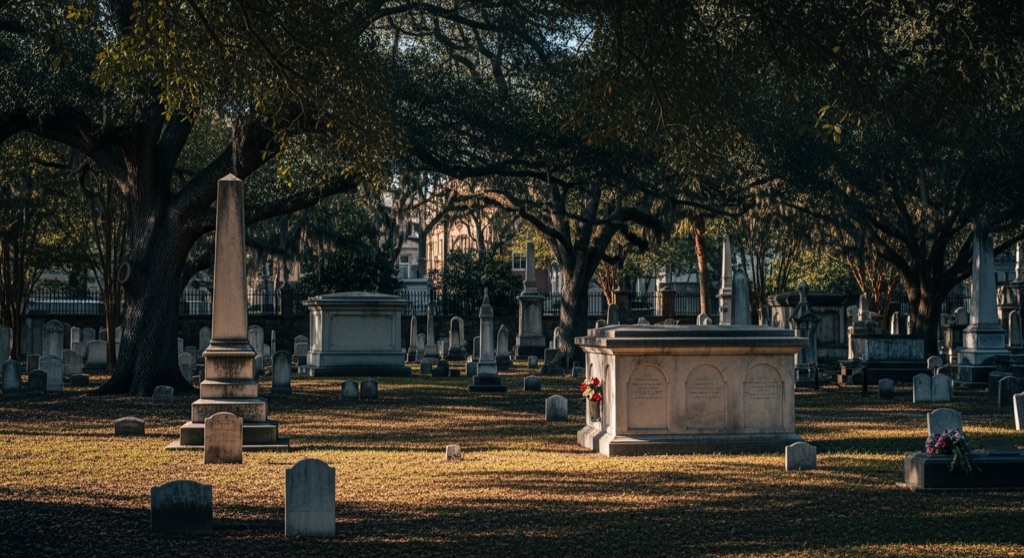
- Coming Street Cemetery — Trade indoor cabinet curiosities for outdoor 18th-century stone history at the oldest Jewish burial ground in the American South, located just a few blocks southwest.
- Halsey Institute of Contemporary Art — Contrast the dim, old-world macabre of 1800s taxidermy and mummies with free, rotating contemporary art exhibitions just a short walk down Meeting Street.
More weird in Charleston
Good to know
Where inside the museum is the Early Days gallery?
It is located on the upper level of The Charleston Museum (360 Meeting Street), situated past the historic silver and war history exhibits.
Who is the mummy in the glass case?
Historically nicknamed the 'Lady of Cairo,' she is an Egyptian woman (dating between 700 and 300 BCE) purchased by curator Gabriel Manigault in 1893 for $200. Her facial wrappings were cut away at the time of sale to confirm human remains were inside.
What other oddities are on display in the room?
The gallery features a two-headed snake specimen, fluid-preserved animals in 19th-century jars, a 1790s Hawaiian grass helmet, narwhal tusks, and plaster casts of Egyptian sculpture like Rameses II.
How much time should I plan for the visit?
Exploring the Early Days gallery takes about 15 to 20 minutes, though pairing it with the adjacent Bunting Natural History gallery adds another 20 to 30 minutes.
Plan a visit & invite your people →
Further reading: Official site · sites.udel.edu · mummies.com
last checked: 2026-07-20