Entry No. 10 — the Charleston file — filed under: cemetery
Coming Street Cemetery
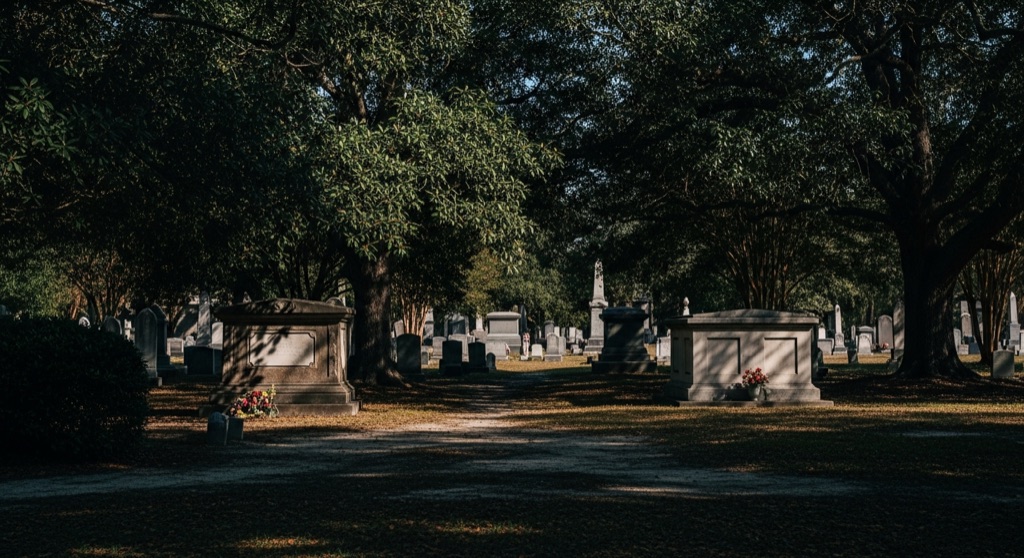
Founded in 1762 and walled behind locked iron gates, this quarter-acre is the oldest Jewish burial ground in the American South — Sephardic headstones from colonial Charleston's earliest Jewish families, kept from new burials for over a century except for the few remaining family plots.
→ Three at a time, never the same twice — explore weird Charleston
The story
In 1762, Charleston’s Sephardic Jewish community established this quarter-acre plot at 189 Coming Street, making it the oldest Jewish burial ground in the American South. Long before it was absorbed into the Radcliffeborough neighborhood, the graveyard sat outside Charleston's city limits. Today, around 600 marble and brownstone markers—box tombs, obelisks, and fluted columns—are packed tightly behind a heavy stuccoed brick wall and a locked iron gate. The oldest identifiable grave belongs to Moses D. Cohen, the congregation’s first ritual leader, who died in 1762.
The cemetery also holds the physical scars of an antebellum schism. In 1840, when Kahal Kadosh Beth Elohim (KKBE) voted to install an organ in its new sanctuary, forty Orthodox members withdrew to form Congregation Shearith Israel. The breakaway group bought an adjacent parcel and constructed a tall brick wall straight down the middle of the graveyard to keep their dead separate from the Reformers. The factions reunited after the Civil War and tore the wall down, but its brick stub remains visible cutting through the grass. Nearby lies Penina Moïse, America’s first published female Jewish poet, alongside David Lopez, the builder who erected KKBE's 1840 Greek Revival synagogue—and who had to buy a private adjacent plot for his wife, Catherine, because she died in 1843 without converting to Judaism.
Regular interments came to a halt in 1887 when KKBE opened Huguenin Avenue Cemetery on the city's outskirts, effectively freezing Coming Street in time. Only direct descendants with reserved spaces in remaining family plots have been interred here since. That century-plus freeze is why the quarter-acre remains untouched by modern monument design—just weathered 18th-century Hebrew slate, zinc markers, and tilted obelisks crumbling quietly beneath live oaks.
What it's like
Arriving at 189 Coming Street, you’ll find no unlocked doors, no visitor desk, and no crowd—just a tall brick wall and a padlocked iron gate. You can peer through the iron bars at dusk to see tilted 18th-century stones set deep in the shade, but to actually step inside, you must contact Kahal Kadosh Beth Elohim at least 48 hours in advance to arrange a docent-led tour. Inside, the quarter-acre is quiet, tight, and uneven, requiring careful footwork around box tombs, mossy obelisks, and the foundation line of the 1840s schism wall.
The move: Read the tilted 18th-century stones through the gate at dusk, then call Kahal Kadosh Beth Elohim to arrange a docent-led tour and actually walk the grounds together.
- 📍 Radcliffeborough, Charleston
- 💸 $$
- ⚡ Up for anything
- 🌗 Indoors
Where: 189 Coming St, Charleston, SC 29403
Hours: Added 2026-07-20 — confirm current hours before you go.
Pair it with
- The Waring Historical Library — A five-minute walk west on the MUSC campus, this rare-book repository houses 19th-century medical instruments contemporary with the cemetery's antebellum interments.
- Macaulay Museum of Dental History — Located nearby on the MUSC campus, this one-room museum rebuilds a 19th-century dental office that mirrors the era of Coming Street's 1800s grave markers.
- Prohibition — Walk two blocks east to Upper King Street for classic cocktails in a 1920s speakeasy setting after a tour of colonial graves.
- Circular Congregational Church Graveyard — Head one mile south to contrast Coming Street's Sephardic markers with Charleston's oldest Christian graveyard, where 1690s death's-head slate monuments tilt beneath crepe myrtles.
More weird in Charleston
Good to know
Can I visit Coming Street Cemetery without booking a tour?
No. The cemetery is locked behind an iron gate on private property owned by Kahal Kadosh Beth Elohim. You can view the grounds through the gate from the sidewalk, but walking inside requires submitting a docent-led tour request to KKBE at least 48 hours in advance.
Who are some notable people buried here?
Notable interments include Moses D. Cohen (KKBE's first ritual leader), Penina Moïse (a prominent 19th-century Jewish American poet and hymnist), Joshua Lazarus (former president of the Charleston Gas Light Company), and veterans from the Revolutionary War, the War of 1812, and the Civil War.
Why is there the foundation of an internal brick wall in the cemetery?
An 1840 dispute over installing an organ at KKBE split the congregation into Reform and Orthodox factions. The Orthodox group, Shearith Israel, established a separate cemetery next door and built a dividing brick wall. When the groups reunited after the Civil War, the wall was demolished, leaving only its lower foundation bricks.
Are burials still performed at Coming Street Cemetery?
Active burials largely stopped in 1887 when the congregation established Huguenin Avenue Cemetery. Burials at Coming Street are strictly limited to the few remaining vacant spaces in historic family plots.
Plan a visit & invite your people →
Further reading: Wikipedia · kkbe.org · nps.gov · savingplaces.org
last checked: 2026-07-20