Entry No. 37 — the Charleston file — filed under: haunted
Saint Helena Parish Chapel of Ease Ruins
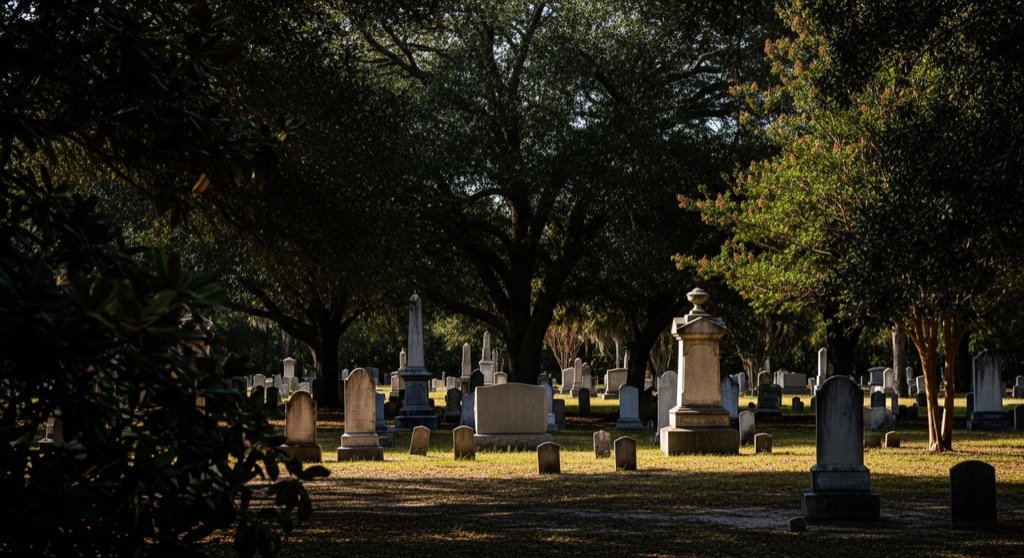
Built around 1740 using tabby construction, this Anglican chapel served planters on Saint Helena Island who lived too far from the parish church in Beaufort. It was abandoned during the Civil War when Union forces occupied the island, and was later gutted by a forest fire in 1886. Today, its remarkably intact tabby walls, plaster fragments, and an adjacent historic cemetery—including a famously 'haunted' mausoleum—remain standing.
→ Three at a time, never the same twice — explore weird Charleston
The story
In 1740, wealthy Anglican planters on Saint Helena Island got tired of the grueling boat trek across the water to Sunday services in Beaufort. Their solution was to burn oyster shells for lime, mix it with sand, water, and whole shells, and pour thick tabby concrete into wall molds to build a local branch church—a 'chapel of ease.' The lime and shell mix glowed so brightly in the marsh sun that locals called it the White Church. It served island families until November 4, 1861, when a messenger interrupted Sunday service to warn that Union forces were taking nearby Beaufort. The planters fled, abandoning the island and their pews for good.
Union troops occupied Saint Helena, and Northern teachers and missionaries moved into the building to instruct formerly enslaved residents, with Methodist freedmen using the sanctuary into the late 1860s. The structure survived the war intact, only to be destroyed in February 1886 by a sweeping forest fire that gutted the timber roof and wood interiors. What remains today is a roofless hollow of pitted, shell-speckled concrete walls holding off the surrounding live oaks.
The real oddity sits in the graveyard. In 1852, Charleston stone-cutter W.T. White built an elaborate mausoleum for planter Edgar Fripp and his wife Eliza. Union soldiers smashed open the vault during the war searching for hidden silver. Caretakers later hired workmen to brick up the broken tomb entrance, but local lore claims the workers returned the next morning to find the bricks neatly dismantled and stacked on the grass beside the wall. They tried sealing it again; the bricks came down again. Eventually, the crew gave up and walked away, leaving the mausoleum door half-sealed—a detail you can still eyeball in the cemetery weeds today.
What it's like
You pull off Lands End Road into a dirt turnout right past Martin Luther King Jr. Boulevard, step past a basic sign, and walk straight into an open-air concrete shell where palm fronds and Spanish moss hang through the missing ceiling. It is completely unstaffed and self-guided, meaning if you show up early in the morning, you will likely have the shell-flecked tabby ruins, plaster remnants, and the Fripp vault entirely to yourself. If you want the full Lowcountry Gothic atmosphere, visit near dusk—though you didn't hear it from us—and make sure to bring heavy bug spray for the marsh gnats.
The move: Stroll through the shaded grounds to admire the 18th-century tabby architecture, photograph the open-air ruins, and explore the historic cemetery.
📍 Before you go The ruins are managed by the Parish Church of St. Helena and are legally open to the public for self-guided visits during daylight hours.
- 📍 St Helena Island
- 💸 Free
- ⚡ Low-key
- 🌗 Outdoors
Where: St Helena Island, SC 29920, USA
Hours: Added 2026-07-20 — confirm current access before you go.
Pair it with
- Old Sheldon Church Ruins — Both 18th-century church ruins are managed by the Parish Church of St. Helena, making them natural companions for a Lowcountry ruin crawl.
- Edisto Island Serpentarium — Trade ghostly 18th-century tabby walls for living reptiles in low-walled outdoor habitats on nearby Edisto Island.
- Fort Dorchester Ruins — Pair this chapel shell with the tabby fort walls at Dorchester for a lesson in colonial oyster-shell masonry.
More weird in Charleston
Good to know
How much does it cost to visit, and what are the hours?
Visiting is free. The ruins are managed by the Parish Church of St. Helena and are legally open to the public for self-guided visits during daylight hours.
What is tabby construction?
Tabby is a colonial Lowcountry concrete made by burning oyster shells to create lime, then mixing it with equal parts water, sand, and whole oyster shells before pouring it into wooden wall forms.
Why is it called a 'Chapel of Ease'?
In colonial South Carolina, chapels of ease were constructed on outlying islands and plantations to spare parishioners the long travel to the parish's primary church in town.
What is the story behind the mausoleum in the graveyard?
Built in 1852 for Edgar and Eliza Fripp, the tomb was broken open by Union troops during the Civil War. When workers later attempted to brick up the entrance, legend says the bricks were repeatedly found neatly dismantled and stacked beside the tomb, leaving it permanently unfinished.
Plan a visit & invite your people →
Further reading: Wikipedia · scpictureproject.org · Atlas Obscura · schistoricproperties.sc.gov
last checked: 2026-07-20