Entry No. 36 — the Charleston file — filed under: ghost town
Fort Dorchester Ruins
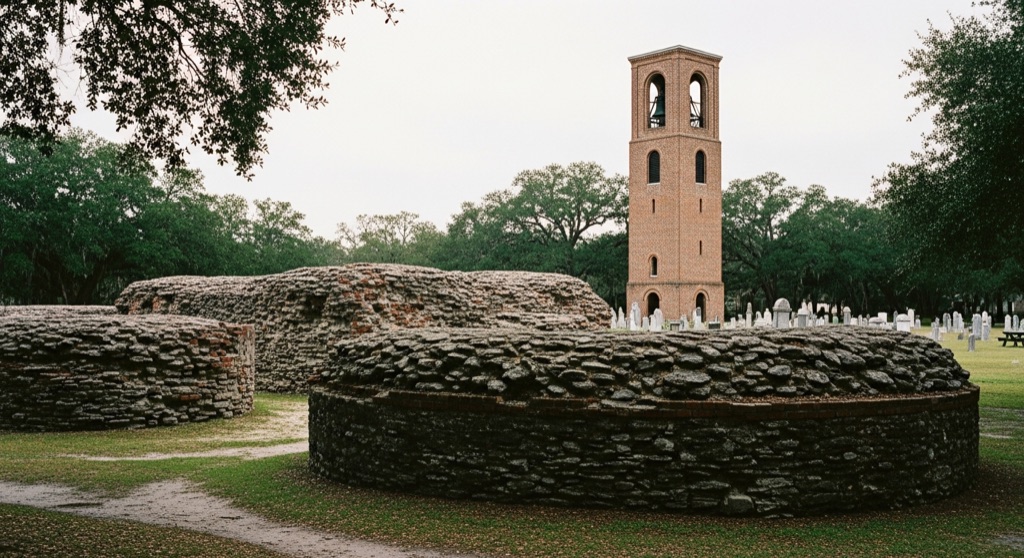
Established in 1697, the colonial trading town of Dorchester was abandoned after the Revolutionary War, leaving behind a ghost town along the Ashley River. Today, the site preserves the ruins of Fort Dorchester, a 1757 fortification built from oyster-shell tabby concrete to protect a powder magazine. Visitors can also view the towering 1751 brick bell tower of St. George's Anglican Church and an early cemetery.
→ Three at a time, never the same twice — explore weird Charleston
The story
Most tourists looking for early colonial history head straight for downtown Charleston's gentrified alleys, but if you drive inland to a bluff overlooking the Ashley River, you'll find a town that simply ceased to exist [1.2.4]. Settled in 1697 by Massachusetts Congregationalists, Dorchester expanded into South Carolina's third-largest trade hub before Revolutionary War troop movements, disease, and economic shifts emptied it out, leaving nature to reclaim forty houses, two wharves, and an Anglican parish by 1788.
What remains sticking out of the dirt is remarkably specific: a 1757 fort constructed entirely from oyster-shell tabby concrete—a slurry of burnt shells, lime, sand, and river water poured into wooden forms to build an eight-foot wall around a gunpowder magazine during the French and Indian War. Stand inside the angular bastion walls and you can still run your fingers across colonial oyster shells that weathered garrisons commanded by Francis Marion and Nathanael Greene.
A short walk through the trees brings you to the four-story brick bell tower of St. George's Anglican Church, built around 1751 and left standing completely alone after the main sanctuary burned and collapsed. Beneath the live oaks and Spanish moss, active archaeological teams regularly scrape back the soil to expose colonial brick foundations, making this one of the few places in the Lowcountry where forgotten history is actively pulled out of the mud in real time.
What it's like
You won't encounter costumed re-enactors or gift-shop crowds here; expect a quiet, moss-draped river bluff where dirt paths connect colonial ruins in near solitude. Pay the small fee at the park entrance kiosk, then follow the trail toward the river. If you visit at low tide, look past the tabby fort walls down into the Ashley River mudbanks to spot the waterlogged wooden timbers of 18th-century shipping wharves poking out from the water.
The move: Take a peaceful walk along the interpretive trails to photograph the historic tabby fort and the iconic brick bell tower, then enjoy a scenic picnic under the live oaks overlooking the Ashley River.
📍 Before you go The ruins are preserved within the Colonial Dorchester State Historic Site, which is open daily to the public for a small admission fee.
- 📍 Summerville
- 💸 Free
- ⚡ Low-key
- 🌗 Outdoors
Where: 300 State Park Rd, Summerville, SC 29485, USA
Hours: Added 2026-07-20 — confirm current access before you go.
Pair it with
- St. George's Bell Tower — Colonial Dorchester State Historic Site — It sits right on the same park grounds—a freestanding 1751 brick bell tower left stranded in the woods after its church burned and decayed away.
- The Canterbury Emporium — Just three miles down the road in downtown Summerville, this shop stocks bulk herbs and occult supplies if you want to follow your ghost-town walk with a dose of Lowcountry magick.
- Sunset Blackwater Swamp Paddle & Fireflies (Charleston Kayak Co.) — Four miles away at Woodlands Nature Reserve, you can trade dry oyster-shell ruins for a twilight kayak trip through dark blackwater cypress swamps.
More weird in Charleston
Good to know
What is tabby concrete made of?
Tabby is a colonial building material created by burning whole oyster shells to make lime, then mixing that lime with sand, river water, and raw oyster shells to pour into heavy timber forms [1.2.7].
Why was the town of Dorchester abandoned?
Occupied by both American and British forces during the Revolutionary War, the town suffered heavy damage and economic disruption. Settlers gradually migrated to Charleston or inland plantations, leaving the town fully abandoned by 1788.
Can you see active archaeological work at Fort Dorchester?
Yes, Colonial Dorchester State Historic Site hosts ongoing archaeological digs where researchers unearth artifacts, brick house foundations, and town structures.
What are the park hours and admission costs?
The park is open daily from 9:00 AM to 5:00 PM and charges a small per-person entry fee collected at the entrance kiosk.
Plan a visit & invite your people →
Further reading: Wikipedia · scpictureproject.org · southcarolinaparks.com
last checked: 2026-07-20