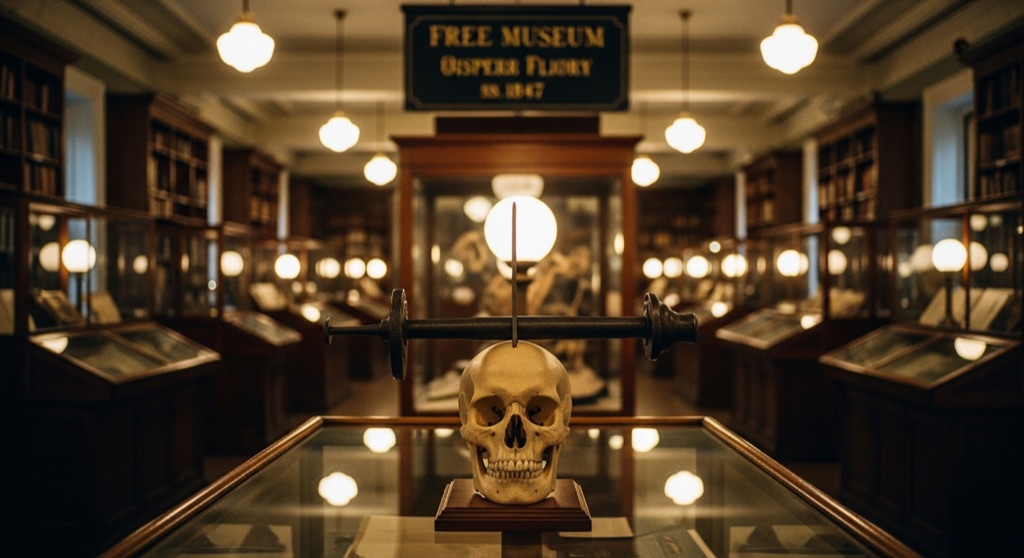
Entry No. 18 — the Boston file — filed under: history
Warren Anatomical Museum
Founded in 1847 with 160 'unusual and instructive' specimens, this free museum on the library's upper floor now holds about 15,000 anatomical and pathological objects — including the actual skull of Phineas Gage, the railroad foreman who survived a three-foot iron tamping rod blown through his frontal lobe in 1848, alongside the rod itself.
→ Three at a time, never the same twice — explore weird Boston
The story
In 1847, Dr. John Collins Warren—a Harvard professor of anatomy and the pioneering surgeon who performed the world's first public operation using ether anesthesia—donated his personal stash of 160 "unusual and instructive" anatomical preparations to Harvard Medical School. What started as a modest teaching cabinet mushroomed over the decades into an archive of roughly 15,000 preserved specimens, pathological bone preparations, and archaic medical tools.
The crown jewel of the collection is the skull of Phineas Gage. In 1848, while blasting rock for a Vermont railroad, a spark prematurely ignited gunpowder, driving a 13-pound, three-foot-seven-inch iron tamping rod straight through Gage's left cheek, behind his eye socket, and out the top of his skull. Miraculously, Gage survived and was speaking within minutes, but the destruction of his prefrontal cortex radically altered his temperament, turning him into neuroscience's foundational case study on how brain geography dictates human personality.
The collection no longer exists as an independent museum building; instead, choice selections are curated inside Harvard's Countway Library of Medicine. In glass cases on the fifth floor, Gage's pierced cranium sits right beside the actual rusted iron rod that passed through it, displayed alongside antique amputation saws, phrenology heads, and centuries of preserved medical anomalies.
What it's like
Getting in requires navigating Harvard's security protocol. Enter Countway Library at 695 Huntington Avenue, present a government-issued photo ID to the guard (work or student IDs won't cut it), and grab a visitor pass. You'll ride the elevator up to the quiet fifth-floor gallery, tiptoeing past medical students hunched over laptops to find the display cases. Unless you hold a Harvard ID, public access is strictly limited to weekend windows (Saturdays 10:00 a.m. to 4:00 p.m. and Sundays 12:00 p.m. to 5:00 p.m.), but admission is entirely free and you'll likely have the skull to yourself.
The move: Wander the free public galleries at Harvard's medical library, then stand face to face with Gage's skull and the tamping iron that made him neuroscience's most famous case study — no ticket, no line, just you two and 15,000 preserved oddities.
- 📍 Longwood Medical Area
- 💸 $$
- ⚡ Up for anything
- 🌗 Indoors
Where: 10 Shattuck Street, Boston, MA 02115 (Countway Library of Medicine, Harvard Medical School)
Hours: Added 2026-07-20 — confirm current hours before you go.
Pair it with
- The Ether Dome — Museum founder Dr. John Collins Warren performed the first public demonstration of ether anesthesia in this very 1821 surgical amphitheater at Mass General.
- Boston Athenaeum — the skin-bound book — Double down on 19th-century macabre Boston history by tracking down a highwayman's memoir bound in his own skin.
- The Mapparium — Cleanse your palate of medical pathology with a stroll inside a three-story, glowing stained-glass globe down the road in Back Bay.
- Coolidge After Midnite (Coolidge Corner Theatre) — After spending the day examining real medical horror, ride the T into Brookline for late-night cult cinema in a 1933 Art Deco theater.
More weird in Boston



Good to know
When can the general public visit?
Non-Harvard ID holders are admitted on Saturdays from 10:00 a.m. to 4:00 p.m. and Sundays from 12:00 p.m. to 5:00 p.m.
What identification do I need to bring?
You must show a valid government-issued photo ID at the first-floor security desk to get a temporary visitor pass. Work or student IDs are not accepted.
Is there an entry fee?
No, visiting the exhibit galleries inside Countway Library is completely free.
Where is Phineas Gage's skull displayed?
It is located in a glass case in the Gallery of the Center for the History of Medicine on the fifth floor of the Countway Library of Medicine.
Plan a visit & invite your people →
Further reading: countway.harvard.edu · Wikipedia · thebostoncalendar.com
last checked: 2026-07-20