Entry No. 6 — the Boston file — filed under: monument
Ether Monument
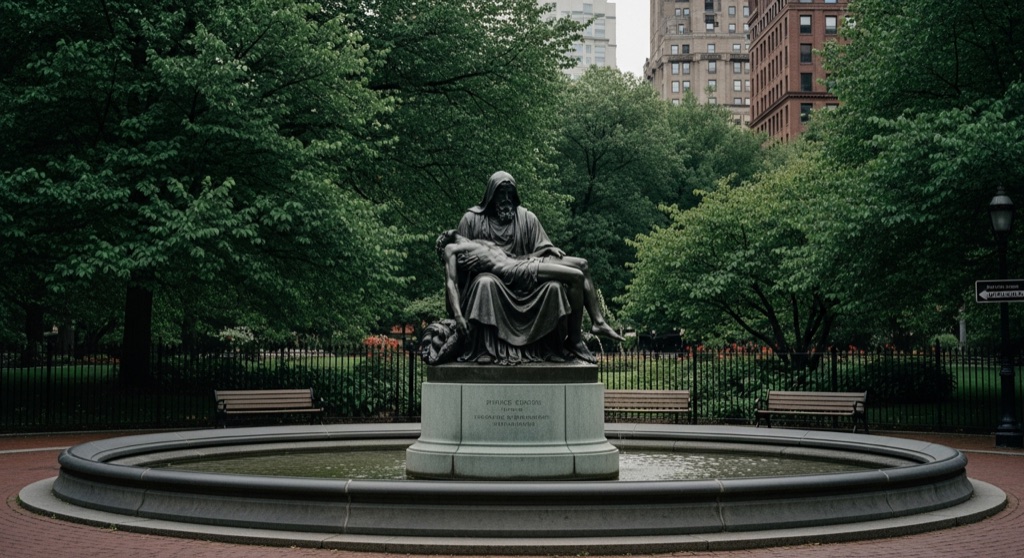
A 40-foot Victorian fountain-monument depicts a robed physician (styled after the Good Samaritan) cradling an injured man — it's the oldest monument in the Public Garden, dedicated in 1868 for the sole purpose of commemorating the 1846 invention of ether anesthesia. The designers deliberately used a fictional, unnamed Moorish-robed doctor instead of crediting any real person, to dodge a bitter contemporary dispute over who actually deserved the discovery.
→ Three at a time, never the same twice — explore weird Boston
The story
Walk into the northwest corner of the Boston Public Garden and you'll find plenty of tourists crowding around the Swan Boats or taking photos of George Washington on horseback. What they usually pass right by is a 40-foot Victorian tower made of white Concord granite and red marble. Look up at the top: a doctor in medieval Moorish robes and a turban cradles a half-naked, unconscious man across his knee. It looks like an obscure biblical carving, but check the base. Dedicated in 1868, this is the oldest monument in the Public Garden, erected for one specific, strange purpose: to glorify diethyl ether, the chemical compound that spared 19th-century patients from undergoing surgery fully awake.
What makes the structure truly conspiratorial isn't the spouting lion-head fountains—it's who isn't carved on it. After dentist William T.G. Morton and surgeon John Collins Warren publicly demonstrated ether anesthesia down the street at Massachusetts General Hospital in October 1846, a vicious blood feud erupted over who deserved the credit. Morton claimed the discovery, his former instructor Charles T. Jackson insisted he gave Morton the chemical formula, Hartford dentist Horace Wells claimed he tried nitrous oxide first, and Georgia physician Crawford Long noted he had been quietly using ether since 1842. The squabble degenerated into smear campaigns, congressional petitions, and lawsuits. When retired merchant Thomas Lee funded the monument 20 years later, architects William Robert Ware and Henry Van Brunt, along with sculptor John Quincy Adams Ward, dodged the mudslinging entirely. They refused to sculpt any of the actual inventors, opting instead for a fictional, unnamed Good Samaritan.
The diplomatic evasion was so glaring that Harvard Medical School professor Oliver Wendell Holmes Sr. famously joked the monument was dedicated to 'ether—or either.' Mark Twain sneered that it memorialized a lie, missing the joke that the monument intentionally refused to name a winner. Today, the fountain stands in the grass as a multi-story tribute to bureaucratic cowardice and the miraculous end of unmedicated agony—four marble bas-relief panels, four spouting lions, and four biblical inscriptions, without a single doctor's name attached.
What it's like
Expect to find the monument tucked away in the quiet grass near the Arlington and Marlborough Street entrance, far from the crowds at the central pond. During warm months, water pumps through the four lion heads into a square basin below, giving you a quiet backdrop while you walk around all four sides to decipher the carved biblical quotes from Isaiah and Revelation. Because it sits in an open public park, there are no tickets or queues, though you'll want to visit during daylight to read the weathered marble inscriptions.
The move: Slip into the Public Garden's quiet northwest corner near Arlington and Marlborough, read the inscriptions on all four sides of the base together, and debate who you think 'really' invented anesthesia before you look it up.
- 📍 Public Garden, Boston
- 💸 Free
- ⚡ Up for anything
- 🌗 Outdoors
Where: Boston Public Garden, near Arlington St & Marlborough St entrance, Boston, MA 02116
Hours: Added 2026-07-20 — confirm current hours before you go.
Pair it with
- The Ether Dome — Walk 15 minutes north to Mass General Hospital to step inside the actual 1821 surgical amphitheater where the 1846 ether demonstration took place.
- Central Burying Ground — Head south into neighboring Boston Common to visit another understated historical plot, established in 1756 to relieve city overcrowding.
- Boston Athenaeum — the skin-bound book — Walk east up Beacon Hill to inspect another macabre 19th-century Boston medical-literary artifact—a book bound in human skin.
More weird in Boston

Good to know
Where in the park is the Ether Monument located?
It stands in the quiet northwest section of the Boston Public Garden, just inside the gate at the corner of Arlington Street and Marlborough Street.
Why isn't any real doctor named on the monument?
A bitter legal and public feud broke out between William T.G. Morton, Charles T. Jackson, Horace Wells, and Crawford Long over who actually discovered anesthesia. Donor Thomas Lee and sculptor John Quincy Adams Ward used an anonymous Moorish-robed Good Samaritan to avoid taking a side.
Where did the actual first ether demonstration take place?
It occurred about a 15-minute walk north at Massachusetts General Hospital in October 1846, inside the surgical theater now known as the Ether Dome.
Is there an admission fee or set hours?
No, it is free and located outdoors in a public park. The Public Garden is generally open daily from sunrise to 11:00 PM, though you should confirm park operating hours before heading out.
Plan a visit & invite your people →
Further reading: Wikipedia · friendsofthepublicgarden.org · amusingplanet.com · hmdb.org
last checked: 2026-07-20