Entry No. 12 — the Atlanta file — filed under: ancient-monument
Rock Eagle Effigy Mound
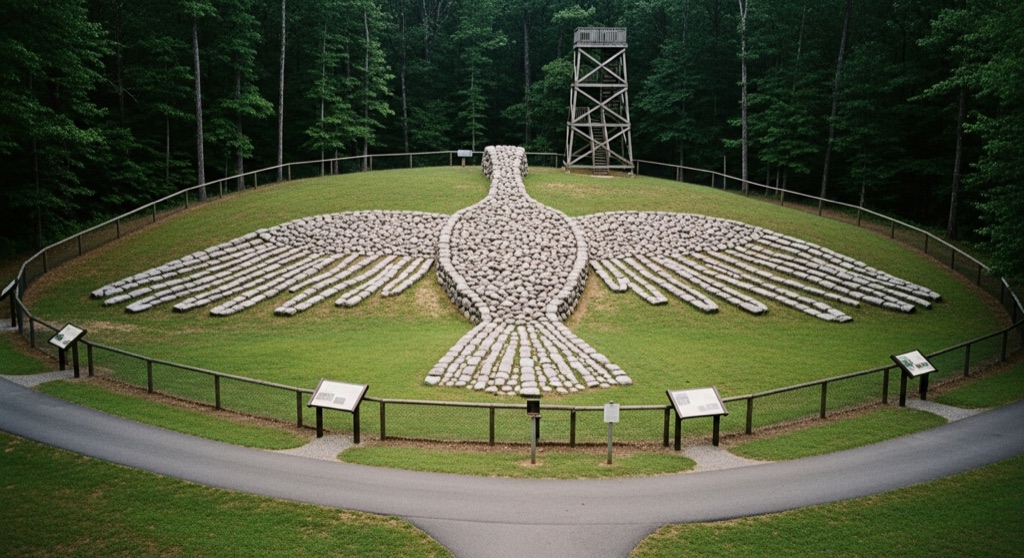
A prehistoric bird effigy built from thousands of hand-placed quartzite stones — 102 feet long, 120 feet wingtip to wingtip — rises from Piedmont forest on land now surrounded by a UGA 4-H summer camp; archaeologists still disagree on whether it's 1,000 or 3,000 years old, or what it was built for.
→ Three at a time, never the same twice — explore weird Atlanta
The story
From ground level, you’re just standing next to an enormous pile of milky white quartzite cobbles in a Piedmont forest. It takes elevation to see the secret: thousands of hand-placed stones arranged precisely into the shape of a massive bird—102 feet head to tail, 120 feet from wingtip to wingtip, with its chest mounded eight feet thick. Archaeologists still bicker over whether it was laid down 1,000 or 3,000 years ago during the Middle Woodland Period, and they can’t even agree on what species it is—some say an eagle, others argue a hawk or a vulture. What everyone agrees on is that its head points directly toward the rising sun.
The effigy survived against ridiculous odds. Creek oral history recorded that the stones were already sitting here when their ancestors migrated into Middle Georgia, so they wisely left the sacred site untouched. When settler Irby Hudson Scott acquired the tract after an 1802 treaty, his family kept the plow away from the rock pile for over a century until selling the land to the federal government in 1938. During the Great Depression, WPA and CCC workers fenced off the perimeter and built a heavy granite viewing tower at the bird's tail—because without height, the entire pattern looks like random quarry scrap.
Today, this ancient mystery sits right on the grounds of the University of Georgia’s Rock Eagle 4-H Center, surrounded by summer camp cabins and a 110-acre lake. When archaeologists excavated the mound back in the 1950s, they found almost no artifacts—just a tiny fragment of cremated human bone, confirming ceremonial use before falling quiet. You're looking at one of only two recognized stone bird effigies east of the Mississippi, and nobody left behind a written manual explaining who hauled the quartz or why.
What it's like
Expect a surreal blend of ancient ritual landmark and active state university summer camp. You’ll park near the woods, walk up to the chain-link security fence enclosing the mound, and climb the steep 1930s stone observation tower at the bird's tail for the essential overhead view—the only vantage point that transforms the white stones into a giant avian silhouette. A paved perimeter path lets you loop the fence to read interpretive panels breaking down the competing archaeological theories. On summer days, you'll hear campers shouting down by the lake, but off-peak weekdays offer a quiet, almost eerie encounter with thousands of years of unexplained physical labor.
The move: Climb the 1930s wooden observation tower for the only vantage that reveals the full bird shape at once, then walk the paved loop around the fenced perimeter reading interpretive panels on the competing theories of who built it and why.
- 📍 Eatonton, GA (Putnam County)
- 💸 Free
- ⚡ Up for anything
- 🌗 Outdoors
Where: 350 Rock Eagle Road, Eatonton, GA 31024
Hours: Added 2026-07-19 — confirm current hours before you go.
Pair it with
- Doll's Head Trail (Constitution Lakes Park) — Pair two outdoor Georgia oddities where human effort transformed the landscape—one built thousands of years ago out of quartz, the other assembled out of modern discarded trash along a wetland trail.
- The Curios Botanica — Follow up an ancient stone ceremonial mound with a visit to a modern Hoodoo botanica stocking conjure oils, ritual powders, and devotional candles.
- Crystal Blue — If staring at thousands of ancient milky quartz stones leaves you wanting a piece of earth to take home, this Little Five Points shop supplies raw quartz, crystals, and spiritual texts.
- Road to Tara Museum — Break up your drive back toward Atlanta with another hyper-specific Georgia historic site—this one an entire museum dedicated solely to the 1939 film Gone with the Wind.
More weird in Atlanta


Good to know
Is there an admission fee to see Rock Eagle Effigy Mound?
No, visiting the mound and climbing the observation tower is free of charge, with access allowed from dawn to dusk.
Can you walk directly onto the quartzite rocks?
No. The entire effigy mound is enclosed by a protective fence to prevent vandalism and stop visitors from disturbing or taking the ancient stones.
Why do you need to climb the tower?
From the ground, the mound looks like a low, unstructured rock pile. The 1930s granite tower provides the height necessary to see the 120-foot bird outline all at once.
What else is located on the property?
The effigy sits within the 1,500-acre Rock Eagle 4-H Center operated by the University of Georgia, which includes a 110-acre lake, education facilities, cabins, and forest trails.
Plan a visit & invite your people →
Further reading: georgia4h.org · Wikipedia · georgiaencyclopedia.org · Reddit
last checked: 2026-07-19