Entry No. 13 — the Atlanta file — filed under: ancient-wall
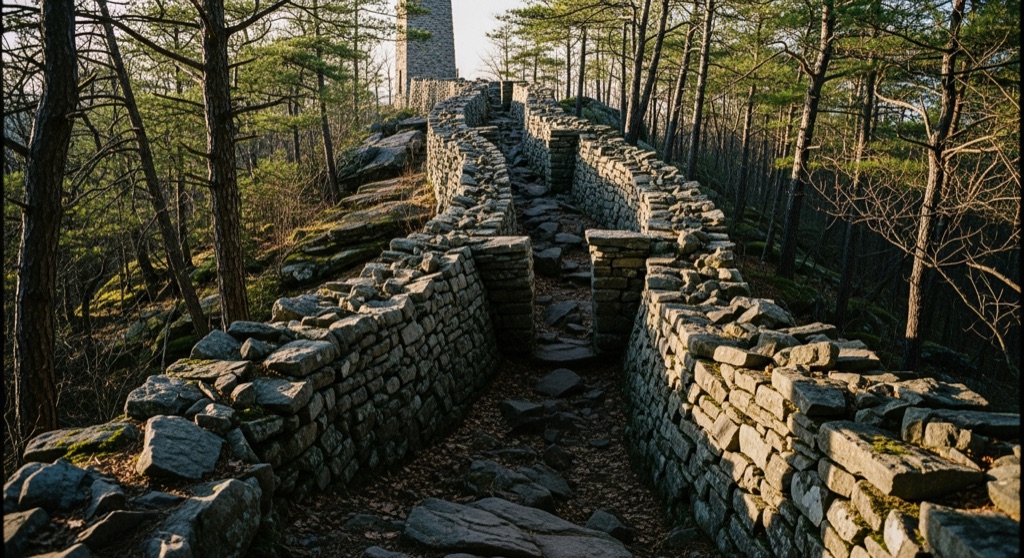
Fort Mountain Ancient Stone Wall
An 855-to-885-foot zigzag wall of stacked stone runs along Fort Mountain's highest ridge, its 19-to-29 pits and ruined gateway unexplained since at least the 1800s — theories range from a Woodland-era ceremonial boundary to a legendary Welsh explorer's fort to the Cherokee "moon-eyed people" myth.
→ Three at a time, never the same twice — explore weird Atlanta
The story
Along the crest of Fort Mountain—2,850 feet up in the Cohutta range—runs an 855-to-885-foot spine of unmortared stacked rock featuring 19 to 29 stone pits and a ruined gateway. Nobody actually knows who built it. When European settlers questioned local Native Americans about the wall in the 1800s, Cherokee lore attributed the structure to the 'moon-eyed people'—a legendary race of short, pale, blue-eyed nocturnal inhabitants who supposedly couldn't tolerate daylight and were driven off during a full moon.
If subterranean nocturnal dwellers aren't conspiratorial enough, alternative theories get even stranger. State historical markers erected in the 20th century popularized a theory that 12th-century Welsh prince Madoc ab Owain Gwynedd landed in Mobile Bay in 1170 and constructed stone fortifications while marching his followers north. Other claims point to Hernando de Soto’s Spanish conquistadors or Cherokee newlyweds setting up honeymoon shelters. Modern archaeologists lean toward Woodland-era Native Americans building it between 500 and 1500 CE as a ceremonial boundary or solar observatory, noting that the wall runs east-to-west and aligns with the winter solstice sunset.
Whatever its original purpose, the wall shares the summit with another notable piece of stonework: a four-story fire tower erected during the Great Depression by the Civilian Conservation Corps on land donated by Atlanta businessman Ivan Allen Sr. Look closely at the tower's facade above one of the windows and you'll spot a heart-shaped stone carved by young mason Arnold Bailey for his sweetheart Margaret Reece. Between ancient mystery pits and 1930s mountain romance, the ridge holds its secrets in plain sight.
What it's like
Expect a dizzying, hair-pin-turn drive up Highway 52 that can trigger motion sickness before you even hit the park gates. Your first stop should be the park office to grab a paper map, since the trailhead for the wall isn't clearly signed from the main park road. The hike itself is a modest 1.5-mile loop along the Summit Trail through mossy, boulder-filled hardwood forest, though dense mountain fog can blanket the West Overlook in seconds. You'll reach the stone wall in about 15 minutes—walk its perimeter, inspect the heart stone on the CCC fire tower, and head back down before darkness falls, when the dense forest shadows start playing tricks on your mind.
The move: Hike the loop trail to the summit past the 1930s CCC stone fire tower, then walk the length of the ancient wall itself and argue over your favorite origin theory — grab the trail map from the park office first, since the wall isn't obviously signed from the main road.
- 📍 Chatsworth, GA (Murray County)
- 💸 Free
- ⚡ Up for anything
- 🌗 Outdoors
Where: 181 Fort Mountain Park Road, Chatsworth, GA 30705
Hours: Added 2026-07-19 — confirm current hours before you go.
Pair it with
- Old Car City USA — Trade ancient, unexplained mountain stone masonry for 34 acres of 4,000 vintage 20th-century American cars rusting away in the forest.
- Paradise Garden (Howard Finster) — Pair pre-Columbian stone mythologies on the ridge with the visionary folk art compound built by preacher Howard Finster down in Chattooga County.
- Tellus Science Museum — Bentley Planetarium & Observatory — Follow up the ancient wall's winter-solstice alignment with modern astronomical telescopes and planetarium shows in Cartersville.
More weird in Atlanta



Good to know
How do I find the ancient stone wall from the parking area?
Pick up a trail map at the park office, as signage from the main park drive is minimal, then follow the 1.5-mile Summit Trail (Stone Wall Loop) on a moderate 15-to-20-minute hike to the wall.
Is there a fee to visit Fort Mountain State Park?
Yes, Georgia State Parks require a $5 daily parking fee per vehicle.
Can you go inside or climb the CCC fire tower?
The historic 1930s stone fire tower is typically open for visitors to climb on weekend afternoons.
What are the primary theories about who built the stone wall?
Archaeological estimates suggest Woodland-era Native Americans built it between 500 and 1500 CE for ceremonial or astronomical purposes, though folklore credits Cherokee myths of the 'moon-eyed people,' 12th-century Welsh prince Madoc, or Spanish conquistadors.
Plan a visit & invite your people →
Further reading: gastateparks.org · Wikipedia · exploregeorgia.org · Reddit
last checked: 2026-07-19