Entry No. 14 — the Atlanta file — filed under: history
Paradise Garden (Howard Finster)
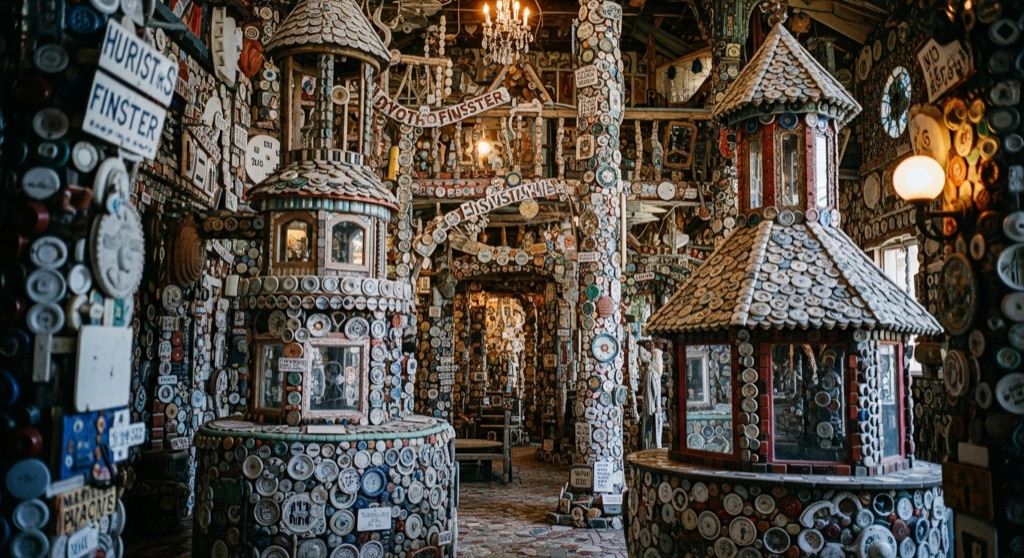
Baptist preacher-turned-visionary artist Howard Finster spent decades packing four acres with a five-story hand-built Folk Art Chapel, a Hubcap Tower, a Bicycle Tower, a Mirror House, and tens of thousands of individual artworks made from scavenged junk and Bible verses — years before R.E.M. and Talking Heads put his art on their album covers.
→ Three at a time, never the same twice — explore weird Atlanta
The story
In 1961, a retired Baptist preacher and self-described master of 22 trades named Howard Finster bought three swampy acres in Chattooga County to build what he initially called the Plant Farm Museum—an outdoor tribute to human invention. But the real shift happened in 1976: while repairing a bicycle wheel, Finster dipped his thumb in white enamel paint and saw a tiny human face formed in the smudge on his skin. A divine voice instructed him to paint sacred art, and he did not stop until he had cataloged and numbered more than 46,000 individual works before his death in 2001.
You didn't hear it from us, but long before rock stars began seeking him out in rural Georgia, Finster was quietly turning recycled scrap into personal theology. He embedded broken crockery, mirror shards, lawnmower blades, hand tools, and hand-lettered scripture into miles of concrete footpaths. He stacked discarded bicycle frames into a soaring open-air tower, constructed a pump house out of Coca-Cola bottles, and in 1982 bought an adjacent church building to erect the multi-tiered, five-story World’s Folk Art Chapel right in the middle of a quiet residential neighborhood.
When bands like R.E.M. and Talking Heads commissioned his paintings for their album covers in the mid-1980s, art dealers and national media converged on Summerville. While major individual paintings were eventually acquired by institutions like the High Museum of Art, the environment itself endured. Maintained today by the Paradise Garden Foundation on Finster’s original homestead, the site remains an authentic, unrepeatable visual sermon carved out of four acres of reclaimed North Georgia marsh.
What it's like
Navigating Paradise Garden feels like stepping into a dense physical labyrinth built entirely from someone else’s unvarnished religious visions and salvaged metal. The ground along the hand-cast, glass-embedded mosaic walkways can be uneven, so wear comfortable flat shoes and bring bug spray for the humid outdoor grounds. The compound sits tucked inside an unsuspecting residential side street in Summerville, so you will pull off a quiet neighborhood road directly into four acres of hand-built towers and painted signs. Give yourself at least two hours to wander through the World's Folk Art Chapel, the Mirror House, and the Pop Culture Gallery, and always check operating hours beforehand as schedule updates occur.
The move: Spend a slow afternoon (open Tue-Sun, 11am-5pm) working through the maze of towers and mosaic walkways, then check whether the Pop Culture Gallery's "Visions of Coca-Cola" exhibit is still up — it's a working museum on Finster's actual homestead, not a recreation.
- 📍 Summerville, GA (Chattooga County)
- 💸 Free
- ⚡ Up for anything
- 🌗 Outdoors
Where: 200 North Lewis Street, Summerville, GA 30747
Hours: Added 2026-07-19 — confirm current hours before you go.
Pair it with
- Old Car City USA — Pair Finster's sacred folk art compound with 34 acres of rusting 20th-century automobiles swallowed by the North Georgia woods.
- Fort Mountain Ancient Stone Wall — Combine a visit to Finster's hand-built religious sanctuary with a hike to the mysterious, prehistoric stone wall running along Fort Mountain's highest ridge.
- Tellus Science Museum — Bentley Planetarium & Observatory — Follow Finster's outsider folk-art visions with a trip to Cartersville's planetarium and observatory for a contrast in cosmic perspectives.
More weird in Atlanta
Good to know
Where is Paradise Garden located?
It is located at 200 North Lewis Street in Summerville, Georgia (Chattooga County), about 90 miles northwest of downtown Atlanta.
Who was Howard Finster and why did he build the garden?
Howard Finster (1916–2001) was a Baptist minister and repairman who created the garden as a physical monument to human invention and religious salvation, eventually producing over 46,000 numbered works of art after experiencing a vision in 1976.
What are the primary structures to see on the property?
Key hand-built features include the five-story World’s Folk Art Chapel, the Bicycle Tower, the Hubcap Tower, the Mirror House, bottle-built structures, and extensive mosaic concrete pathways embedded with tools, glass, and hand-written Bible verses.
What is the connection between Paradise Garden and 1980s music?
Howard Finster designed famous album covers for R.E.M. (Reckoning) and Talking Heads (Little Creatures), which brought global national attention to his remote Georgia homestead.
Plan a visit & invite your people →
Further reading: Official site · Wikipedia · georgiaencyclopedia.org
last checked: 2026-07-19