Entry No. 15 — the Atlanta file — filed under: artist colony
The Goat Farm Arts Center
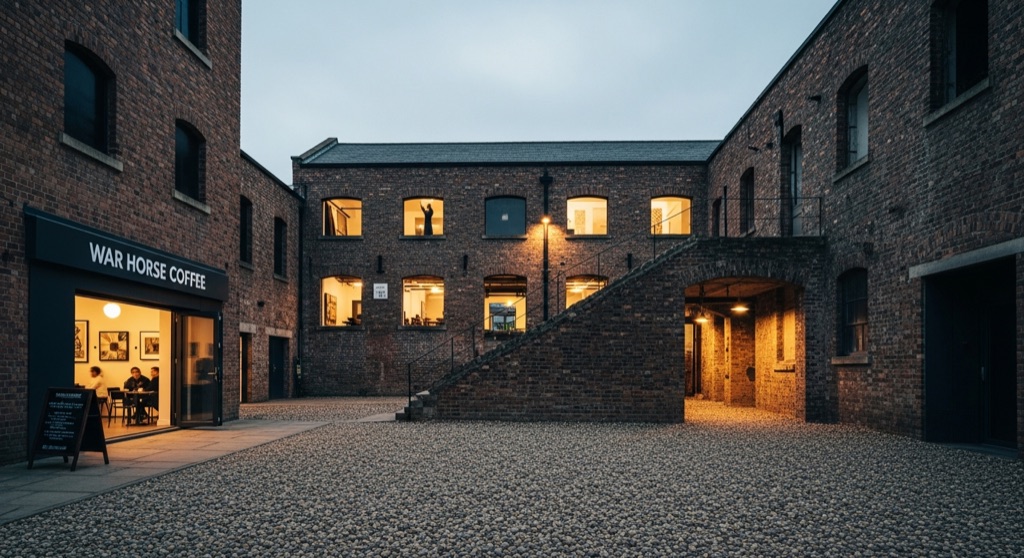
A 12-acre 19th-century cotton-gin-and-textile-mill ruin, still "frozen in time," now packed with studios for hundreds of artists, a pebble-filled courtyard, the hollowed-out Goodson Yard event space, and a donation-based coffee shop called War Horse. One local called it "Atlanta's worst kept secret" — the kind of place you have to already know exists.
→ Three more abandoned & forgotten places in Atlanta — never the same twice
The story
In 1889, this 12-acre site on Foster Street was the E. Van Winkle Gin and Machine Works, churning out heavy cotton-milling equipment before pivoting to manufacture munitions during World War II. By the 1970s, sheet metal operator Robert Haywood bought the complex and brought in live goats for a practical reason: the city fined him for overgrown weeds, and the animals were cheaper than mowing over piles of industrial debris. Local artists started renting the unheated brick bays shortly after, scrubbing decades of factory soot off the walls while CSX freight trains rumbled past.
When Anthony Harper and Chris Melhouse took over in 2010, they turned the crumbling complex into a self-funding creative engine, using tenant studio rents to fund grants, theater productions, and contemporary dance troupes. Hollywood noticed the heavy industrial rust too: film crews transformed the hollowed-out masonry of Goodson Yard into District 12 for The Hunger Games: Catching Fire and shot scenes for The Walking Dead among the overgrown courtyards.
Despite modern residential development rising around the perimeter, the core complex remains frozen in time. You didn't hear it from us, but behind the unmarked wooden doors, hundreds of artists still cut, paint, and build here daily, flanked by real goats near the fence line and War Horse—a donation-based coffee nook tucked inside building B-4A that feels more like an abandoned Victorian library than a commercial business.
What it's like
Arrive near dusk when the gravel lot fills up and the setting sun hits the exposed brickwork. Skip looking for a coffee shop sign; head into building B-4A, drop what you feel in the donation box at War Horse, and drink drip coffee surrounded by dusty board games and an out-of-tune upright piano. Wander the pebble-filled courtyards as work lights spill from open studio doors—you might stumble into a dance rehearsal, a welder throwing sparks in an open bay, or an unscripted exhibition in the roofless shell of Goodson Yard. Park in the multi-level deck above the gate or the gravel lot, bring cash if you plan to get coffee, and visit on a quiet weeknight to avoid event crowds.
The move: Wander the industrial ruins at dusk, grab a coffee at War Horse, and see whatever gallery show, dance rehearsal, or open studio happens to be spilling out of the brick buildings that night — the programming changes constantly, so no two visits are alike.
- 📍 West Midtown / Blandtown, Atlanta
- 💸 $$
- ⚡ Up for anything
- 🌗 Indoors
Where: 1200 Foster Street NW, Atlanta, GA 30318
Hours: Added 2026-07-19 — confirm current hours before you go.
Pair it with
- Goat n Hammer — Since it sits directly inside the Goat Farm complex on Foster Street, you can walk from the raw art studios straight into a working forge where blacksmiths teach traditional metalworking.
- Robert C. Williams Museum of Papermaking — Less than a mile east at Georgia Tech, trade the complex's industrial brick and iron for thousands of historic paper specimens and handmade watermarks.
- Trap Music Museum — Head just over a mile southwest into Bankhead to jump from post-industrial studio ruins to an interactive museum dedicated to Atlanta trap music.
More weird in Atlanta
Good to know
Is there an admission fee to enter the Goat Farm?
No, walking through the outdoor courtyards and central complex is free, though specific evening performances or gallery shows in Goodson Yard may be ticketed.
Are there actual goats on the grounds?
Yes, a small herd of live goats still lives in a fenced area near the parking lot, continuing a tradition that started in the 1970s.
How does the coffee shop War Horse work?
War Horse operates inside building B-4A on a pay-what-you-wish donation model, serving simple hot beverages in a room furnished with vintage library tables and antique decor.
Where should I park when visiting?
You can park in the main gravel lot on site or use the paid parking deck located right above the entrance gate on Foster Street.
Plan a visit & invite your people →
Further reading: atlantamagazine.com · Wikipedia · artsatl.org
last checked: 2026-07-19