Entry No. 43 — the Atlanta file — filed under: ruins
Olde Rope Mill Ruins
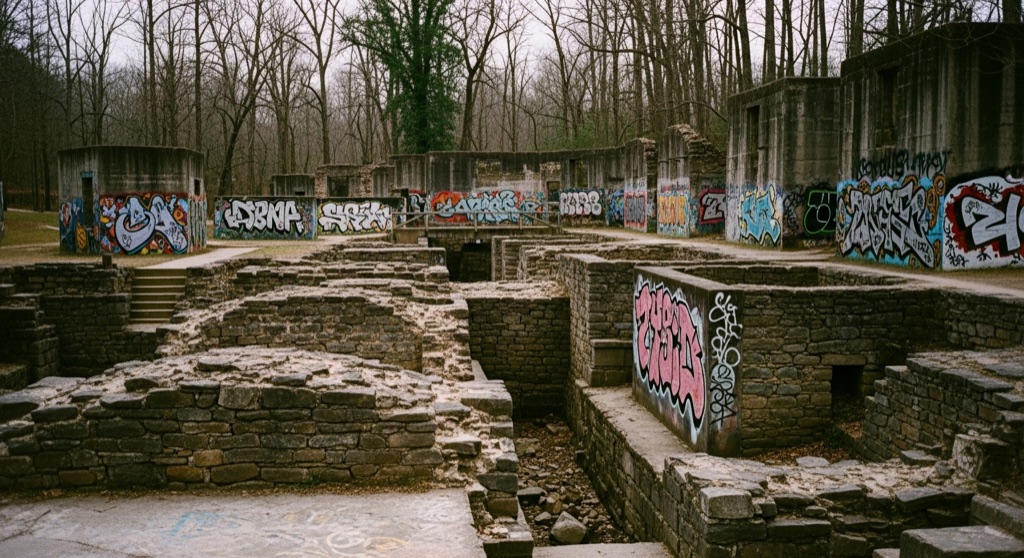
Originally established as a gristmill in the 1840s, this site along the Little River transitioned into a cotton rope mill in the 1870s before closing in 1949. Today, the ruins feature crumbling stone foundations, a largely intact millrace channel, and concrete structures covered in vibrant graffiti.
→ Three more abandoned & forgotten places in Atlanta — never the same twice
The story
Before Woodstock transformed into North Atlanta suburban sprawl, Little River ran fast enough to drive heavy stone machinery. A gristmill was established on this bank in the 1840s, but by the 1870s, operators realized twisting local cotton into well rope and agricultural plow lines yielded far better profits. Unlike typical mills of the era that relied on massive wooden water wheels, this operation harnessed an angled stone millrace channel to drive an internal water turbine, housing the machinery inside a wood-frame building later rebuilt in brick in 1903.
The mill didn't fall to Civil War arson or sudden fires like so many Georgia industrial sites. It met its end in 1949 due to federal infrastructure: engineers prepared to dam the Etowah River basin to create Lake Allatoona downstream, forcing the facility to close its sluice gates permanently. Decades of river humidity, flooding, and neglect eventually rotted the superstructure, leaving behind floor foundations, sluice gate slots, and mossy stone retaining walls creeping up the hillside.
What makes the site genuinely strange today is its second life as an unauthorized outdoor canvas. Vibrant aerosol murals, tags, and street art completely coat the 19th-century concrete foundations, the intact millrace walls, and the active elevated railway embankment running just past the trail's end. You end up walking through an unscripted collision of Reconstruction-era hydro-engineering and modern suburban graffiti.
What it's like
Park at Olde Rope Mill Park, cross the wooden footbridge over Little River, and turn right immediately onto the dirt river trail. You'll quickly hit the main millrace and the graffiti-slathered stone foundations; mountain bikers and river kayakers share the general park, but few stick around the actual ruins for long. Watch your step around the upper hill section—some underground cavities remain taped off due to stone collapses, and the rocky climb up toward the active train tracks features loose, shifting stone. Go early on a overcast weekday morning if you want to inspect the mortised sluice slots without stepping around local photo shoots.
The move: Stroll along the park's scenic trails, cross the footbridge over the Little River, and photograph the historic stone foundations and colorful graffiti murals together.
📍 Before you go The ruins are located within Olde Rope Mill Park, a publicly accessible municipal park with maintained hiking and biking trails.
- 📍 Woodstock
- 💸 Free
- ⚡ Low-key
- 🌗 Outdoors
Where: 4FJH+5J, Woodstock, GA 30188, USA
Hours: Added 2026-07-20 — confirm current access before you go.
Pair it with
- Sope Creek Paper Mill Ruins — Pair Little River's rope mill with the multi-story stone paper mill ruins along Sope Creek for a full day exploring North Georgia's water-powered industrial decay.
- Old Car City USA — Trade 19th-century masonry and water channels for 34 acres of rusting mid-century sheet metal swallowed by the Bartow County forest.
- Concord Woolen Mill — Compare Woodstock's cotton-rope factory to Smyrna's 1847 woolen mill remains nestled along Nickajack Creek.
- HALO Salt + Energy Studio — Shake off the river mud and spray-paint dust inside a Himalayan salt room hidden in the back of a Marietta chiropractic office.
More weird in Atlanta
Good to know
How do I reach the mill ruins from the park entrance?
Cross the main pedestrian footbridge over the Little River from the parking lot and turn right immediately onto the riverbank trail. The stone foundations and millrace appear within a short walk.
Why did the rope mill close down in 1949?
It ceased operations in anticipation of the construction of Allatoona Dam, which altered regional river flows to form Lake Allatoona.
Is it safe to explore around the active railroad tracks above the site?
The elevated track at the end of the trail is an active freight line. While visitors often climb the embankment to view the trackside graffiti, you should exercise caution on the steep, loose rock and stay off the rails.
What kind of terrain should I expect along the ruins?
The primary trail running along the millrace channel is mostly flat dirt, but scrambling onto the upper stone foundations requires navigating tree roots, mud, and slippery river rocks.
Plan a visit & invite your people →
Further reading: Atlas Obscura · visitwoodstockga.com
last checked: 2026-07-20