Entry No. 45 — the Atlanta file — filed under: ruins
Concord Woolen Mill
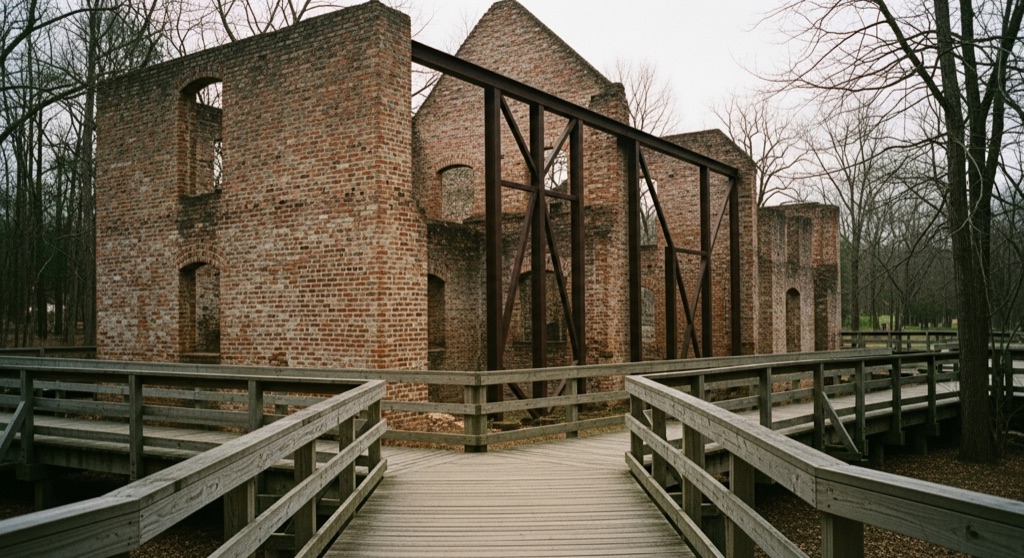
Dating back to 1847, this historic mill once manufactured Confederate uniforms during the Civil War before being burned down by Union troops in 1864. Rebuilt after the war, it operated until 1916 when it was permanently abandoned and left to the elements. Today, its crumbling brick walls are stabilized by massive steel 'ghost framing' beams along the scenic Heritage Park Trail.
→ Three more abandoned & forgotten places in Atlanta — never the same twice
The story
In 1847, Robert Daniell and Martin Ruff built a water-powered mill along Nickajack Creek. When the Civil War broke out, the operation took on a specific contract: spinning coarse grey wool fabric for Confederate military uniforms. That work put a target on the roof. On July 4, 1864, General William T. Sherman’s Union troops reached the creek during the Battle of Ruff’s Mill, set the timber and brick structure on fire, and left the bank charred.
The mill survived its own destruction twice. Rebuilt in the late 1860s, the facility churned out flannel and woven goods until another fire gutted the property in 1889. The owners rebuilt again, but the operation stalled until it was permanently abandoned in 1916. For eighty years, pine trees pushed up through the floorboards and heavy vines pulled apart the two-foot-thick brickwork.
The oddest intervention happened in 1996. When Cobb County began detonating dynamite nearby to carve out the East-West Connector highway, engineers realized the shockwaves would shake the surviving 19th-century masonry into dust. Instead of letting the walls collapse, the Department of Transportation erected a structural steel skeleton—what they called 'ghost framing'—inside and around the shell. What you see today isn't pure natural decay, but a Civil War casualty locked inside a modern steel cage.
What it's like
Park at the main Heritage Park trailhead off Fontaine Road and follow the unpaved path down through switchbacks and wooden boardwalks spanning the wetlands. As you follow Nickajack Creek, the red brick ruins rise suddenly beside the dirt path, held upright by industrial steel I-beams that outline the mill's long-lost roofline. It is quiet, uncrowded, and open daily from sunrise to sunset, though exposed tree roots and creek mud mean you shouldn't wear good shoes.
The move: Hike the scenic 1.7-mile Heritage Park Trail together, crossing the wooden boardwalks over the wetlands to reach and photograph the striking, steel-reinforced brick ruins along Nickajack Creek.
📍 Before you go The ruins are located directly along the public Heritage Park Trail, which is free and open to the public from sunrise to sunset.
- 📍 Smyrna
- 💸 Free
- ⚡ Low-key
- 🌗 Outdoors
Where: Heritage Park Trail, Smyrna, GA 30082, USA
Hours: Added 2026-07-20 — confirm current access before you go.
Pair it with
- Eleanor's — After trekking along Nickajack Creek to inspect industrial ruins, step through a walk-in cooler door 3.8 miles away in Smyrna for drinks inside a hidden lounge.
- Sope Creek Paper Mill Ruins — Cross over toward Marietta to compare these steel-caged woolen ruins with another set of Civil War-era industrial mill remains along Sope Creek.
- New Manchester Mill Ruins, Sweetwater Creek State Park — Follow the trail of Union destruction down to Sweetwater Creek, where Sherman’s troops burned a massive five-story textile mill during the same July 1864 campaign.
More weird in Atlanta

Good to know
How much does it cost to visit the Concord Woolen Mill ruins?
Nothing. The ruins sit along the Heritage Park Trail, which is free and open to the public daily from sunrise to sunset.
How do you reach the ruins from the trailhead?
Park at the corner of Fontaine Road and Nickajack Road, then take the 1.7-mile unpaved trail across the wetland boardwalks along Nickajack Creek.
Why is there heavy steel framing built inside the brick walls?
Cobb County engineers installed the steel 'ghost framing' in 1996 to keep the fragile brick walls from collapsing when road crews blasted dynamite for the nearby East-West Connector highway.
Can you walk inside the mill structure?
No. The interior is fenced off for safety and historic preservation, but the open steel structure lets you look directly into the ruin from the trail.
Plan a visit & invite your people →
Further reading: cobblandtrust.org · hikingproject.com
last checked: 2026-07-20