Entry No. 31 — the Atlanta file — filed under: mill ruins
Sope Creek Paper Mill Ruins
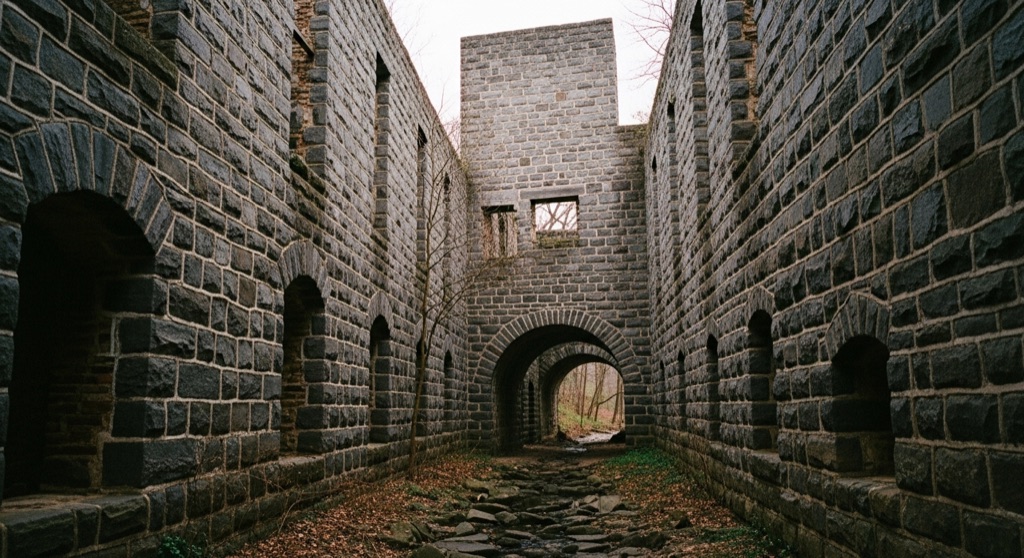
Multi-story stone ruins of the Marietta Paper Mill, which supplied paper for Confederate currency until Union troops burned the original buildings in 1864; what stands now was rebuilt afterward. The creek itself is named for a Cherokee man, 'Old Chief Sope,' who is said to have defied the 1838 forced removal and stayed on quietly, teaching local boys Cherokee words until his death.
→ Three more abandoned & forgotten places in Atlanta — never the same twice
The story
The stacked-stone walls looming over Sope Creek look like medieval castle ramparts left to crumble in an Atlanta pine forest, but their origins are purely industrial. Incorporated in 1859 as the Marietta Paper Mill, the complex churned cotton and linen rags into pulp, producing newsprint and paper that eventually supplied Confederate currency. That function made it an immediate target during the Civil War: on July 5, 1864, Union cavalry under General Kenner Garrard torched the facility. What you see today isn't the original Civil War building, but the rugged ruins of the 1865 post-war rebuild—which caught fire again in 1870, was rebuilt in 1871, and was ultimately abandoned for good in 1902.
The creek itself carries a quiet, contested history. Local lore claims the stream was named for 'Old Chief Sope,' a Cherokee man who defied the forced 1838 removal on the Trail of Tears, remaining hidden along the banks and teaching local boys Cherokee vocabulary until his death. Federal land lottery records tell a starker tale: 1832 maps list it as 'Soap Creek,' named for a Cherokee resident named Soap who, alongside his family, was forcibly displaced to Oklahoma. Either way, the high granite cliffs and rushing water feel remarkably cut off from the suburban subdivisions lurking just beyond the tree line.
Walk along the old raceway and foundations today and you'll spot massive archways, iron bolts anchored in stone, and multi-story masonry walls being slowly reclaimed by forest roots. The National Park Service and local conservancies have had to step in to clear invasive vegetation threatening to push the 19th-century stonework apart. It remains one of the largest concentrations of structural mill ruins in the Chattahoochee River National Recreation Area, sitting quietly off Paper Mill Road while modern commuter traffic rushes across the bridge overhead.
What it's like
Expect a quick downhill hike of about a half-mile from the small lot on Paper Mill Road straight to the creek bed. To hit the ruins directly without wandering toward Sibley Pond first, stick to the narrow trail to the left of the map board at the lot's far end. The lot fills up quickly on sunny weekends, so hit it on a weekday morning or near dusk to secure a spot. Bring your phone fully charged to scan the QR code for the $5 daily parking pass—the park is strictly cashless—and keep in mind there are no public restrooms or water fountains at the trailhead.
The move: Cross the old car-bridge over the creek to reach the crumbling multi-story walls and scramble the short rocky loop before the $5 daily parking pass's daylight window runs out.
- 📍 Marietta / Chattahoochee River NRA
- 💸 $$
- ⚡ Up for anything
- 🌗 Indoors
Where: Sope Creek Unit, Paper Mill Rd SE, Marietta, GA 30067
Hours: Added 2026-07-19 — confirm current hours before you go.
Pair it with
- Concord Woolen Mill — Follow up one set of Civil War mill ruins with another by heading 9 miles southwest to the 1847 Concord Woolen Mill, which was also burned by Union troops in 1864.
- Eleanor's — Trade dusty stone ruins for a cold cocktail by slipping through the walk-in cooler door at Muss & Turner's, 6.7 miles southwest in Smyrna.
- Phoenix & Dragon Bookstore — Drive 4.4 miles east to Sandy Springs to swap 19th-century industrial ruins for metaphysical books, crystals, and daily psychic readers.
More weird in Atlanta

Good to know
How much does parking cost?
Parking is $5 per vehicle per day, paid digitally via QR code at the trailhead or online. National Park Service America the Beautiful passes and $40 annual Chattahoochee NRA passes are also accepted.
Are there public restrooms or water fountains at Sope Creek?
No. The Sope Creek trailhead lot has no restrooms, trash cans, or water fountains, so plan ahead before you arrive.
How long is the hike to the ruins?
It is a short half-mile walk downhill from the parking lot to the mill ruins along the creek. Adding the full loop around Sibley Pond brings the total distance to about 1.5 miles.
Were these exact standing walls burned during the Civil War?
Union troops torched the original paper mill on July 5, 1864, but the multi-story stone ruins visible today belong to the rebuilt mill structures constructed in 1865 and 1871.
Plan a visit & invite your people →
Further reading: atlantatrails.com · n2backpacking.com · packgoats.wordpress.com · eastcobb.com · ajc.com · Reddit
last checked: 2026-07-19