Entry No. 34 — the Atlanta file — filed under: public-art
Folk Art Park
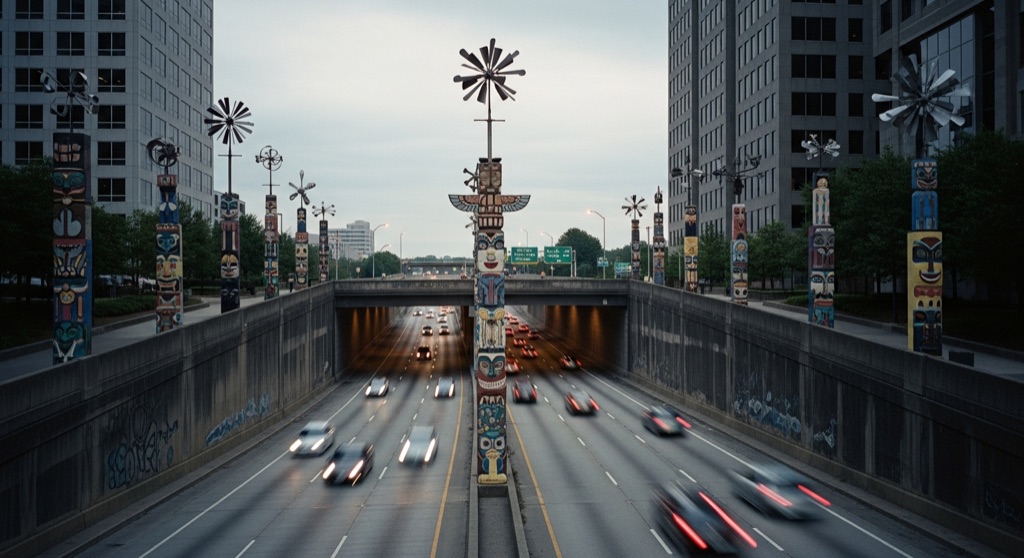
Built into the leftover concrete embankments above the Downtown Connector for the 1996 Olympics, this half-forgotten sliver of park stacks up outsider-art landmarks — R.A. Miller's tin whirligigs, Eddie Owens Martin's (St. EOM's) painted totems, and Rev. Howard Finster's reliefs — directly over eight lanes of interstate traffic.
→ Three at a time, never the same twice — explore weird Atlanta
The story
When Atlanta rushed to spruce up its urban core for the 1996 Summer Olympics, city planners faced an awkward structural hurdle: the Downtown Connector, a roaring eight-lane interstate trench, sliced directly through the center of town. The Corporation for Olympic Development in Atlanta (CODA) decided to cap several leftover concrete bridge embankments over the freeway and turn them into the Georgia Department of Transportation's very first public art project. But instead of erecting standard corporate bronzes, they filled these gray traffic islands with the raw, visionary creations of Georgia’s self-taught folk artists.
The result is one of the strangest artistic collisions in the South. Perched directly over the rumble and diesel exhaust of I-75/I-85, you’ll find tin whirligigs by R.A. Miller, wooden reliefs by Rev. Howard Finster—the Baptist preacher who painted album covers for R.E.M. and Talking Heads—and painted, mandala-topped totems honoring Eddie Owens Martin (St. EOM), the creator of the infamous Pasaquan art commune. Works by Archie Byron, Lonnie Holley, Vollis Simpson, and James Harold Jennings were also welded right into the highway infrastructure.
It was designed as an open-air tribute to regional visionary culture, but over the years it faded into a half-forgotten sliver of city transit space—a weird pocket of outsider art hiding in plain sight between glass office towers. While municipal crews occasionally step in to restore the weather-worn tin and fading paint, hundreds of thousands of commuters speed underneath every day without ever suspecting that a gallery of Southern visionary art is hovering right above their roof racks.
What it's like
Don't expect a grassy park with shade trees; this is a set of concrete pedestrian plazas and traffic islands spanning highway overpasses. You'll hear the constant roar of eight lanes of interstate traffic beneath your feet as you loop through the street corners near Courtland Street NE and Ralph McGill Boulevard NE. Plan for a quick 10-to-15-minute walkthrough—it is best visited around dusk, when the highway streetlights kick on and illuminate the metal whirligigs and painted totems against the downtown skyline. It sits just a five-minute walk east of the Civic Center MARTA station, making it an easy offbeat stop on your way into downtown.
The move: Walk the short loop above the freeway near Civic Center MARTA station at dusk, when the totems catch the highway lights, then head into downtown for dinner — five odd minutes of visionary Georgia folk art wedged between office towers and the Connector.
- 📍 Downtown Atlanta
- 💸 Free
- ⚡ Up for anything
- 🌗 Outdoors
Where: Courtland St NE & Ralph McGill Blvd NE, Atlanta, GA 30308
Hours: Added 2026-07-19 — confirm current hours before you go.
Pair it with
- Trader Vic's — Pair a windy stroll above eight lanes of interstate traffic with a dive into the windowless basement tiki sanctuary inside the nearby Hilton Atlanta.
- The Ellis Hotel (former Winecoff Hotel) — Walk five blocks south to explore another historic downtown concrete landmark at the site of the infamous 1946 Winecoff Hotel fire.
- Whitespace Gallery — Trade outdoor visionary folk art for contemporary gallery exhibitions tucked inside an 1893 carriage house in Inman Park.
- Robert C. Williams Museum of Papermaking — Follow up Georgia’s raw, self-taught folk visions with an ultra-niche deep dive into world papermaking history over at Georgia Tech.
More weird in Atlanta

Good to know
Is Folk Art Park a traditional park with grass and seating?
No. It is a series of concrete urban plazas and traffic islands built on highway overpass bridges over the Downtown Connector interstate.
How much does it cost to visit, and what are the hours?
It is completely free and located on public city sidewalks accessible 24/7, though daylight or dusk offer the best visibility for viewing the artwork.
Which artists are featured in the park?
The installations feature works and designs by notable Southern self-taught artists, including Rev. Howard Finster, Eddie Owens Martin (St. EOM), R.A. Miller, Vollis Simpson, Archie Byron, Lonnie Holley, and James Harold Jennings.
How do I get there using public transit?
Take the MARTA train to the Civic Center Station; Folk Art Park is located a short five-minute walk east along Ralph McGill Boulevard at Courtland Street.
Plan a visit & invite your people →
Further reading: tripexplorersguide.com · atlantamagazine.com · downtownatlanta.com · Atlas Obscura · ocaatlanta.com
last checked: 2026-07-19