Entry No. 44 — the Atlanta file — filed under: ruins
Tinsley Mill Ruins
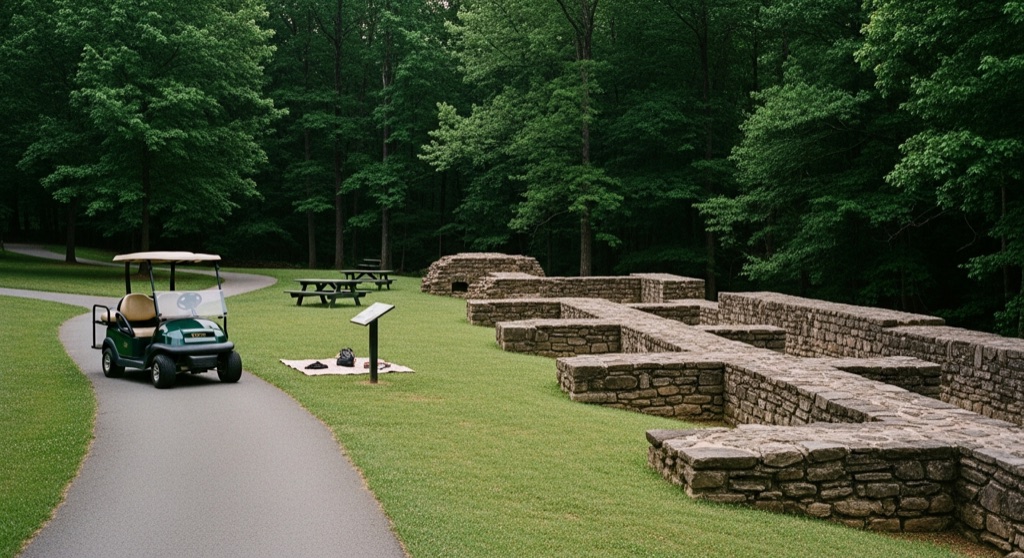
Tinsley Mill Ruins, located along Flat Creek, preserve the stone foundations and pillars of a 19th-century grist mill. Originally built by George Ware, the mill changed hands several times before being purchased by 'Doc' Tinsley in 1936 and eventually burning down after 1960. Today, the ruins sit adjacent to a quiet public picnic area accessible via Peachtree City's multi-use cart paths.
→ Three more abandoned & forgotten places in Atlanta — never the same twice
The story
Long before Peachtree City paved over a hundred miles of golf cart paths and drew up master-planned residential villages, Flat Creek was powering grist mill gears. Originally built by George Ware—who also ran a nearby woolen sock mill, a cotton gin, and a government-licensed peach brandy distillery along the creek—the mill cycled through names and owners for over a century. By the 1870 census, operating as Leach's Mill under owner E.W. Leach, it ran on 40 horsepower, ground 40 bushels of corn a day, and paid its single employee $200 a year.
In 1936, local resident 'Doc' Tinsley bought the operation, only to watch a flood destroy the Flat Creek dam later that same year. Instead of abandoning the site, Tinsley bypassed the river entirely, hooking the millstones up to gasoline-powered motors and grinding grain for another 24 years until selling out to the Phillips-Harrington Land Company in 1960. Shortly after developers took ownership, the wooden building burned down, leaving behind only the heavy stone foundations, support pillars, and masonry walls right alongside what is now the 12th green of Flat Creek Golf Course.
What makes Tinsley Mill strange isn't just that it survived, but how thoroughly suburban Peachtree City grew around it without erasing it. You can pull up to these 19th-century foundations on an electric golf cart, sit at a public picnic table on the grass, and look into the skeletal stone remains of a former peach brandy outpost. You didn't hear it from us, but you're resting on the same former Ware plantation grounds where Chief William McIntosh's family stayed in 1825 after he signed away Creek territory to the federal government.
What it's like
Expect a sun-dappled, quiet grassy clearing right off the paved multi-use cart path, where stream water trickles past exposed stone footings and golf carts occasionally hum by in the distance. Because parking for standard automobiles is restricted to nearby residential cul-de-sacs, arriving on foot, by bicycle, or via golf cart is the standard play. The site is low-key and rarely crowded—usually just a lone walker on the bench or a neighborhood dog owner passing through—offering a quiet picnic table directly adjacent to 19th-century masonry.
The move: Rent a golf cart to explore the city's paved path system, stopping at the ruins for a quiet picnic on the grass next to the historic stone foundations.
📍 Before you go The ruins are located in a public park area along the Peachtree City multi-use cart path system, complete with a picnic table, bench, and historical marker, though direct vehicle parking is limited to nearby cul-de-sacs.
- 📍 Peachtree City
- 💸 Free
- ⚡ Low-key
- 🌗 Outdoors
Where: Peachtree City, GA 30269, USA
Hours: Added 2026-07-20 — confirm current access before you go.
Pair it with
- Hammered Heart Forge — Pair 19th-century grist mill stonework with a hands-on blacksmithing workshop on a 50-acre horse farm just eight miles down the road.
- Road to Tara Museum — Trade genuine Fayette County industrial ruins along Flat Creek for Clayton County's collection of movie costumes and Hollywood memorabilia.
- New Manchester Mill Ruins, Sweetwater Creek State Park — Compare Peachtree City's quiet, gas-converted grist mill footings to the massive, Union-burned five-story textile mill ruins along Sweetwater Creek.
More weird in Atlanta

Good to know
How do you access the ruins if you arrive in a regular car?
Direct street parking right at the ruins is extremely limited in the surrounding residential cul-de-sacs, so visitors typically park in nearby public lots and walk, bike, or ride a golf cart along Peachtree City's multi-use path system to reach the site.
What remains of the original mill structure today?
The wooden superstructure burned down after 1960, leaving behind the original stone foundations, pillars, and structural masonry intact along Flat Creek.
Was the mill always known as Tinsley Mill?
No. Over its operational history, the site was variously known as Ware's Mill, Greer's Mill, Russell's Mill, Leach's Mill, and finally Tinsley's Mill after 'Doc' Tinsley bought it in 1936.
How did the mill operate after its dam washed out?
After a 1936 flood destroyed the dam on Flat Creek, 'Doc' Tinsley converted the machinery to run on gasoline-powered engines, keeping the mill running until 1960.
Plan a visit & invite your people →
Further reading: peachtree-city.org · visitpeachtreecity.com · fayettehistory.org
last checked: 2026-07-20